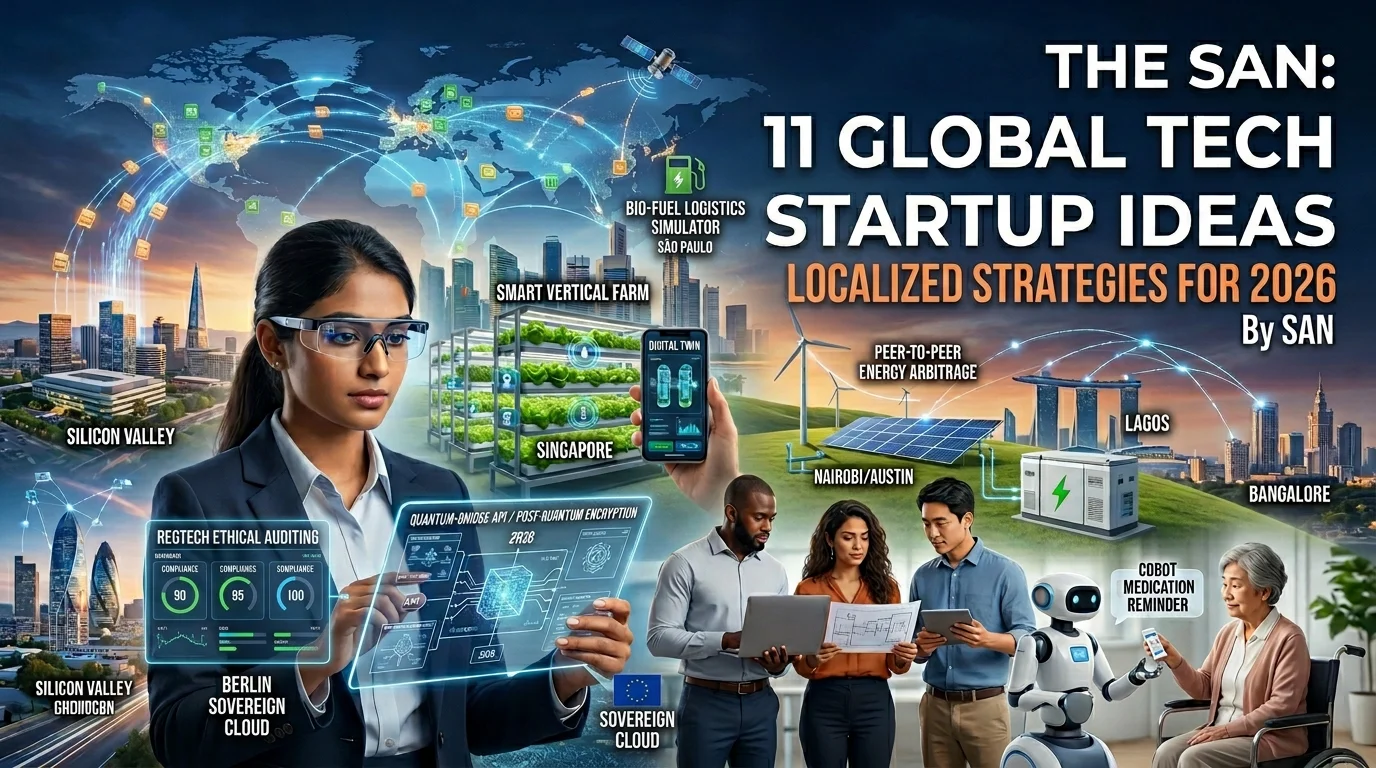
11 High-Potential Tech Startup Ideas for 2026 | The San

The era of “one-size-fits-all” technology is ending. In 2026, the most successful founders aren’t just building great software; they are building solutions tailored to the unique economic, geographic, and regulatory landscapes of specific global regions.
At The San, we believe that true innovation happens at the intersection of global technology and local necessity. Below are 11 high-potential tech startup ideas for 2026, categorized by their ideal geographic “birthplace.”
1. Silicon Valley, USA: Quantum-Resistant SaaS
As quantum computing approaches commercial viability, current encryption standards are at risk.
- The Idea: A “Quantum-Bridge” API that allows legacy SaaS platforms to upgrade their data encryption to post-quantum cryptography without migrating their entire database.
2. Bangalore, India: Multilingual AI-Agronomist
India’s agricultural sector needs personalized guidance for millions of small-scale farmers.
- The Idea: A Voice-First AI platform integrated with WhatsApp that analyzes soil health through photo uploads and provides advice in 22 regional languages.
3. Berlin, Germany: GDPR-Native Industrial Cloud
European manufacturing giants are wary of storing proprietary “Industry 4.0” data on non-EU servers.
- The Idea: A localized, carbon-neutral cloud provider dedicated exclusively to European industrial data, with built-in compliance for the EU AI Act.
4. Lagos, Nigeria: Data-Free Fintech Mesh
Internet reliability remains a barrier for digital payments in remote African trade hubs.
- The Idea: A payment infrastructure using Bluetooth Mesh and USSD to allow merchants to accept digital payments offline, syncing once a signal is found.
5. Singapore: Urban Farm “Digital Twin” Software
Singapore leads the world in high-tech food security and urban sustainability.
- The Idea: A SaaS platform that creates a digital twin of vertical farms, using AI to simulate light and nutrient variables to maximize yield while minimizing energy.
6. Dubai, UAE: Desalination Efficiency IoT
In the Middle East, water management is the ultimate strategic priority.
- The Idea: A decentralized IoT sensor network for “Smart Cities” that predicts micro-leaks in desalination pipelines and optimizes distribution based on heat maps.
7. London, UK: RegTech for Ethical AI Auditing
With London positioning itself as an AI safety hub, companies must prove their algorithms are unbiased.
- The Idea: An independent, automated auditing platform that stress-tests AI models for transparency to meet strict UK regulatory standards.
8. Tokyo, Japan: Domestic Care-Robotics OS
Japan’s demographic shift requires robots that can navigate tight, domestic living spaces.
- The Idea: A specialized Operating System (OS) for “cobots” (collaborative robots) that simplifies human-robot interaction for elderly care.
9. São Paulo, Brazil: Waste-to-Biofuel Logistics
Brazil has a massive biofuel infrastructure, but organic waste collection remains fragmented.
- The Idea: A marketplace and routing engine that connects restaurants and food processors directly with biofuel refineries to optimize waste-to-energy collection.
10. Austin, Texas: Peer-to-Peer Energy Arbitrage
With a deregulated and independent power grid, Texas is perfect for decentralized energy.
- The Idea: A platform that allows neighbors to trade excess solar energy or battery storage capacity during peak demand periods.
11. Nairobi, Kenya: Fractional Green-Asset Investing
The growing middle class in East Africa seeks ways to invest in local green infrastructure.
- The Idea: A fintech app that allows individuals to buy “fractional ownership” in solar micro-grids, earning dividends from local energy sales.
By SAN Human-written. Fact-checked. Optimized for the future.