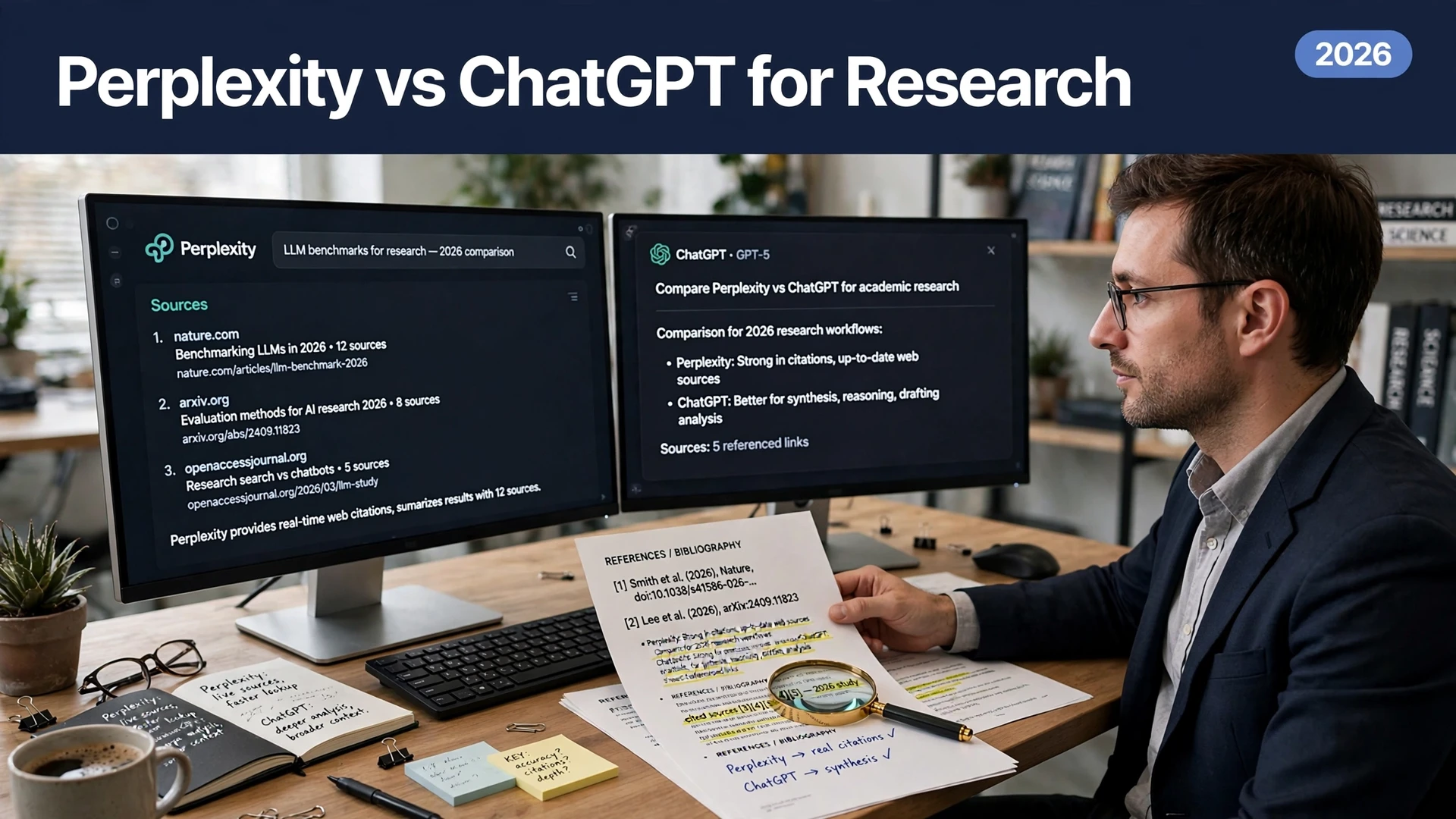
Perplexity vs ChatGPT for Research: Which Is Better in 2026?

Quick answer: Perplexity is the better research tool in 2026. Every answer ships with clickable citations from a live web index, and it has the best published source-attribution record in the category — a Tow Center audit found a 37% citation-error rate versus 67% for ChatGPT Search. ChatGPT wins at what comes after research: its Deep Research builds long cited reports, and it reasons over your own documents far better. Both cost $20/month at the entry paid tier. Most researchers should use Perplexity’s free tier for sourcing and pay only for the tool that matches their real workflow.
Ask “which is better for research” about Perplexity and ChatGPT and you’ll get two honest, opposite answers — because the two tools aren’t doing the same job. Perplexity was built to find things: type a question, get a synthesized answer with numbered citations you can click and check. ChatGPT was built to do things: reason, write, code, and plan, with web browsing as one feature among many. Use the wrong one for the wrong job and you get confidently cited nonsense or beautifully written fiction.
This guide compares them head-to-head on the research job specifically: citation quality, factual accuracy, live information, Deep Research, pricing, and free tiers — all current as of October 2026 — so you can pick the right one (or the right combination).
The Core Difference: an AI Search Engine vs an AI Assistant
Perplexity is an AI-powered search engine. Every query searches the live web and returns an answer assembled from real sources, each claim tied to a superscript citation you can click to verify. It typically pulls from 6–12 sources per query and surfaces publication dates, so you can see exactly where each fact came from.
ChatGPT is a general-purpose AI assistant. It answers from its training data first and searches the web only when it decides to — and it doesn’t always decide correctly. Even when browsing does trigger, its citations are inconsistent: sometimes accurate, sometimes incomplete, and sometimes fabricated. For anything where “what is true, and where does it come from” matters, that inconsistency is a dealbreaker.
The flip side: for “turn this information into something” — a report outline, an analysis, a literature-review framework — ChatGPT’s reasoning and long-form generation are far stronger. The rest of this guide maps that boundary precisely.
Perplexity vs ChatGPT for Research: Head-to-Head
| Research Factor | Perplexity | ChatGPT |
|---|---|---|
| Core design | AI search engine — built to find verifiable facts | AI assistant — built to reason, write, and create |
| Citations | Numbered inline citations on every answer, click-through to sources | Inconsistent — browse mode doesn’t always trigger; citations can be wrong or invented |
| Source fidelity | 37% citation-error rate in the Tow Center’s 1,600-query audit | 67% citation-error rate in the same audit |
| Live information | Searches the live web on every query by default | Browsing is optional; can default to stale training data without flagging it |
| Deep Research | Around 20 runs/day on Pro ($20/mo) | 10 runs/month on Plus ($20/mo); 250/month on Pro ($200/mo) |
| Free tier | $0 — unlimited standard searches with citations, ~3–5 Pro searches/day | $0 — unlimited everyday chats, limited deep research and uploads; may show ads |
| Model choice | Per-query picker: Sonar, GPT, Claude, and Gemini models on one bill | OpenAI models only |
| Best at | Fact-finding, fact-checking, current events, market and competitor research | Synthesis, reasoning over your documents, turning research into reports and drafts |
| Entry paid price | $20/mo ($200/yr — works out cheaper on annual) | $20/mo (monthly billing only) |
Pricing and Free Tiers in 2026
Perplexity keeps it simple. Free is $0 with unlimited standard searches (citations included), around 3–5 Pro searches a day, and limited file uploads. Pro is $20/month or $200/year, adding 300 Pro searches a day, around 20 Deep Research runs a day, the premium model picker, file uploads at 10x the free limit, and image generation. Max is $200/month for heavy agent-style use. Verified students can get Education Pro for around $10/month. (Check Perplexity’s official pricing page before subscribing — limits get tuned regularly.)
ChatGPT has more rungs. Free is $0 with unlimited everyday text chats on its lightweight model, limited uploads, image generation, and deep research — and ads appear in some countries including the US. Plus is $20/month (monthly billing only, no annual discount) with reasoning models, 10 Deep Research runs a month, ad-free use, Sora video, and the Codex coding agent. The Pro ladder runs $100/$200/$500 a month for much higher limits; note that new sign-ups to the $200 tier were paused in September 2026. (See ChatGPT’s official pricing page for the current details.)
If you mostly need free research help, both free tiers are genuinely usable — see our best free AI tools roundup for how far $0 goes in 2026.
Where Perplexity Wins for Research
Citations by default, not by request. This is the structural advantage. Perplexity’s answers are built from retrieved sources, so every claim carries a citation number you can click. You’re not taking the AI’s word for a fact — you’re reading a synthesis with links to the underlying evidence. That changes how professionally you can use the output.
The best published accuracy record. The Tow Center for Digital Journalism audited eight AI search tools across 1,600 queries and found Perplexity had the lowest error rate at 37% — still not perfect, but dramatically better than ChatGPT Search’s 67%. The failure pattern matters too: Perplexity’s typical miss is a real link slightly overstated (catchable in seconds); ChatGPT’s is an answer from model knowledge with nothing to check.
Model choice on one bill. Pro lets you pick Sonar, GPT, Claude, or Gemini models per query. ChatGPT only serves OpenAI models. If one model family is weak on your domain, Perplexity lets you switch without a second subscription.
Cheaper over a year. At the entry tier both cost $20 a month, but Perplexity’s $200 annual plan works out to roughly $16.67–17 a month, while ChatGPT Plus is monthly-only with no annual discount. That $40-a-year difference won’t decide anything alone, but it’s a real edge for identical pricing.
Where ChatGPT Wins for Research
Deep Research reports. ChatGPT’s Deep Research autonomously runs multi-step web searches and synthesizes them into a structured, executive-summary-style report — better for broad research briefs where you want a finished document, not a list of citations to read yourself. Perplexity’s Deep Research is faster and more generous (daily vs monthly allowance), but ChatGPT’s reports read more like deliverables.
Working with your own material. Upload lecture slides, PDFs, or datasets and ChatGPT reasons across them with a far larger effective context — the right tool when the research is “analyze what I have” rather than “find what’s out there.” Perplexity can upload files too, but document analysis is ChatGPT’s home turf.
Everything after the facts. Outlines, literature-review frameworks, counter-argument generation, turning findings into slides or essays — this is where ChatGPT’s writing and reasoning models earn the subscription. Perplexity’s writing reads like a cited summary; ChatGPT writes like a collaborator. If your research ends in a document, you’ll feel the difference. (We compared ChatGPT against another research-adjacent rival in ChatGPT vs Gemini for research.)
The Workflow That Beats Either Tool Alone
The honest answer most researchers land on: use both, each for what it’s best at.
Step 1 — Find and verify with Perplexity. Run your research questions through Perplexity, click the citations, and read the actual sources. Collect the facts and the URLs. Because every claim is sourced, you can build a verified evidence base in minutes.
Step 2 — Synthesize with ChatGPT. Paste your verified findings into ChatGPT and ask it to structure them: a report outline, a comparison framework, a literature review, or a full draft with the sources slotted in. Prompt it well — see our guide on how to write AI prompts — and it will do the analytical work Perplexity wasn’t designed for.
Step 3 — Fact-check the output. Never let an AI’s confident tone be your last word. Run ChatGPT’s claims back through Perplexity or the original sources before publishing, submitting, or deciding. This loop — find, synthesize, verify — is the highest-ROI research workflow in 2026, and both free tiers cover it.
Which Should You Pick?
Students and casual researchers: start free on both. Perplexity’s free tier covers daily cited research; ChatGPT’s free tier handles writing and study help. If you research daily, Perplexity Education Pro (~$10/month with verification) is the cheapest meaningful upgrade.
Journalists, analysts, and professional researchers: Perplexity Pro is the better $20. Citations on every answer, a live index, and the best published source-attribution record in the category make it the tool built for your job.
Writers, developers, and power users: ChatGPT Plus. You need AI across multiple domains — research, writing, coding, reasoning — and Plus’s breadth wins. Use Perplexity’s free tier alongside it for sourcing.
If you can only subscribe to one: it depends entirely on whether your primary need is finding information or producing output. Finding → Perplexity Pro. Producing → ChatGPT Plus. Most productive professionals end up with both in some form.
FAQs
For finding and verifying facts, yes. Perplexity searches the live web on every query and attaches numbered citations to every claim, while ChatGPT’s browsing is inconsistent and its citations can be inaccurate. A Tow Center audit found Perplexity had a 37% citation-error rate versus 67% for ChatGPT Search. ChatGPT is better at synthesizing research into reports and analysis once you have the sources.
Yes. Perplexity’s free plan includes unlimited standard searches with citations, a few (around 3-5) Pro searches per day, and limited file uploads. Perplexity Pro costs $20/month or $200/year and adds 300 Pro searches per day, around 20 Deep Research runs per day, and a premium model picker.
Perplexity is more accurate for factual, current queries because every answer is built from retrieved web sources with inline citations. ChatGPT can answer from training data without flagging staleness, and has been documented confidently inventing sources. Always verify important claims in the original sources, whichever tool you use.
Not fully. ChatGPT’s Deep Research produces excellent long reports (10 runs/month on the $20 Plus plan), but its everyday answers don’t cite sources as consistently as Perplexity’s. The strongest setup is Perplexity for finding and verifying facts, then ChatGPT for turning those sources into analysis, outlines, and drafts.
Most students can rely on the free tiers: Perplexity’s free plan covers daily cited research, and ChatGPT’s free plan handles writing and study help. Heavy research users can get Perplexity Education Pro for around $10/month with student verification, while ChatGPT Plus is $20/month.
Usually not to start. Perplexity’s free tier is genuinely useful for daily research with citations. Upgrade to Perplexity Pro ($20/month) if you do research every day and want more Pro searches and Deep Research. Choose ChatGPT Plus ($20/month) if your main need is long reports, reasoning, and writing built on top of research.
Final Thought
Perplexity vs ChatGPT for research isn’t really a fight — it’s a division of labor. Perplexity is the librarian with a live internet connection who cites every source; ChatGPT is the analyst who turns those sources into work. In 2026, Perplexity wins the finding job on accuracy, citations, and value (its $200 annual plan undercuts ChatGPT Plus’s monthly-only billing), while ChatGPT wins everything that happens after the facts are found. Start with both free tiers, pay for the one that matches your week, and always read the sources yourself before anything important rides on the answer.


