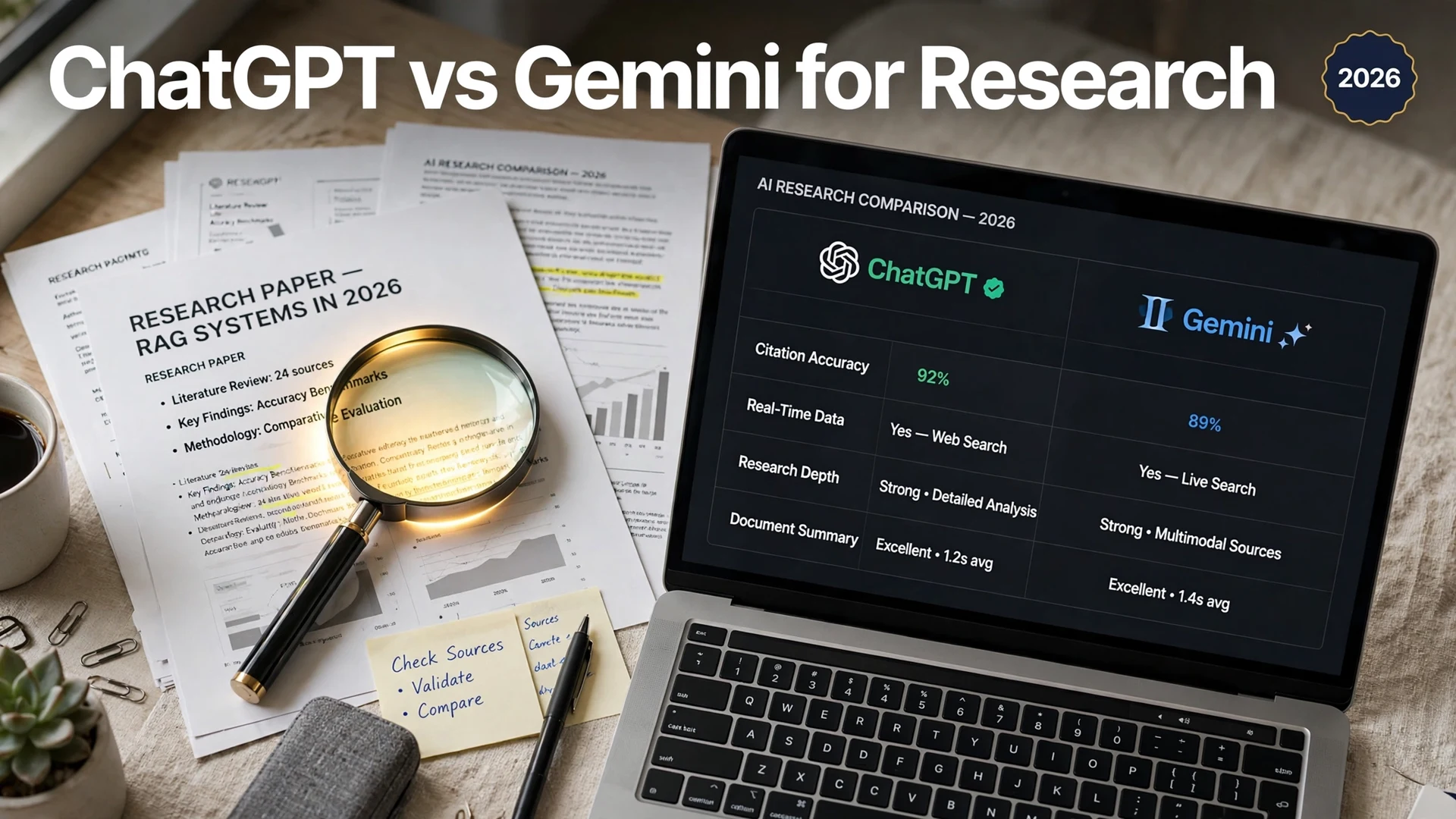
ChatGPT vs Gemini for Research: Which Is Better in 2026?

Quick answer: ChatGPT’s Deep Research produces deeper, more polished, structured reports — the better pick when the final document matters. Gemini’s Deep Research browses more sources per query and is deeply wired into Google Workspace — the better pick for broad coverage and Google-ecosystem users. Both cost around $20 per month for their mainstream plans, and both include some Deep Research access on their free tiers. For fast, cited answers rather than full reports, Perplexity beats both.
“Research” is doing a lot of work in that question, so let us split it. There is quick research — “what changed in this policy last month, with sources” — and deep research — “produce a 20-page cited briefing on this market.” ChatGPT and Gemini both do both, but they win in different halves. This comparison covers each mode head-to-head with pricing as of October 2026, then gives you a verdict by use case. For the broader assistant comparison, see our Gemini vs ChatGPT vs Claude vs Copilot breakdown.
The Short Answer
- Deep, structured reports: ChatGPT wins. Its Deep Research shipped first and still produces the most executive-ready synthesis — clearer structure, better write-up polish, more reliable citations.
- Broad source coverage: Gemini wins. It browses 100+ pages per query against Google’s index and shows you its research plan to review before it runs.
- Quick current-facts answers: Gemini edges it, thanks to live Google Search baked into every response. ChatGPT’s quick answers have improved but still trail on freshness.
- Price: effectively a tie — ChatGPT Plus $20/month, Google AI Pro $19.99/month.
- Ecosystem: Gemini if you live in Gmail, Docs, and Drive; ChatGPT if you want Projects workspaces and the broader tool integrations.
Deep Research Face-Off: ChatGPT vs. Gemini
Deep Research is the agentic mode where the AI plans a research strategy, browses dozens of sources over several minutes, and returns a long cited report. It is the closest thing to hiring a research analyst, and it is where the two assistants differ most.
ChatGPT Deep Research: depth and polish
ChatGPT’s Deep Research was the first to ship and remains the most refined. Reports come back with clear executive summaries, logical section structure, and prose that needs less editing before you can share it. Runtimes can stretch to around 30 minutes for complex briefs. On Plus ($20/month) you get around 10 deep research runs per month; higher Pro tiers ($100/$200/$500, restructured in September 2026) raise that dramatically. The free plan includes limited deep research access.
Its weak spot is citation reliability. In the largest URL-validity study comparing research agents, ChatGPT invented around 3.5% of the links it cited — the best score in the test, but still a reminder that every link in an AI report deserves a click before you trust it. Official site: openai.com.
Gemini Deep Research: breadth and the Google advantage
Gemini’s Deep Research leans on Google’s index: it browses 100+ pages per query, reaches further into scholarly and long-tail sources, and — a genuinely useful touch — shows you its research plan so you can edit it before the run starts. It lives inside the Google apps you already use, and results export straight to Google Docs. Deep Research is available on every plan, including a limited allowance on the free tier (free-tier terms have been tightening in October 2026, so verify current limits in your account); Google AI Pro ($19.99/month) raises usage limits, and the 1-million-token context window on Pro means enormous documents stay in scope.
Its weak spots: the write-up polish trails ChatGPT (expect more editing), the breadth can dilute focus on narrow questions, and the same URL-validity study found a higher rate of invented or unreliable links — around 13.3%. Verify citations here more aggressively than with ChatGPT. Official site: gemini.google.com.
Comparison: ChatGPT vs. Gemini for Research
| Feature | ChatGPT | Gemini |
|---|---|---|
| Deep Research reports | More polished, structured, executive-ready | Broader, plan reviewable before run |
| Sources per query | Dozens | 100+ pages |
| Typical runtime | Up to ~30 min | Several minutes |
| Citation reliability | Better (~3.5% invented links in testing) | Weaker (~13.3% invented links in testing) |
| Quick current-facts answers | Good, improved | Better — live Google Search built in |
| Deep Research on free plan | Limited | Included, with limits |
| Mainstream plan | Plus $20/mo (~10 deep runs/mo) | AI Pro $19.99/mo |
| Context window (paid) | Up to 400K reasoning (Pro) | 1M tokens (AI Pro) |
| Ecosystem | Projects workspaces, broad integrations | Gmail, Docs, Drive, Android |
When Gemini Wins
- You live in Google Workspace. Research that starts in Gmail, pulls from Drive, and exports to Docs without copy-paste is a genuine workflow advantage — not a marketing bullet.
- You need maximum source coverage. For literature sweeps, competitive scans, and “did I miss anything” questions, Gemini’s 100+ pages per query and scholarly reach are unmatched.
- You want to steer the research. Reviewing and editing the research plan before the run starts catches misinterpretations early and saves wasted runs.
- You mostly use the free tier. Gemini has included a limited Deep Research allowance on its free tier (verify in your account — free-tier terms have been shifting in October 2026); ChatGPT’s free access is limited.
- Long documents. The 1-million-token context window on AI Pro swallows entire books and datasets.
When ChatGPT Wins
- The final document matters. If the report goes to a client, a boss, or a publication, ChatGPT’s structure and prose need less editing.
- You need the most trustworthy citations. Both tools hallucinate links; ChatGPT does it measurably less (~3.5% vs ~13.3% in comparative testing).
- You want organized long-term research. ChatGPT’s Projects (available on every plan) keep sources, chats, and files organized per research topic.
- Complex multi-step briefs. ChatGPT’s longer runtimes (up to ~30 minutes) suit questions that need sustained, multi-angle investigation.
How to Research Better With Either Tool
The tool matters less than the habits. These apply to both:
- Write the brief first. A vague prompt (“research EV batteries”) gets a vague report. Specify the question, the audience, the timeframe, and what a good answer looks like. Our AI prompting guide has formulas for exactly this.
- Click every citation that matters. Invented links are the known failure mode of both tools. Any claim you will repeat or publish gets its source opened and read.
- Run the same brief on both, once. For high-stakes research, the $40 for one month of both plans is cheap insurance — ChatGPT for the polished draft, Gemini for the coverage check, then merge.
- Ask for the counter-evidence. Add “include the strongest arguments against this conclusion” to every deep research prompt. It is the single highest-ROI sentence in AI research.
- Keep a sources file. Paste the verified links into your own document as you go. Six months later, the report is stale but your source list is still gold.
And the honest footnote: for fast, cited orientation — “give me the key facts on X with sources, in two minutes” — Perplexity beats both. Its free tier offers several deep searches per day, and Pro runs around $20/month for far more. Use Perplexity for orientation, then ChatGPT or Gemini for the full briefing. See our roundup of the best free AI tools in 2026 for where Perplexity fits in a research stack.
FAQs
For deep, polished, structured reports — yes, ChatGPT’s Deep Research is the stronger tool, with better write-up quality and more reliable citations. For broad source coverage and Google Workspace integration, Gemini wins. Match the tool to the job.
Gemini has an edge: it browses 100+ pages per query with stronger scholarly reach and a 1-million-token context window on AI Pro for long documents. But verify its citations carefully — comparative testing found a higher rate of invented links than ChatGPT.
ChatGPT Plus is $20 per month with around 10 deep research runs per month; higher Pro tiers ($100-$200-$500) raise that. Google AI Pro is $19.99 per month, and Gemini has included a limited Deep Research allowance even on its free plan — verify in your account, since free-tier terms are shifting in October 2026.
ChatGPT hallucinates less. In the largest URL-validity study comparing research agents, ChatGPT invented around 3.5% of cited links versus around 13.3% for Gemini. Always click and verify citations that matter, whichever tool you use.
Yes — many power researchers do exactly that. Use ChatGPT for the polished draft and Gemini for the coverage check, then merge. For fast cited answers rather than full reports, add Perplexity as a third tool.
For quick, cited orientation — yes. Perplexity returns sourced answers in minutes with several free deep searches per day, while ChatGPT and Gemini’s Deep Research modes take longer and produce full reports. Use Perplexity for orientation, then a deep research tool for the briefing.
Final Thought
For research in 2026, ChatGPT is the better writer and Gemini is the better gatherer. If your work ends in a document someone else reads, ChatGPT’s Deep Research gets you closer to finished. If your work starts with “find everything on this,” Gemini’s breadth and Workspace integration are hard to beat. Many serious researchers keep both — and use Perplexity for the quick questions in between.


