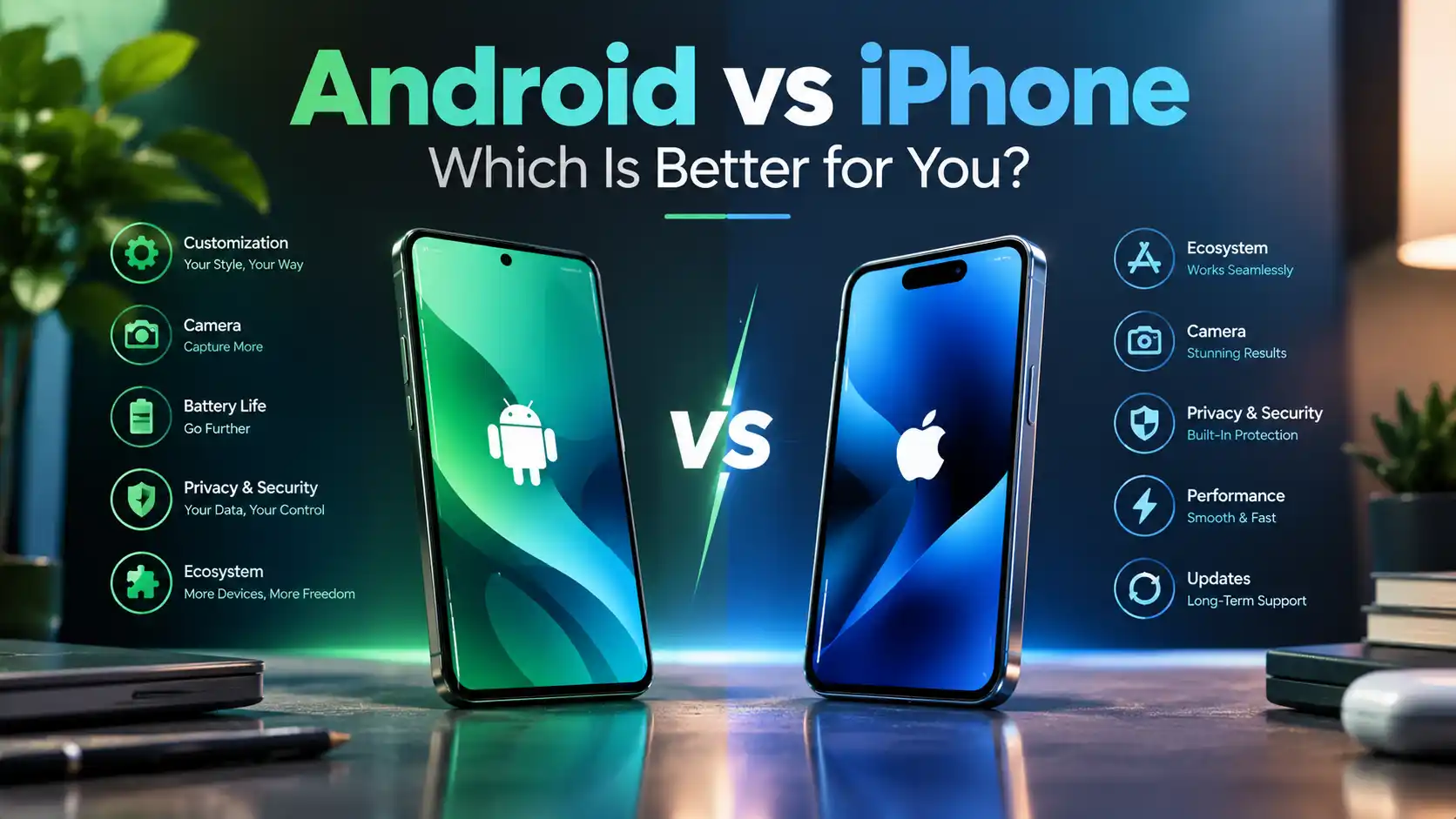
Android vs iPhone: Which Is Better for You?

Choosing between Android vs iPhone is not just a question of specifications. The two platforms take different approaches to hardware, software, customization, privacy, updates, accessories, apps, and ecosystem integration.
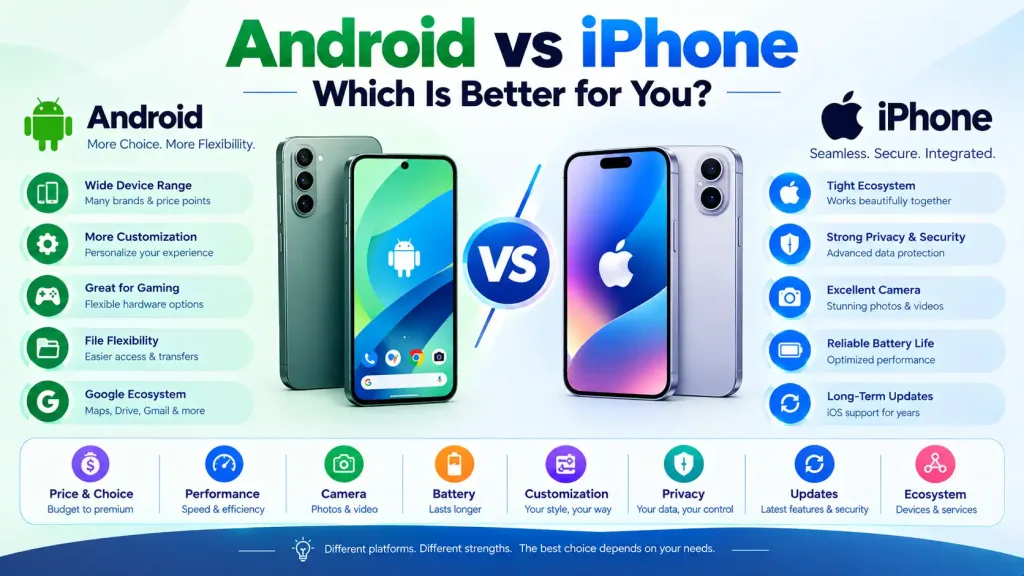
Android gives buyers a wide range of phones from different manufacturers, while iPhone combines Apple’s hardware, iOS, apps, services, and other Apple devices into a more tightly controlled ecosystem.
As of 2026, Android and iPhone continue to dominate the global smartphone operating-system landscape. StatCounter’s August 2026 worldwide mobile data reported 67.61% for Android and 32.36% for iOS. These figures represent web usage/page views measured by StatCounter, not the percentage of all phones in existence or total device shipments.
So, Android vs iPhone—which one should you choose? The answer depends on what matters most to you.
Android vs iPhone at a Glance
| Category | Android | iPhone |
|---|---|---|
| Operating system | Android | iOS |
| Manufacturers | Google, Samsung and many other manufacturers | Apple only |
| Device variety | Very wide range | Curated iPhone lineup |
| Customization | Generally broader | More controlled |
| Software consistency | Varies by manufacturer and model | Apple controls hardware and software |
| Price range | Budget to ultra-premium | Mostly mid-range to premium |
| File management | Generally more flexible | More controlled through iOS |
| Ecosystem | Broad, multi-brand ecosystem | Highly integrated Apple ecosystem |
| Cross-device features | Depends on manufacturer and services | Strong integration with Mac, iPad and Apple Watch |
What Is the Difference Between Android and iPhone?
The biggest difference is the business and software model.
Android is an operating system that manufacturers can adapt to their own devices. Google describes Android as an open platform where manufacturers can customize the experience for different hardware and customers.
iPhone, on the other hand, is designed and sold by Apple, which controls the hardware and iOS experience together.
That distinction creates several downstream differences.
Android gives you more manufacturers, designs, price points, form factors, and software interfaces.
iPhone gives you a more controlled hardware/software combination and close integration with Apple’s other products.
Android vs iPhone Market Share
According to StatCounter’s August 2026 worldwide mobile operating-system data:
| Mobile OS | Worldwide Share |
|---|---|
| Android | 67.61% |
| iOS | 32.36% |
| Other systems | Small remaining share |
The figures are StatCounter’s web-based mobile operating-system measurements, so they should not be interpreted as installed-base or sales-market-share numbers.
Android’s wider manufacturer ecosystem is a major reason the platform appears across a much larger variety of devices.
Android vs iPhone: Price and Device Choice
This is one of Android’s biggest structural differences.
Android is available on phones across a very broad range of prices and hardware configurations. Google’s current Android phone ecosystem includes Pixel devices as well as phones from other manufacturers, including foldable and high-end devices.
Apple offers a much more controlled iPhone lineup. Apple’s current range includes models such as the iPhone Air, iPhone 17, iPhone 17e and iPhone 18 Pro family.
Which platform gives you more choice?
So for phone choice and hardware variety, Android provides more possibilities.
| Need | Android | iPhone |
|---|---|---|
| Budget phones | Many options | Fewer options |
| Mid-range phones | Many options | More limited |
| Flagship phones | Many manufacturers | Apple’s flagship lineup |
| Foldables | Multiple manufacturers | Not a primary iPhone category |
| Design variety | Very broad | More controlled |
Android vs iPhone Performance
Performance comparisons are complicated because Android is not one phone.
A low-cost Android phone and a premium flagship Android phone can have completely different processors, cameras, displays and memory configurations.
The same applies when comparing a budget iPhone with an iPhone Pro.
For example, Apple’s current iPhone 18 Pro uses the A20 Pro chip, while Google’s current Android phone lineup includes newer Pixel 11 models and other flagship Android devices.
That means statements such as “Android is faster than iPhone” or “iPhone is always faster than Android” are too broad.
For performance, compare specific phones in the same price category.
What matters most for performance?
Look at:
- Processor
- GPU
- RAM
- Storage speed
- Thermal design
- Display refresh rate
- Software optimization
- Gaming performance
- Sustained performance
Android vs iPhone for Gaming
Both platforms have access to major mobile games.
The more useful question is which specific phone handles your games better.
A premium Android gaming phone can offer:
- High-refresh-rate displays
- Aggressive thermal systems
- Gaming-focused controls
- Large batteries
- More gaming-oriented customization
A modern iPhone can offer highly optimized hardware and software integration.
Therefore, don’t choose an operating system solely because someone claims it is automatically better for gaming.
Check the individual phone’s sustained performance, thermals, display, battery capacity and game support.
Android vs iPhone Camera
Camera quality is another area where broad platform comparisons can be misleading.
Premium Android phones can offer:
- Large camera sensors
- Telephoto systems
- Computational photography
- Advanced manual controls
- High-resolution modes
- Specialized camera hardware
Modern iPhones also use sophisticated computational photography and video processing. Apple’s current iPhone 18 Pro, for example, has a 48MP Fusion Main camera with variable aperture and advanced video capabilities.
For photography, compare the actual models rather than simply asking whether Android or iPhone has a better camera.
Camera features worth comparing
| Feature | What to check |
|---|---|
| Main camera | Sensor size and image quality |
| Ultrawide | Field of view and low-light performance |
| Telephoto | Optical zoom range |
| Video | Resolution, stabilization and frame rates |
| Front camera | Resolution and video capabilities |
| Night photography | Computational processing |
| Manual controls | RAW, exposure and professional controls |
| AI features | Editing and scene-processing tools |
Android vs iPhone Battery Life
Battery life depends heavily on the individual phone.
Factors include:
- Battery capacity
- Processor efficiency
- Display size
- Refresh rate
- Cellular signal
- Background applications
- Gaming
- Camera usage
- Software optimization
Apple’s current iPhone 18 Pro Max is advertised by Apple as offering up to 45 hours of video playback, showing how much battery performance can vary between iPhone generations and models.
Android phones can also have very large batteries, but comparing battery capacity alone isn’t enough.
A phone with a larger battery does not automatically deliver longer real-world battery life.
Android vs iPhone Software
As of this comparison, Google’s latest major Android release is Android 16, while Apple’s latest iPhone operating system is iOS 27.
Android 16 includes features such as adaptive refresh-rate support, improved notifications, predictive back, security improvements, and expanded multitasking capabilities.
iOS 27 introduces new Apple Intelligence features and Siri AI, alongside broader platform improvements. Apple says iOS 27 became available on September 14, 2026.
Android vs iOS software philosophy
Android generally emphasizes:
Choice + customization + device diversity
iOS emphasizes:
Integration + consistency + controlled hardware/software
Neither description means every feature is exclusive to one platform. Both operating systems continue to adopt features that were previously associated more strongly with the other.
Android vs iPhone Customization
Android generally provides more flexibility for users who like changing how their phone looks and behaves.
Google describes customization and manufacturer diversity as fundamental parts of Android’s design. Android 16 also adds customization improvements such as themed icons and expanded interface controls.
iPhone provides customization as well, but Apple’s overall approach is more controlled.
Android customization can include
- Home-screen layouts
- Launchers
- Widgets
- Default apps
- File management
- Multiple hardware form factors
- Manufacturer-specific interfaces
- More system-level customization
iPhone customization includes
- Widgets
- Home-screen layouts
- Lock-screen customization
- Control Center customization
- Focus modes
- App and privacy controls
If customization is one of your highest priorities, Android’s broader platform flexibility is an important factor.
Android vs iPhone Security
Security is not as simple as saying one operating system is secure and the other is insecure.
Both platforms use extensive security mechanisms, but they take different approaches.
Android 16 includes security improvements such as stronger protections around intent handling, local network permissions, key management, and other platform components. Google also provides Android privacy controls and permission management.
Apple provides extensive app permissions, privacy controls and App Tracking Transparency. Apple’s system requires apps to request permission when they want to track users across other companies’ apps and websites.
For either platform, security still depends on:
- Keeping software updated
- Installing trustworthy apps
- Using strong authentication
- Avoiding suspicious links
- Using unique passwords
- Enabling device security features
Keeping track of all those unique passwords is exactly what a password manager is for — see our hands-on Bitwarden vs 1Password comparison to find out which one is worth paying for.
Android vs iPhone Software Updates
This is an area where you need to distinguish Android as a platform from individual manufacturers.
Google currently states that Pixel 8 and later devices receive seven years of OS and security updates, starting from when the device first became available on the Google Store in the US.
Other Android manufacturers have their own support policies.
With iPhone, Apple controls both the hardware and the operating system, allowing the company to manage iOS updates across supported iPhone models.
The important point
Do not ask:
Does Android get updates longer than iPhone?
Ask:
How long does this specific Android model receive OS and security updates?
That is a much more useful buying question.
Android vs iPhone Ecosystem
The ecosystem is one of the most important differences.
Apple’s Continuity features are designed to make an iPhone work closely with other Apple devices. Apple documents features including AirDrop, Handoff, Universal Clipboard, Continuity Camera, iPhone control from Mac, and using iPad as a second Mac display.
This can be particularly useful if you already use:
- Mac
- iPad
- Apple Watch
- AirPods
- Other Apple services
Android also has a broad ecosystem, but it is more manufacturer- and service-dependent.
Google emphasizes compatibility and diversity across Android devices, while manufacturers can add their own ecosystem features.
Android vs iPhone for Privacy
Privacy is another area where the platforms use different approaches.
Apple provides controls such as:
- App Tracking Transparency
- App permissions
- Privacy labels
- Location controls
- Private data controls
- iCloud security features
Apple says App Tracking Transparency requires apps to obtain user permission before tracking activity across other companies’ apps and websites.
Android also provides extensive privacy controls. Google’s Android privacy system includes permission management and a Privacy Dashboard that shows access to sensitive information such as location, camera and microphone.
The better comparison is therefore not simply “which phone is private?”
Instead, compare:
- Permission controls
- App tracking
- Data collection
- Cloud services
- Account settings
- Advertising controls
- Manufacturer policies
Android vs iPhone File Management
Android generally offers more flexibility for handling files and connecting to different hardware.
Depending on the manufacturer and Android version, users can interact with files, USB devices, external storage and different transfer methods with relatively few restrictions.
iPhone’s file management has improved significantly, but Apple’s system remains more controlled around system access and application data.
For people who frequently:
- Download files
- Move documents
- Connect USB devices
- Transfer media
- Manage folders
- Work with different file formats
Android can be more flexible.
Android vs iPhone for Work
Both platforms are capable work devices.
Android can be attractive for users who want:
- File flexibility
- Multitasking
- Larger range of hardware
- Foldable devices
- Customization
- Google services
iPhone can be especially convenient for people already working within Apple’s ecosystem.
For example, Apple Continuity allows supported devices to share files, copy and paste across devices, hand off tasks and use an iPhone with a Mac in several integrated ways.
For business users, the best choice depends heavily on the tools your organization already uses.
Android vs iPhone for Students
Students often care about:
- Price
- Battery life
- Camera
- Messaging
- Social media
- Note-taking
- Productivity
- Long software support
- Accessories
Android provides more choices at different price levels, while iPhone can be attractive to students already using Apple’s ecosystem.
The right decision often comes down to budget and the devices you already own.
Android vs iPhone for Social Media
Both platforms support the major social-media applications.
For creators, the more important questions are:
- Camera quality
- Video recording
- Microphone quality
- Editing tools
- Storage
- Battery
- App optimization
- Accessories
A flagship Android phone and a flagship iPhone can both be excellent creator devices.
Rather than choosing a platform based on general reputation, compare the specific camera and video capabilities of the phones you’re considering.
Android vs iPhone: Pros and Cons
div style=”overflow-x:auto;-webkit-overflow-scrolling:touch;width:100%;margin:20px 0;”>| Platform | Advantages | Considerations |
|---|---|---|
| Android | Wide device choice, more price points, customization, flexible hardware, many form factors | Update policies and software experience can vary between manufacturers |
| iPhone | Strong Apple ecosystem integration, controlled hardware/software experience, long-running platform support | Less hardware variety and generally less system-level customization |
Android vs iPhone: Which Should You Buy?
There is no single answer that applies to everyone.
Android may make more sense when you want:
- More phone choices
- More price ranges
- Greater customization
- More hardware variety
- Foldable options
- More flexible file management
- A specific Android manufacturer feature set
iPhone may make more sense when you want:
- Strong integration with Mac and iPad
- Apple’s Continuity features
- A tightly controlled hardware/software experience
- iOS
- Apple’s services and accessories
- A straightforward upgrade path within the iPhone ecosystem
The biggest deciding factor may actually be what devices you already own.
Someone with a Mac, iPad and Apple Watch may value Apple’s ecosystem integration differently from someone who uses Windows, Google services and several different brands of hardware.
Android vs iPhone: What About AI?
AI is becoming an important part of both platforms.
Android 16 includes AI-related features and system capabilities, while Google continues integrating Gemini across Android devices.
Apple’s current iOS 27 introduces new Apple Intelligence capabilities and Siri AI. Apple says Siri AI provides expanded intelligence, personal context understanding and systemwide capabilities, with availability rolling out by language.
This area changes quickly, so specific AI features should always be evaluated on the particular phone model and software version.
Android vs iPhone: Common Myths
“Android phones are all cheap.”
False.
Android includes inexpensive phones as well as premium flagship and foldable devices.
“All Android phones get updates for the same amount of time.”
False.
Update support depends on the manufacturer and model. Google, for example, offers seven years for Pixel 8 and later models under its stated policy.
“iPhones are always faster.”
Too broad.
Performance depends on the specific iPhone and Android phone being compared.
“Android is less secure.”
This is too simplistic.
Android includes extensive security and privacy features, while security also depends on the specific device, update policy, apps and user behavior.
“iPhones have better cameras.”
Not universally.
Camera quality depends on the specific models and their hardware, software processing and intended use.
Android vs iPhone: Which Is Better for You?
The best choice depends on your priorities.
| Your priority | What to consider |
|---|---|
| Lowest possible price | Android has a much wider range of devices |
| Maximum customization | Android generally provides more flexibility |
| Mac + iPhone integration | Apple’s Continuity ecosystem is a major factor |
| Foldable phones | Android has multiple manufacturers and form factors |
| Long Pixel support | Pixel 8 and later have Google’s seven-year policy |
| Simple hardware/software pairing | Apple controls both the iPhone and iOS |
| Extensive device choice | Android |
Final Verdict
Android vs iPhone is ultimately a choice between two different approaches to smartphones.
Android emphasizes choice, manufacturer diversity, customization and hardware variety. iPhone emphasizes Apple-controlled hardware and software, ecosystem integration and a more standardized experience.
There is no universally best platform.
The smarter way to choose is to compare the things that actually affect your daily use: budget, camera, battery life, gaming, software support, customization, privacy, file management and the other devices you already own.
That approach is much more useful than choosing based only on the Android vs iPhone debate.