Google Ads vs Facebook Ads: Which Is Better for Your Business?

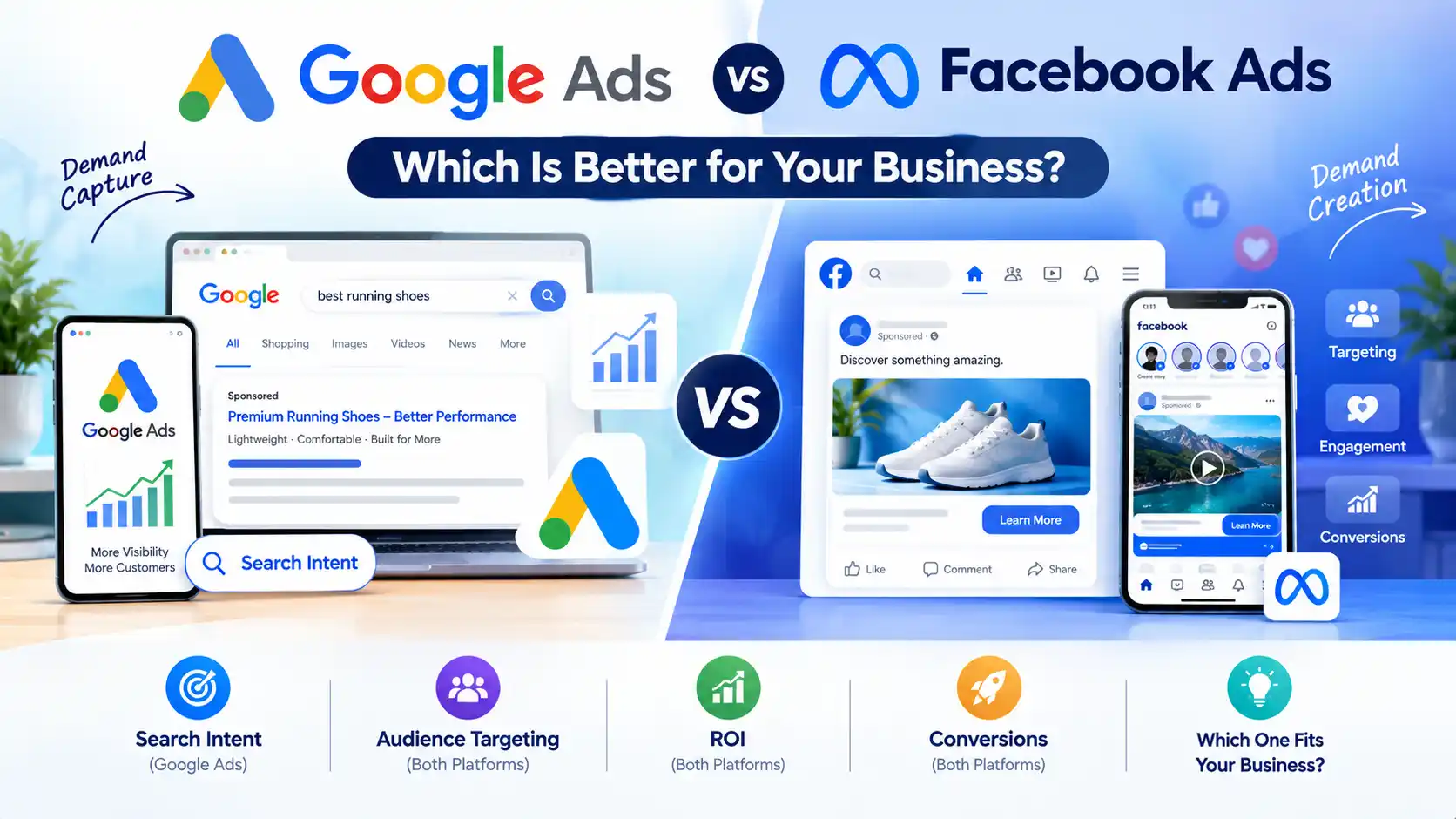
Google Ads vs Facebook Ads is not really a question of which advertising platform is universally better. The better choice depends on whether your business needs to capture existing demand or create demand and reach potential customers before they search.
Google Ads is particularly useful when people are actively searching for what you sell. Facebook Ads, now part of the broader Meta advertising ecosystem, is particularly useful when visual creative, audience discovery, remarketing, and social-platform reach are important.
For many businesses, the most effective strategy is not choosing one platform forever, but understanding where each platform fits in the customer journey.
Google Ads vs Facebook Ads: Quick Answer
| Factor | Google Ads | Facebook Ads |
|---|---|---|
| Core strength | Capturing existing demand | Creating and influencing demand |
| Typical user state | Searching for something | Browsing, discovering, comparing |
| Main targeting signal | Search intent, keywords, audience signals | Audience, behavior, creative and AI signals |
| Strong formats | Search, Shopping, Display, YouTube, Performance Max | Image, video, Reels, Stories, carousel and other Meta formats |
| Particularly useful for | Services, local search, urgent needs, high-intent products | Ecommerce, visual products, discovery, brand building |
| Conversion path | Search → ad → landing page → action | Feed/Reels/Stories → ad → landing page or platform action |
| Cost model | Auction-based | Auction-based |
| Creative importance | Important | Often extremely important |
| Automation | Google AI, Smart Bidding, Performance Max, AI Max | Meta AI, Advantage+ |
| Best starting question | “Are people already searching for this?” | “Can I reach people likely to want this?” |
Google itself explains that its advertising system runs an auction when users search or encounter eligible advertising inventory, with factors such as bid, ad quality, landing-page quality, context and competition affecting Ad Rank.
Meta also uses auction-based delivery, with ads selected dynamically according to factors such as targeting and the value an ad is expected to provide to the user.
What Is the Difference Between Google Ads and Facebook Ads?
The fundamental difference is how the platforms find potential customers.
Google Ads can respond to what someone is actively searching for. If a person searches for “emergency plumber near me,” “buy running shoes,” or “accounting software,” the search itself provides a valuable signal about intent.
Facebook Ads work differently. People are generally using Facebook or Instagram for content and communication rather than explicitly searching for a business solution. Your advertising therefore has to create enough interest for the user to stop, engage, click, sign up, or purchase.
That makes the platforms complementary rather than identical.
Google Ads = demand capture
Google Search is particularly useful when demand already exists.
For example:
User searches → sees relevant ad → visits website → requests quote
The advertiser is meeting a user at a moment when the user has already expressed an interest through a search query.
Google’s advertising auction considers the search context, including the query, location, device, time and other signals.
Facebook Ads = demand creation and discovery
Facebook and Instagram can introduce an offer to people who may not have been searching for it.
For example:
User watches content → sees product → becomes interested → visits website → researches → purchases
This is especially useful when your product or service benefits from strong visual presentation, storytelling, demonstrations, social proof, offers or repeated exposure.
Meta’s advertising system also increasingly relies on AI-based optimization rather than requiring advertisers to manually control every targeting decision. Advantage+ sales campaigns are designed as an end-to-end AI optimization solution.
Google Ads vs Facebook Ads: Audience Intent
Intent is one of the biggest differences between the two platforms.
Imagine a company selling office chairs.
A Google user searches:
“best ergonomic office chair for back pain”
That search suggests an active information or purchasing need.
A Facebook user may simply be scrolling through their feed when an attractive advertisement for an ergonomic chair appears.
The second person could become a customer, but the advertising platform had to create the initial interest.
This produces two different acquisition models:
Google: intercept existing demand.
Facebook: generate or influence demand.
Neither is inherently superior. The appropriate platform depends on the product, customer journey and objective.
Google Ads vs Facebook Ads: Ad Formats
Google Ads is no longer limited to traditional text ads.
Google’s current advertising ecosystem includes Search, Display, YouTube, Discover, Gmail and Maps. Performance Max can access these channels from a single campaign.
Google Search also has AI Max, an optimization layer for Search campaigns that can expand search-term matching and automate parts of creative and landing-page optimization.
Meta’s ecosystem is strongly visual. Its placements include Facebook, Instagram, Messenger and Audience Network, with formats such as Feed, Stories and Reels. Meta also supports Advantage+ placement optimization.
This gives each platform a different creative emphasis.
Google Ads is especially strong for:
- Search ads
- Shopping and product advertising
- YouTube advertising
- Local-intent searches
- Display advertising
- Performance Max
Facebook/Meta Ads is especially strong for:
- Image advertising
- Short-form video
- Reels
- Stories
- Carousel creative
- Social discovery
- Audience-based campaigns
Google Ads vs Facebook Ads: Cost
There is no universal price for either platform.
Google Ads does not charge one fixed amount per click. Actual CPC depends on the auction, competition, ad quality, context and bidding strategy. Google states that higher-quality ads can obtain better positions and may pay less per click than lower-quality ads.
Meta’s costs similarly vary by campaign objective, competition, audience, creative and auction conditions.
2026 benchmark comparison
These are U.S. benchmark medians, not guaranteed prices. The Google study covered 13,474 search campaigns between April 2025 and March 2026; the Meta study covered nearly 1,800 campaigns using traffic and leads objectives. Because the campaign objectives and user behavior differ, the CPC and CPL figures should be used as benchmarks rather than a simple “winner” calculation.
This distinction is extremely important.
A $0.60 Meta click is not automatically more valuable than a $5 Google click.
A cheaper click only matters if it eventually produces valuable business results.
Is Google Ads More Expensive Than Facebook Ads?
In many benchmark datasets, Google Search clicks are more expensive than Meta traffic clicks.
WordStream’s 2026 U.S. benchmark reported a median Google Search CPC of $5.42, compared with $0.60 for Meta traffic campaigns. Meta lead campaigns had a median CPC of $1.80.
However, comparing CPC alone can be misleading.
Suppose:
- Google generates 10 high-intent visitors at $5 each.
- Facebook generates 100 inexpensive visitors at $0.50 each.
If the Google visitors are much more likely to become customers, the cheaper Facebook traffic may not actually produce the better business result.
The important metrics are therefore:
Cost per qualified lead → customer conversion rate → customer acquisition cost → revenue → profit
Google Ads vs Facebook Ads for Small Businesses
Small businesses often need to choose carefully because advertising budgets are limited.
Google Ads can make sense when:
Your customers actively search for the problem you solve.
Examples include:
- Plumbers
- Dentists
- Lawyers
- Accountants
- Repair services
- Local contractors
- Emergency services
- Business software
- Professional services
These businesses can benefit from appearing when customers are already searching for relevant services.
Facebook Ads can make sense when:
Your product or service can be demonstrated visually or benefits from audience discovery.
Examples include:
- Fashion
- Beauty
- Food
- Fitness
- Events
- Consumer products
- Courses
- Lifestyle products
- Ecommerce
- New brands
The creative itself can create curiosity and demand.
Google Ads vs Facebook Ads for Ecommerce
Ecommerce businesses can potentially use both platforms for different stages of the buying journey.
Google can capture searches such as:
“buy wireless earbuds”
“best running shoes”
“organic skincare online”
Meta can introduce the same product to people who may not yet be actively searching for it through product images, videos, Reels, testimonials and promotions.
Google’s Performance Max can also extend beyond Search into YouTube, Display, Discover, Gmail and Maps, making Google advertising much broader than traditional Search alone.
For ecommerce, the more useful question is often:
Which part of the customer journey needs more investment?
If existing demand is strong, Search can capture it.
If the challenge is discovering new customers, Meta’s audience and creative ecosystem can be valuable.
Google Ads vs Facebook Ads for Local Businesses
Local businesses can benefit from Google’s intent-based ecosystem because potential customers frequently search for nearby services.
Google’s advertising inventory includes Maps and local-related surfaces through its wider advertising system.
Consider searches such as:
- “restaurant near me”
- “car repair near me”
- “dentist near me”
- “hotel near me”
- “emergency electrician”
These searches reveal immediate local intent.
Facebook and Instagram can still help local businesses generate awareness, promote offers, showcase reviews, and build repeated exposure in a particular area.
A local business may therefore use:
Google for active demand + Meta for discovery and remarketing.
Google Ads vs Facebook Ads for B2B
B2B advertising requires a more careful approach.
Google Search can work well when prospects know what type of solution they need and search for it.
For example:
“CRM software for small business”
or
“inventory management software”
Meta can contribute earlier in the funnel by reaching specific professional audiences, generating awareness, promoting educational content, or retargeting website visitors.
For B2B companies, the quality of the lead matters much more than the raw number of leads.
A campaign generating 100 low-quality leads may be less useful than a campaign generating 20 leads with strong purchase intent.
Google Ads vs Facebook Ads for Brand Awareness
Meta often provides a strong environment for visual brand storytelling because advertising can appear alongside the content people already consume.
Video, Reels, Stories and image creative can communicate a product concept without requiring someone to type a search query.
Google also has strong awareness capabilities through YouTube, Display, Discover and other inventory, particularly when campaigns are configured beyond traditional Search.
Therefore, “Google = only people ready to buy” and “Facebook = only awareness” are both oversimplifications.
Both platforms now cover multiple stages of the customer journey.
Google Ads vs Facebook Ads: Targeting
Google’s targeting model is heavily connected to search behavior and contextual signals, although modern Google AI increasingly expands beyond manually selected keywords.
AI Max for Search can use broad match and keywordless technology to identify additional relevant queries while using AI to optimize targeting and creative.
Meta’s advertising system increasingly relies on automated audience discovery and AI optimization through Advantage+.
Meta describes Advantage+ sales campaigns as an end-to-end automated solution designed to match ads with people most likely to take action.
This means the old comparison:
Google = manual keywords
Facebook = manual interests
is no longer an accurate description of the platforms.
Both systems are becoming increasingly automated.
Google Ads vs Facebook Ads: Which Has Better ROI?
There is no universal ROI winner.
Return on investment depends on:
- Product margin
- Customer lifetime value
- Conversion rate
- Average order value
- Lead quality
- Ad creative
- Landing-page quality
- Audience
- Competition
- Attribution
- Tracking accuracy
- Follow-up process
The correct calculation is not:
“Which platform has the cheapest CPC?”
It is:
ROI = (Revenue generated − advertising cost) ÷ advertising cost
For lead-generation businesses, you can go one step further.
Customer acquisition cost = Total ad spend ÷ New customers
This is far more useful than comparing CPC in isolation.
When Should You Choose Google Ads?
Google Ads can be a strong fit when:
- People already search for your product or service.
- Searches indicate meaningful commercial intent.
- Your landing page can convert visitors efficiently.
- Your customer value supports competitive CPCs.
- You need local, product or service-related search visibility.
Google’s auction and Ad Rank system evaluates factors including bid, ad quality, landing-page quality, search context and competition, so campaign structure and relevance matter substantially.
When Should You Choose Facebook Ads?
Facebook/Meta Ads can be a strong fit when:
- Your product is visually appealing.
- You need to introduce your brand to new audiences.
- Creative storytelling is important.
- You want to test different messages and offers.
- Your audience spends significant time on Meta platforms.
- You want to combine prospecting with remarketing.
Meta’s current ecosystem supports automated campaign optimization through Advantage+ as well as multiple placements and creative formats.
Google Ads vs Facebook Ads: Which Is Better for Your Business?
Instead of asking which platform is universally better, use this decision framework:
This is a framework, not a guarantee. Your own conversion and customer-value data should ultimately determine the budget split.
Can You Use Google Ads and Facebook Ads Together?
Yes.
In many customer journeys, the two platforms can perform different roles.
A potential customer might first encounter a brand on Instagram, later search for the company on Google, compare several competitors, visit the website, and eventually convert after another advertisement or direct visit.
This is why measuring platforms in isolation can sometimes underestimate the contribution of earlier touchpoints.
A practical funnel might look like:
Meta Ads → Website Visit → Google Search → Brand Search → Conversion
or:
Google Search → Website Visit → Meta Retargeting → Conversion
The actual path varies by business.
How Much Should You Spend on Google Ads or Facebook Ads?
Do not start by asking:
“Should I spend $500 on Google or $500 on Facebook?”
Start by determining:
How much can one customer be worth to the business?
For example, suppose:
- Average customer revenue = $500
- Gross margin = 50%
- Maximum acceptable acquisition cost = $100
You could then work backward from the maximum customer acquisition cost and acceptable lead cost.
For a lead-generation business:
Maximum CPL = Maximum CAC × Lead-to-customer conversion rate
If your maximum customer acquisition cost is $100 and 20% of qualified leads become customers:
Maximum CPL = $100 × 20% = $20
This is more useful than blindly using an industry-average CPC or CPL.
Google Ads vs Facebook Ads: Common Mistakes
Comparing CPC only
CPC is a platform metric, not a profit metric.
Comparing different campaign objectives
A Meta traffic campaign and a Google lead-generation campaign are designed for different outcomes.
Ignoring landing-page quality
Both platforms can send traffic, but your website determines what happens next.
Google explicitly considers landing-page quality as part of its advertising system.
Using weak creative on Meta
A technically correct targeting setup cannot compensate for an advertisement that people ignore.
Optimizing for cheap traffic instead of valuable customers
Cheap clicks can produce expensive customers.
Running ads without reliable conversion tracking
Without accurate conversion data, it becomes difficult to determine which campaigns are genuinely producing business value.
Frequently Asked Questions
Neither platform is universally better. Google Ads is particularly suited to capturing existing search demand, while Facebook/Meta Ads can be particularly useful for audience discovery, visual advertising and demand generation. The appropriate choice depends on your product, customer journey and advertising objective.
Many benchmark datasets show lower average CPCs on Meta than Google Search. For example, WordStream’s 2026 U.S. benchmarks reported a $0.60 median CPC for Meta traffic campaigns versus $5.42 for Google Search. However, these are different campaign environments, so cheaper CPC does not automatically mean better ROI.
Both can play important roles. Google can capture shoppers who are already searching for products, while Meta can help introduce products through visual advertising and audience discovery. The best channel depends on your product, customer journey, creative assets and conversion economics.
Google Ads can be particularly useful for local businesses when customers actively search for services, locations or solutions. Meta can complement this by building awareness, promoting offers and reaching local audiences through visual content.
Meta is well suited to visual brand storytelling, while Google can also support awareness through YouTube, Display, Discover and other advertising inventory. Google’s Performance Max campaigns can access multiple Google channels from one campaign.
There is no universal conversion-rate winner. Benchmark results vary by industry, campaign objective and audience. WordStream’s 2026 benchmark reported an 8.18% median conversion rate for Google Search campaigns and 8.54% for Meta lead campaigns, but those datasets represent different campaign types and should not be treated as a controlled head-to-head test.
A business can use both when each platform has a distinct role in the customer journey. Google can capture active demand while Meta can support discovery, awareness, creative testing and remarketing.
The most important business metric is usually the value generated relative to acquisition cost. Depending on the business, that may mean cost per qualified lead, customer acquisition cost, revenue per customer, return on ad spend or profit.
Final Takeaway
The Google Ads vs Facebook Ads comparison becomes much clearer when you stop treating both platforms as identical advertising channels.
Google Ads is strongest when demand already exists and people are actively searching for a solution.
Facebook/Meta Ads is particularly useful when you need to create interest, reach new audiences, or use compelling visual creative to influence the buying journey.
Modern advertising platforms are also converging. Google now uses AI across Search and Performance Max, while Meta increasingly automates audience, placement, creative and campaign optimization through Advantage+.
So the most useful question for a business is not:
“Google Ads or Facebook Ads?”
It is:
“Where is my customer in the buying journey, and which platform can reach that customer most efficiently?”
That question produces a much more useful advertising strategy than comparing CPC alone.