Google vs Bing vs Yahoo Market Share: Latest Global Data

Google, Bing, and Yahoo are three of the best-known names in web search, but their actual market shares are very different.
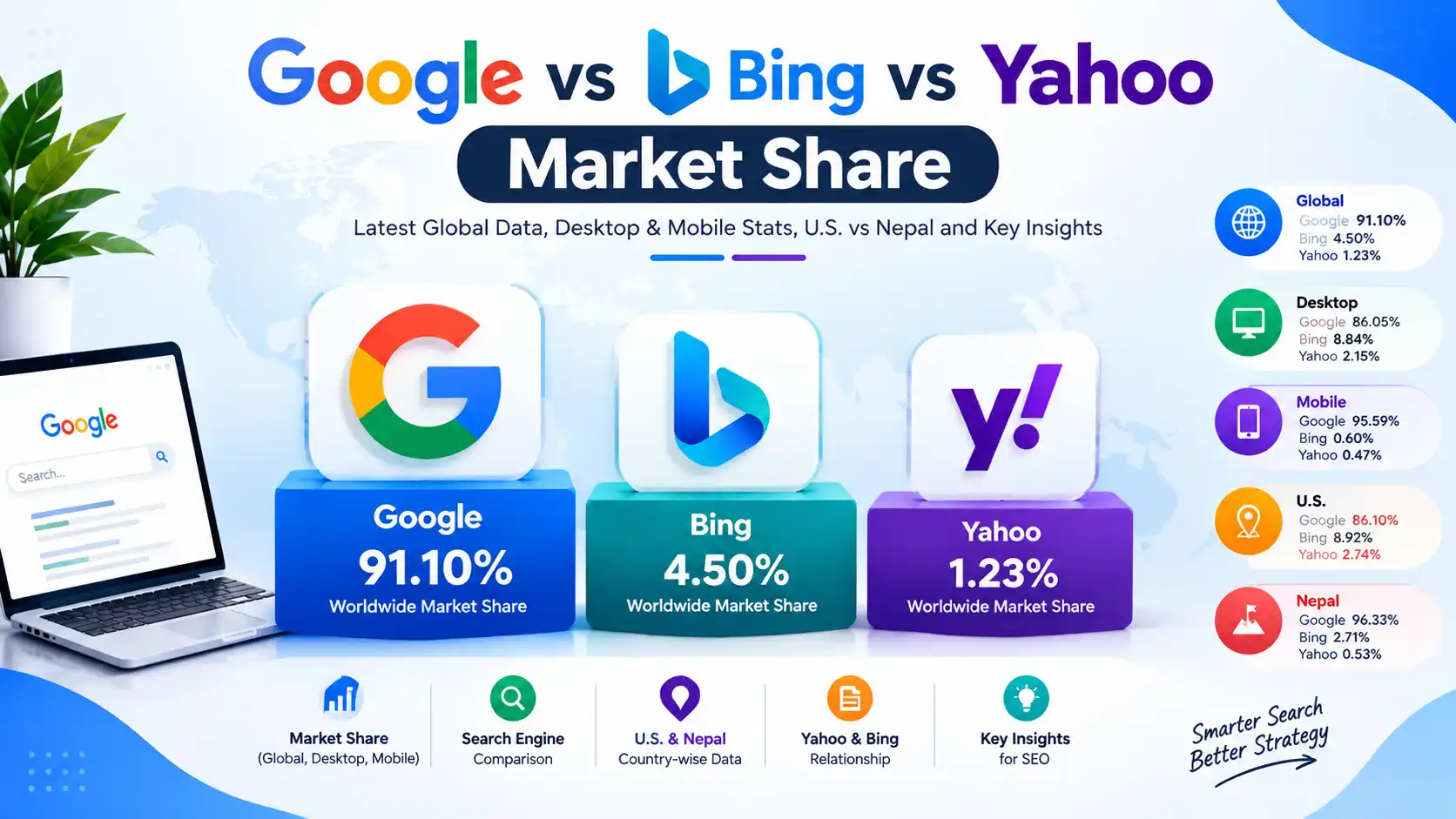
According to StatCounter’s latest available worldwide data for August 2026, Google accounted for 91.10% of global search-engine referrals, followed by Bing at 4.50% and Yahoo at 1.23%.
The numbers also change significantly depending on whether you look at desktop or mobile search.
Google vs Bing vs Yahoo Market Share
| Search Engine | Worldwide | Desktop | Mobile |
|---|---|---|---|
| 91.10% | 86.05% | 95.59% | |
| Bing | 4.50% | 8.84% | 0.60% |
| Yahoo | 1.23% | 2.15% | 0.47% |
Source: StatCounter Global Stats, August 2026.
Google is therefore the dominant search engine globally, while Bing has a substantially larger share on desktop than on mobile. Yahoo also performs relatively better on desktop than on mobile.
Important: StatCounter’s figures represent search-engine referrals to websites, not the total number of searches performed.
What Is Search Engine Market Share?
Search engine market share refers to the proportion of measured search activity or search referrals attributed to each search engine.
Different research companies can report slightly different figures because their methodologies, datasets, platforms, and definitions can vary.
StatCounter calculates its search-engine statistics by analyzing page views referred from search engines across its network of more than one million websites.
This means its data should be interpreted as search referral share, rather than a literal count of every search query made worldwide.
Which Search Engine Has the Highest Market Share?
Google has the highest global search-engine market share.
In August 2026, StatCounter recorded:
- Google: 91.10%
- Bing: 4.50%
- Yahoo: 1.23%
Google’s share is therefore more than 20 times Bing’s and far larger than Yahoo’s worldwide share.
Source: StatCounter Global Stats, August 2026.
Google Market Share
Google remains the dominant search engine across worldwide web search.
Its August 2026 share was approximately 91.10% globally.
Google’s position becomes even stronger on mobile devices, where it held 95.59% of worldwide search-engine referrals in August 2026.
On desktop, Google’s share was lower at 86.05%, but it still represented the large majority of measured search referrals.
This difference is important when evaluating search-engine usage because desktop and mobile audiences behave differently.
Bing Market Share
Bing was the second-largest search engine worldwide in August 2026, with approximately 4.50% of global search-engine referrals.
Bing’s desktop presence is considerably stronger than its mobile share.
In August 2026:
- Worldwide Bing share: 4.50%
- Desktop Bing share: 8.84%
- Mobile Bing share: 0.60%
The desktop figure is therefore the more important number to consider when studying Bing’s role in worldwide search.
Bing is Microsoft’s search engine and also plays an important role in Microsoft’s broader search and AI ecosystem.
Yahoo Market Share
Yahoo accounted for approximately 1.23% of worldwide search-engine referrals in August 2026.
Its share was:
- Worldwide: 1.23%
- Desktop: 2.15%
- Mobile: 0.47%
Yahoo therefore has a substantially larger measured share on desktop than on mobile.
There is also an important technical distinction when comparing Yahoo with Google and Bing.
According to Yahoo’s own help documentation, Yahoo Search’s algorithmic search results are provided by Microsoft Bing.
That means Yahoo remains a separate search destination and brand, but its core algorithmic web-search results are supplied by Bing.
Is Yahoo the Same as Bing?
Not exactly, but they are closely connected.
Yahoo Search is a distinct consumer search service, while Microsoft’s Bing technology provides its algorithmic search results.
This matters when analyzing the search market because Yahoo’s branded search usage is measured separately from Bing’s referral share, even though the underlying algorithmic results are provided by Bing.
In simple terms:
Yahoo = separate search brand and destination
Bing = Microsoft search engine technology powering Yahoo’s algorithmic results
Google vs Bing vs Yahoo on Desktop
Desktop search produces a very different distribution from mobile.
According to August 2026 StatCounter data:
| Search Engine | Desktop Market Share |
|---|---|
| 86.05% | |
| Bing | 8.84% |
| Yahoo | 2.15% |
Bing’s 8.84% desktop share is nearly twice its worldwide all-device share of 4.50%.
Yahoo also rises from 1.23% worldwide to 2.15% on desktop.
For websites targeting office users, businesses, software audiences, and desktop-heavy industries, this difference can be relevant when considering search-engine visibility.
Source: StatCounter Global Stats, August 2026.
Google vs Bing vs Yahoo on Mobile
Mobile search is much more concentrated.
August 2026 worldwide mobile figures were:
| Search Engine | Mobile Market Share |
|---|---|
| 95.59% | |
| Bing | 0.60% |
| Yahoo | 0.47% |
Google therefore accounted for more than nine out of every ten measured mobile search referrals in StatCounter’s dataset.
Bing and Yahoo had comparatively small mobile shares.
For publishers with a mobile-heavy audience, the mobile figures provide important context that the overall global market-share numbers alone do not show.
Source: StatCounter Global Stats, August 2026.
Google vs Bing vs Yahoo Market Share in the United States
The United States has a different search distribution from the worldwide average.
StatCounter’s August 2026 figures show:
| Search Engine | U.S. Market Share |
|---|---|
| 86.10% | |
| Bing | 8.92% |
| Yahoo | 2.74% |
Bing and Yahoo therefore have considerably more measured share in the United States than they do worldwide.
This is one reason geographic search-market data is useful. A global percentage can hide major differences between countries.
Source: StatCounter Global Stats, August 2026.
Why Does Google Have Such a Large Search Market Share?
Several factors contribute to Google’s scale, including its widespread availability across devices, search products, browser ecosystem, Android ecosystem, local-search services, and long-established user behavior.
However, market-share statistics alone do not explain why users choose one search engine over another.
Search behavior differs by country, device, browser, demographic group, and use case.
That is why a global market-share number should be treated as a high-level measurement rather than a complete explanation of search behavior.
Why Is Bing Stronger on Desktop?
The worldwide data shows a clear difference between desktop and mobile:
Bing: 8.84% desktop vs 0.60% mobile.
This means Bing’s overall market position is much more closely associated with desktop search than mobile search.
For SEO professionals, software companies, publishers, and business websites, this is an important distinction because many professional and workplace searches happen on desktop computers.
The percentage itself should still be interpreted as StatCounter referral share rather than the percentage of all actual queries.
Does Yahoo Still Matter for SEO?
Yahoo has a much smaller global share than Google and Bing, but it should not simply be ignored when discussing the search ecosystem.
Yahoo remains a separate search destination and its algorithmic web results are supplied by Microsoft Bing.
For a website owner, the practical takeaway is that strong technical SEO and high-quality content can have value across multiple search environments, while the relative traffic opportunity will depend heavily on audience location and device usage.
What Does Search Engine Market Share Mean for SEO?
Market-share data helps answer a strategic question:
Where is search traffic concentrated?
The August 2026 data suggests three clear patterns:
- Google dominates worldwide search referrals.
- Bing has a significantly larger share on desktop than on mobile.
- Yahoo has a relatively small global share but remains part of the Microsoft-powered search ecosystem.
For most websites, search-engine optimization should therefore be based on the actual audience being targeted rather than on one global percentage alone.
A U.S.-focused desktop software website, for example, may experience a different search-engine mix from a mobile-first website targeting Nepal.
Google had approximately 91.10% of worldwide search-engine referrals in August 2026 according to StatCounter.
Bing had approximately 4.50% of worldwide search-engine referrals in August 2026.
Yahoo had approximately 1.23% of worldwide search-engine referrals in August 2026.
Yes. In StatCounter’s August 2026 worldwide data, Bing had 4.50% compared with Yahoo’s 1.23%.
Yes. Bing and Yahoo together accounted for about 5.73% of worldwide measured search-engine referrals in August 2026, compared with Google’s 91.10%.
Google, with 95.59% of worldwide mobile search-engine referrals in August 2026 according to StatCounter.
Google, with 86.05% of worldwide desktop search-engine referrals in August 2026.
Yes. Yahoo states that its algorithmic search results are provided by Microsoft Bing.
No. StatCounter’s figures are based on search-engine referrals to websites, not the total number of searches performed.
Google remains overwhelmingly dominant in worldwide search, with 91.10% of measured search-engine referrals in August 2026.
Bing follows with 4.50%, while Yahoo records 1.23%.
The most interesting difference appears when the data is separated by device: Bing reaches 8.84% on desktop but only 0.60% on mobile, while Google rises to 95.59% on mobile.
For a more accurate understanding of search-engine usage, always consider the country, device, measurement method, and date alongside the headline market-share number.
Source: StatCounter Global Stats, August 2026; Yahoo Help documentation.