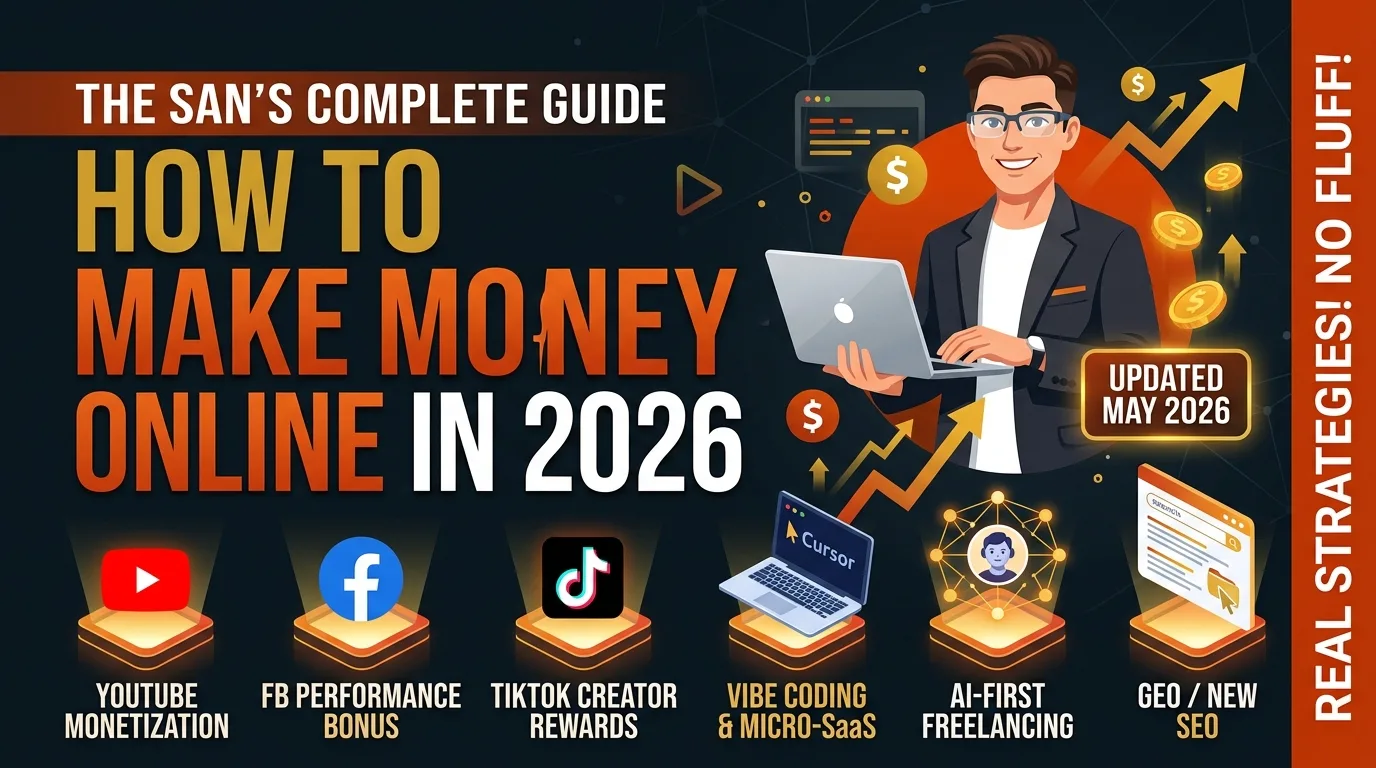
How to Make Money Online in 2026
The Real, No-Hype Blueprint
I’m The San — and after years of testing every strategy out there, I’ve put together the only guide you’ll need this year. Real platforms. Real numbers. Zero shortcuts that don’t work.
Let me be upfront with you. When I started this blog, I tested almost every online income method that existed — dropshipping, content mills, print-on-demand, generic affiliate sites. Some worked, some didn’t, and most of the ones that did work in 2022 are barely worth your time in 2026.
The internet has changed — fast. And if you’re still following advice that was written two or three years ago, you’re likely putting effort into strategies that have already been disrupted. That’s not your fault. But it is something you need to fix.
This is my most comprehensive guide to date. I’m covering every major income method that’s genuinely working right now, with the specific requirements, realistic income ranges, and the honest truth about what it takes to get there. No income claims pulled from thin air. No “overnight success” nonsense.
If you want a shortcut, I genuinely can’t help you. But if you want a real, structured path to building sustainable online income in 2026 — you’re in exactly the right place. Let’s get into it.
Part 1: Why 2026 Is Different — And Why Most Old Advice Is Dead
I want to start here because understanding why things have changed is just as important as knowing what to do next. If you understand the shift, you’ll make better decisions about where to invest your time and energy. If you skip this and just chase tactics, you’ll keep running into the same wall.
Three things happened nearly simultaneously that reshaped the entire online economy, and they’re still playing out right now.
The AI Agent Shift: From Tool to Competitor
In 2024, most people used AI to write faster. In 2026, AI agents don’t just write — they act. They research prospects, pull contact information, craft personalized outreach based on real-time behavioral signals, and follow up automatically. What used to take a virtual assistant forty hours a week can now be done by an agent running continuously in the background.
This sounds alarming, but here’s what most people miss: someone has to build, configure, and manage those agents. That gap — between businesses who desperately need AI systems and the people who actually know how to build them — is one of the biggest income opportunities in 2026. I’ll go deep on this in the freelancing section.
For further context on how AI agents are transforming business operations, McKinsey’s research on generative AI’s economic potential is worth reading. The numbers are significant.
Platform Monetization Grew Up
YouTube, TikTok, and Meta spent years building audiences. Now they’re competing hard to keep creators on their platforms, and they’re doing it with money. The monetization programs available to small creators in 2026 are genuinely better than anything that existed two years ago. You can start earning before you hit 1,000 followers on YouTube. That wasn’t possible before.
How People Search Has Fundamentally Changed
A growing portion of search queries are now resolved inside AI systems — Perplexity, Google’s AI Overviews, and ChatGPT Search. These systems don’t return ten blue links. They synthesize an answer and cite two or three sources. The sites that get cited are the ones with dense, specific, authoritative information. This has given rise to a new discipline called Generative Engine Optimization (GEO) — which I’ll cover in detail later.
Part 2: YouTube — Still the Highest Long-Term ROI for Creators
I know YouTube gets dismissed as “too competitive” these days. And honestly? For generic content, it is. But for creators who build genuine expertise in a specific niche — especially in high-value categories like personal finance, AI tools, SaaS reviews, or career development — YouTube remains unmatched for long-term compounding income.
Here’s the thing about YouTube that people overlook: a video you upload today can still generate meaningful views — and income — two or three years from now. No other social platform offers that kind of evergreen return on your creative effort. That’s not an accident. It’s a structural advantage that you should be building toward.
YouTube’s 2026 Monetization Tiers
| Tier | Requirements | What You Unlock |
|---|---|---|
| Fan Funding (Entry Level) | 500 subscribers · 3 public uploads / 90 days · 3,000 watch hours or 3M Shorts views | Super Chat, Super Thanks, Channel Memberships |
| YouTube Partner Program (Full) | 1,000 subscribers · 4,000 watch hours or 10M Shorts views | Ad revenue sharing, full monetization tools, channel store |
The entry tier matters more than most people realize. Channel Memberships — where your audience pays a monthly fee for exclusive access to templates, prompts, community, or bonus content — frequently outperform ad revenue for channels under 10,000 subscribers. If you have 700 subscribers and 60 of them pay $5.99/month for exclusive resources, that’s $359/month before you’ve even qualified for the full Partner Program.
At the full YPP tier, RPMs in competitive niches range from $18 to $35 per 1,000 views in the US market. A channel averaging 60,000 views/month in the finance or AI space can realistically earn $1,080–$2,100 from ads alone — before sponsorships, memberships, or affiliated products.
For the full breakdown of how to optimize your channel from scratch, read my guide on setting up your YouTube strategy at thesaninfo.com. I cover everything from channel setup to monetization sequencing.
Part 3: Facebook Performance Bonus — The Opportunity Most People Ignore
I’ll be honest — Facebook isn’t where I personally spend my social time. But the audience that is there — primarily the 30–65 age bracket — has disposable income, clear interests, and a strong tendency to engage with content that speaks directly to their daily life. Meta knows this, and they’ve built a monetization model that rewards creators who serve that audience consistently.
The Facebook Performance Bonus program pays creators based on the performance of their public posts — reach, engagement, and share rate — across all formats. Text posts, images, and Reels all qualify. This is fundamentally different from most platforms that gate creator income behind video production.
How Much Can You Actually Earn?
Creators posting consistently in niches like personal finance, parenting, career advice, and health are reporting between $500 and $2,000 per month in performance bonuses alone — without selling a single product. One creator I reference in the case studies section earned $2,800 in a single month from text-based posts about family finance.
Eligibility typically requires 5,000+ followers and a platform invitation. The good news: Meta has been accelerating invitations significantly in 2026 for active pages that demonstrate consistent engagement.
You can read more about Meta’s creator monetization policies directly on Facebook for Creators — the payout structures are documented there, though the specific amounts vary by market and content category.
Part 4: TikTok Creator Rewards Program — Better Payouts, Stricter Rules
If you used TikTok’s original Creator Fund and felt like you were earning almost nothing despite decent view counts — you weren’t imagining it. The fund was widely criticised for its near-negligible per-view payouts. The Creator Rewards Program (CRP) that replaced it is a genuinely different beast, with significantly better compensation — but only for content that meets its specific criteria.
CRP Requirements at a Glance
| Requirement | Specification |
|---|---|
| Minimum Followers | 10,000 |
| Recent View Count | 100,000 views in the past 30 days |
| Video Length | Must exceed 60 seconds |
| Video Quality | High definition (HD) required |
| Qualified Views | For You Page views with 5+ seconds watch time |
That last requirement — “qualified views” — is the most important one to understand. The CRP doesn’t pay you for passive scrollers. It pays you for viewers who actually stop and watch. Content that hooks people from the first second and delivers enough value or entertainment to keep them past the five-second mark earns; everything else basically doesn’t.
The content formats that consistently generate qualified views: structured tutorials, personal storytelling with a clear arc, educational explainers in specific niches, and genuine “how I did this” content backed by real experience. Trendy sounds and meme formats rarely meet the 5-second engagement threshold at scale.
Part 5: Vibe Coding & Micro-SaaS — Building Software Without Being a Developer
“Vibe coding” is a term that first gained traction from AI researcher Andrej Karpathy, and while the name sounds casual, the concept is genuinely transformative for anyone who has ever thought “I wish there was an app for that” but assumed they couldn’t build it without years of programming experience.
Vibe coding is the practice of building real, functional software applications using natural language instructions inside AI-powered development environments — tools like Cursor, Replit, or Windsurf. You describe what you want the software to do, in plain English, and the AI writes the code. You test it, give feedback, and iterate.
The income opportunity here comes from the economics of software products. You build something once, and it can generate recurring subscription revenue every month without proportional extra work. That’s what genuine passive income actually looks like — and for the first time in history, you don’t need a computer science degree to access it.
What Is a Micro-SaaS?
A micro-SaaS is a narrowly scoped software tool that solves one specific, recurring problem for a defined professional audience. Not an app that does everything — a tool that does one thing exceptionally well for people who need that thing done regularly and are already paying to have it done manually or inefficiently.
A real-world example: A listing description generator for real estate agents, pulling property data from a CRM and producing SEO-optimized listing copy automatically. Every agent hates writing those descriptions. At $19/month, you only need 100 agents subscribed to generate $1,900 in monthly recurring revenue from a single tool. Scale to 300 subscribers and you have a $5,700/month software product.
How to Go from Idea to Income
Find a real friction point
Look for tasks that professionals in a specific industry do repeatedly, dislike doing, and would pay to eliminate. Niche Reddit communities, freelance job boards, and product reviews of existing tools are your best research tools. Look for the word “tedious” — it almost always signals an automation opportunity.
Describe it precisely to your AI editor
Open Cursor or Replit and describe what you want built. The more specific you are, the better the output. “Build a web app that monitors a Google Sheet for new rows and sends a customized WhatsApp message to the relevant client automatically” produces a working prototype. Vague prompts produce vague results.
Polish the interface and landing page
Use AI to refine the UI, add error handling, and write a simple landing page that clearly communicates what the tool does and who it’s for. The quality of your landing page affects conversion more than you’d expect — first impressions matter even for cheap tools.
Sell before you perfect it
Find your first 10 users from the community where you identified the problem. Offer them a founding member discount in exchange for honest feedback. Real user input is worth more than another month of solo refinement. Ship, learn, iterate.
Part 6: High-Value Freelancing — What the Market Is Actually Paying For in 2026
The freelance market has split into two very different tracks. On one end, commodity services — basic content writing, generic graphic design, template-based web development — are being compressed hard by AI. Rates are dropping and the competition from automated tools is brutal.
On the other end, AI implementation services — designing, building, and deploying AI-powered systems for businesses — are commanding rates that would have seemed extraordinary two years ago. The reason is simple: every business owner has heard that AI can save them money and time. Almost none of them know how to actually set it up. That gap is your income opportunity.
Becoming an AI Architect: What It Means and What It Pays
One of the highest-demand services right now is building what’s increasingly called a “company brain” — an internal knowledge base powered by AI that allows employees to ask questions in plain language and get accurate, sourced answers based on the company’s own documents.
This is built using a technique called Retrieval-Augmented Generation (RAG). The process involves ingesting the company’s internal documents — policies, SOPs, product manuals, customer data — into a searchable vector database, then layering a conversational AI interface on top. The result is an employee who can ask “what’s our return policy for wholesale clients?” and get an instant, accurate answer pulled from actual company files.
Businesses that would have spent $60,000 a year on a knowledge management employee are now paying $10,000 for a one-time build. The math is obvious to them, which is why the demand is so strong.
Agentic Outreach: Helping Businesses Replace Manual Prospecting
Another high-demand service: building intelligent outreach systems that monitor for business intent signals — a company just raised funding, just hired a new VP of Marketing, just posted a job listing that signals a new strategic direction — and trigger personalized, timely outreach automatically using tools like Clay.
Companies that used to spend significant staff time on manual prospecting will pay well for systems that do it continuously and intelligently. If you can build and manage these workflows, you’re providing measurable ROI — which makes pricing conversations much easier.
Part 7: Website & Blog Monetization — Building a Digital Asset That Compounds
Running a content website in 2026 is harder than it was in 2021, and easier than people think it is right now. Harder because the competition for attention is fiercer and the standards for quality are higher. Easier because the tools for creating and distributing genuinely good content are more accessible than ever.
The mistake most bloggers are making right now is optimizing for an algorithm that’s already changed. Traditional keyword-stuffing SEO is largely obsolete. What works now is building content that is genuinely the best available answer to a specific question — and making sure it’s structured in a way that both search engines and AI systems can easily read and cite.
How to Monetize Your Website in 2026
Programmatic Advertising: Premium ad networks like Mediavine (50,000 monthly sessions minimum) pay significantly more than Google AdSense for the same traffic. In the right niche, display ads alone can generate substantial monthly income at scale.
Affiliate Marketing 2.0: The highest-converting affiliate content in 2026 goes beyond comparison tables. Sites that offer interactive decision tools — helping visitors identify the exact right product for their specific situation — convert dramatically better than static review pages. Think less “top 10 list” and more “personalized recommendation engine.”
Digital Products: Templates, prompt libraries, mini-courses, and tool kits priced between $15–$97 convert well from content traffic and have zero fulfillment cost. This is one of the cleanest income models for bloggers who’ve built audience trust.
Site Sales (Digital Estates): Niche websites generating $1,000/month in verified revenue are consistently selling for $35,000–$45,000 on marketplace platforms. Building and selling content sites is itself a viable income strategy for patient, systematic creators. I explore this model in depth over at thesaninfo.com.
Part 8: GEO — Generative Engine Optimization Explained Simply
This is the section most blogs aren’t covering yet, which means it’s where your biggest competitive advantage lives right now.
When someone asks an AI search engine a question, the system doesn’t browse the web in real time — it pulls from indexed content that meets specific quality signals and synthesizes an answer. The sources it cites are the ones that will receive traffic. Understanding how to get cited is GEO.
The Four Pillars of GEO in 2026
1. Direct Answer First
Open every article with a 1–2 sentence direct answer to the primary question. AI systems extract the clearest, most direct answer and surface it to users. If your best answer is buried in paragraph seven, it won’t get cited. Front-load the value.
2. Information Density Over Word Count
Replace vague statements with specific, verifiable data. “Many creators earn on YouTube” tells an AI nothing. “YouTube channels in the finance niche earn $18–$35 per 1,000 views in the US market in 2026” is a citable fact. Fill your content with real numbers, real dates, real names, and real outcomes.
3. Structured Data Markup
Implement FAQ schema, Article schema, and How-To schema so AI agents can accurately parse and categorize your content. This is no longer an advanced optional tactic — it’s a baseline requirement for any content site that wants to compete for AI citations. Google’s Structured Data documentation is the definitive reference.
4. Entity-Based Topic Coverage
Instead of targeting isolated keywords, build comprehensive coverage of topics as interconnected entities. A strong article about YouTube monetization should naturally reference and link to related entities: creator economy trends, platform policies, revenue models, audience retention benchmarks. AI systems understand topical authority through this web of connections, not through keyword density.
Part 9: Two Real Examples of What Success Actually Looks Like
I include these not to make you think it’s easy, but to make it concrete. Both of these are real outcomes from real people using the strategies I’ve described. Neither happened overnight. Both required consistent effort over several months.
🧑💻 Case A: The 19-Year-Old Who Built Software Without Writing Code
A 19-year-old with no programming background set out to build a Chrome extension for Shopify store owners that automates the collection and AI-generated response of customer reviews. He had no Python experience. No JavaScript knowledge. What he had was a clear understanding of the problem — store owners hated writing individual review responses — and the patience to describe exactly what he wanted to build inside an AI development environment, test the output, and iterate.
Four months of consistent work. One specific problem. One tool built entirely through natural language prompting. Revenue target achieved.
👩👧 Case B: The Stay-at-Home Parent Earning $2,800 in One Month
A stay-at-home parent built a Facebook Page around one specific topic: practical personal finance for families. Not financial theory or investment advice — real, specific tips for managing household budgets, cutting grocery bills, building a small emergency fund on a tight income. The content was posted daily, in a tone that felt like advice from a trusted friend rather than a financial advisor.
One month: $2,800 in Facebook Performance Bonus payouts. No product to sell. No video equipment. No ad spend. Consistency and genuine usefulness were the entire strategy.
Part 10: The 90-Day Execution Plan — Stop Consuming, Start Building
The honest truth about most people who read guides like this one is that they finish reading and then look for the next guide. That’s the trap. The information is not the obstacle. Execution is. So here’s a structured 90-day framework designed to move you from reading to earning as directly as possible.
This plan assumes you have 1–2 focused hours available per day. If you have more, great — accelerate the phases. If you have less, extend the timeline, but don’t abandon it.
Phase 1 — Days 1 to 15: Build Your Stack and Learn to Use It
Sign up for an AI coding environment (Cursor is my current recommendation), a premium conversational AI subscription, and an image generation tool. Spend these two weeks not watching tutorials about AI — actually using these tools to build things. Prompt for a tool, test it, break it, fix it, repeat. Prompting is a muscle. You only develop it by using it.
Phase 2 — Days 16 to 45: Launch Your Content Presence
Start a YouTube channel and a simple website simultaneously. Aim for three short-form videos per week and one substantial long-form article per week. Don’t wait until things are perfect. The algorithm rewards signals of genuine engagement and consistency, not production quality. Ship early and refine based on what resonates.
Phase 3 — Days 46 to 75: Create and Launch Your First Product
Build a monetizable micro-product. This could be a curated AI prompt library ($27 flat), a micro-SaaS tool ($9–$19/month subscription), or a niche resource bundle ($47). Price it as a no-brainer for your specific audience. Get your first 10–20 paying customers and gather structured feedback. Don’t over-engineer before you validate. Launch fast, improve consistently.
Phase 4 — Days 76 to 90: Scale and Reinvest
Use your growing content presence to drive audience toward your product. Reinvest 30% of early revenue into outreach automation or targeted promotion. Begin reaching out to potential high-ticket service clients — a portfolio of two or three documented real-world results from your own projects is enough to start those conversations. You don’t need ten clients. You need one good one to start.
Part 11: The Questions I Get Asked Most — Answered Honestly
How much money can I realistically earn in the first 90 days?
Probably less than you’re hoping. The first 90 days are infrastructure — you’re building an audience, validating a product, and establishing credibility. Most people see their first meaningful income between months 3 and 6. Freelance AI implementation services can generate income faster because you’re solving a specific problem for a paying client rather than building an audience first. Set realistic expectations for the early phase and you’ll avoid the discouragement that causes most people to quit too soon.
Do I need technical skills to get started with vibe coding?
No — genuinely, no. What you need is the ability to describe what you want built clearly and specifically, and the patience to test, give feedback, and iterate. Understanding basic concepts (what an API does, what a database is) will speed up your progress, but these are concepts you can learn in a weekend, not a semester. The barrier is far lower than most people assume.
Which method generates income the fastest?
Freelance AI implementation services offer the shortest path from zero to significant income — but they require some credibility first, which usually means doing a few initial projects at reduced rates for your network. Content monetization (YouTube, blogs) compounds beautifully over 12–24 months but has a slower initial payoff. If you need income within 60 days, focus on freelancing. If you’re building a 2–3 year income machine, content and product are your best long-term bets.
Is GEO replacing traditional SEO entirely?
It’s adding a new layer on top, not replacing it. Traditional search still drives significant traffic, and the core fundamentals — quality content, good technical structure, authoritative backlinks — still matter. GEO adds a new dimension: making your content legible and citable for AI-generated answers. The good news is that the qualities GEO rewards (specificity, directness, factual density) also improve your traditional search performance. Invest in both simultaneously.
I work full-time. Can I actually build this as a side project?
Yes — but be realistic about your available time and energy. The 90-day plan above is designed around 1–2 focused hours per day. If you protect that time and don’t let it bleed into passive consumption (watching YouTube about the strategy instead of executing it), it’s genuinely achievable. The most common mistake is picking two or three strategies at once. Pick one, commit for 90 days, measure results, then decide what’s next.
Do I need to already have an audience to start?
No. Every method in this guide has a path that starts from zero. For content platforms, the audience grows as you publish. For freelancing, you find clients through outreach and your network. For micro-SaaS, your first users come from the community where you identified the problem. The biggest misconception is that you need an audience before you can earn anything — you need to provide value, and the audience follows from that.
The Bottom Line — From The San
I’ve been building online income streams for long enough to know that the people who succeed aren’t always the most talented or the most technically skilled. They’re usually the most consistent. They pick a direction, execute it with discipline, adjust based on real feedback, and don’t quit when month two looks exactly the same as month one.
The opportunity in 2026 is real. The tools are better than they’ve ever been. The platforms are paying more than they ever have. The demand for people who understand AI and can implement it for businesses is extraordinary. But none of that matters if you’re still reading about it in six months without having started.
Pick one path from this guide. Spend this week setting up the tools. Publish your first piece of content or reach out to your first potential client. The gap between knowing and doing is still the biggest differentiator — in 2026, just as it was in every year before it.
I publish new strategies, breakdowns, and case studies regularly at thesaninfo.com. Bookmark it. Come back when you need to recalibrate. And go build something.
— The San
Disclaimer: All earnings figures cited in this article reflect 2026 market benchmarks and publicly reported creator data. Individual results depend on niche selection, content quality, execution consistency, audience size, and market conditions. Nothing in this guide constitutes financial or legal advice. Always conduct your own research before making business decisions.