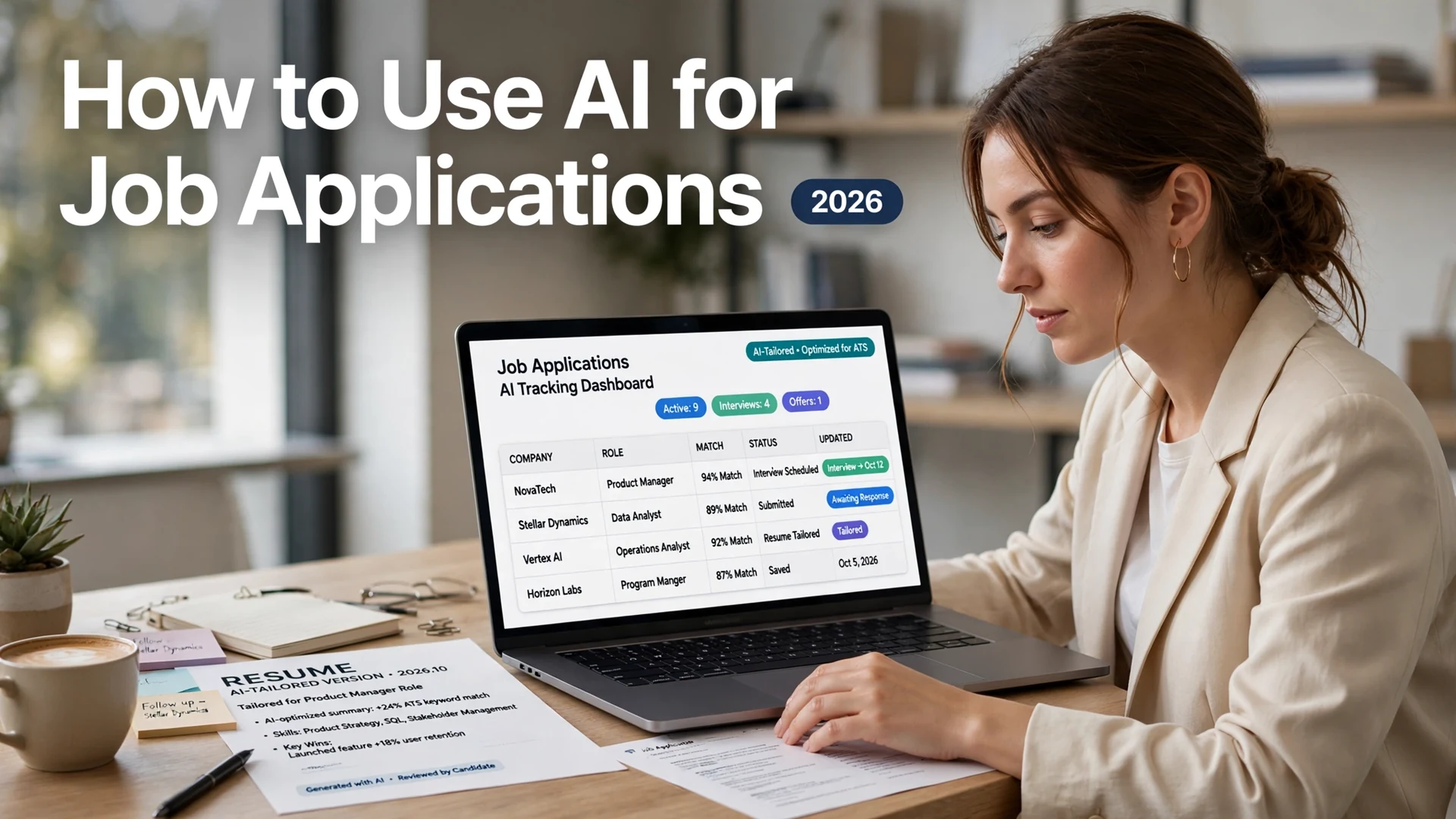
How to Use AI for Job Applications (2026 Guide)

Quick answer: Use AI for job applications as a four-stage system: Teal (free) to track applications and tailor resumes per posting, Rezi ($29/mo or $149 lifetime) or Jobscan (5 free scans/mo) to beat ATS keyword filters, ChatGPT or Claude to draft cover letters and bullet points, and AI mock interviews to rehearse answers. Never let AI invent experience — recruiters check, and one caught lie ends the process.
In 2026, roughly three out of four resumes never reach a human. Applicant Tracking Systems (ATS) — software like Taleo, Greenhouse, and iCIMS — scan, score, and rank every application before a recruiter glances at it. The good news: the same AI wave that built those filters also built tools to get through them. The bad news: most job seekers use AI wrong, pasting generic AI-written resumes that read like everyone else’s and fail the same filters.
This guide shows the workflow that actually works in 2026: which AI tool to use at each stage, what each one costs, and where the red lines are.
The AI Job-Application Workflow That Actually Works
Stop thinking of AI as “a resume writer.” The winning setup in 2026 is a pipeline with four stages, each with its own tool:
1. Track everything with Teal
High-volume applying without a tracker is how good postings slip through the cracks. Teal combines a job-application tracker with an AI resume builder: save jobs from 40+ job boards with its Chrome extension, keep every application stage in one pipeline, and tailor a resume version per posting. Its free tier covers the tracker and a serviceable resume builder at $0, which makes it the best starting point for most people. Paid Teal+ runs around $29/month if you want the full AI tailoring features.
2. Beat the ATS filter with Rezi or Jobscan
This is the stage most people skip — and the one that decides whether a human ever sees your resume. ATS filters match your resume’s vocabulary against the job description, so a resume tuned for one posting can miss the keywords of the next.
Rezi is the strongest paid pick for pure ATS optimization: real-time scoring against 20+ criteria, keyword feedback as you type, and ATS-safe templates. It costs around $29/month, with a $149 lifetime plan that pays for itself fast during a long search. Jobscan goes deeper on diagnostics — it reverse-engineers specific ATS platforms and scores your resume against the actual posting, with 5 free scans a month before the $49.95/month plan kicks in. Because it’s pricey, the smart move is one focused month of Jobscan, not a standing subscription.
3. Draft with ChatGPT or Claude — then edit hard
For cover letters, bullet points, and summaries, the general assistants still beat the specialist builders on writing quality. Paste the job description plus your raw experience and ask for tailored bullets; then rewrite every line in your own voice. For the full resume-writing walkthrough, see our guide on how to write a resume with AI.
4. Rehearse with AI mock interviews
ChatGPT’s voice mode and Claude both run convincing mock interviews: give them the job description, ask them to play the hiring manager, and answer out loud. It is the closest thing to a free interview coach — awkward at first, genuinely useful by the third round.
| Tool | Best for | Free tier | Paid from (as of Oct 2026) |
|---|---|---|---|
| Teal | Tracking applications + per-job tailoring | Yes — tracker + resume builder | ~$29/mo (Teal+) |
| Rezi | ATS-first resume building | Limited | ~$29/mo or $149 lifetime |
| Jobscan | Deep ATS match-score diagnostics | 5 scans/month | ~$49.95/mo |
| Kickresume | Design-forward resumes + AI writing | Yes — limited | ~$4.50/mo (billed yearly) |
| ChatGPT / Claude | Cover letters, bullets, interview prep | Yes — generous free tiers | $20/mo (Plus / Pro) |
| Enhancv | Visual polish for creative roles | Yes — limited | ~$24.99/mo |
How to Tailor Your Resume with AI (Without Lying)
Tailoring is the highest-leverage AI use in the whole job search — and the easiest to do dishonestly. Here is the honest method:
Step 1: Paste the job description and your master resume into ChatGPT or Claude. Step 2: Ask it to list the posting’s top 10 keywords and skills, then flag which ones your resume already covers and which are genuinely missing. Step 3: For the ones you cover, ask it to rewrite your bullets using the posting’s vocabulary — same facts, their words. Step 4: For the ones you don’t have, do NOT invent them. Either learn the skill, or leave it out and address it in the cover letter.
This distinction matters because recruiters now run AI checks of their own, and background verification catches fabricated titles fast. One invented job title discovered in reference checks ends the process — and sometimes the offer after it’s signed. AI should translate your real experience into the employer’s language, never manufacture experience you don’t have.
Use AI for Interview Prep, Not Interview Cheating
Legitimate prep: mock interviews, STAR-method answer structuring, company research summaries, questions to ask the interviewer. Ask the AI to be brutal — “point out every weak answer and tell me what a hiring manager would think” produces better rehearsal than gentle encouragement.
Where the line is: using hidden AI tools to feed you answers during a live video interview. Companies increasingly detect this, and getting caught is a career-level black mark. Prepare with AI, perform as yourself.
The Red Lines: What AI Can’t (and Shouldn’t) Do
AI can’t network for you — referrals still beat cold applications by an order of magnitude, so spend the time AI saves you on actual outreach. It can’t decide which jobs fit your life. And it shouldn’t write a resume so generic it could belong to anyone: if every bullet sounds like a template, hiring managers smell it instantly. The candidates winning in 2026 use AI for leverage — tailoring, tracking, rehearsal — and keep the judgment, the voice, and the honesty human.
FAQs
The highest-leverage uses: tailoring your resume to each job description’s keywords (ATS filters match vocabulary per posting), tracking applications, drafting cover letters, and rehearsing with mock interviews. Teal’s free tier covers tracking and basic tailoring.
They help you get past the filter — Jobscan scores your resume against the actual posting and Rezi gives real-time ATS scoring. But they can’t fix a resume with no relevant experience, and keyword-stuffing without the real skills backfires in interviews.
Teal (free), Rezi (~$29/month or $149 lifetime), Jobscan (5 free scans/month, then ~$49.95/month), Kickresume (from ~$4.50/month yearly), and Enhancv (~$24.99/month). Start free and pay only where free tiers limit you.
Tailoring means translating your real experience into the posting’s vocabulary — legitimate and expected. Lying means inventing titles, skills, or dates you don’t have. Recruiters verify, and one caught lie can end the hiring process.
Yes, if they’re genuine. Paste the job description and ask for the top 10 keywords, then rewrite only the bullets covering experience you actually have. Never add skills or titles you don’t hold — verification catches it.
Use AI to rehearse: have ChatGPT or Claude play the hiring manager, answer out loud, and ask for brutal feedback. Don’t use hidden AI tools to feed you answers during live interviews — companies detect it and it’s a career-level black mark.
Final Thought
The 2026 job search rewards systems, not tools. A free Teal account tracking every application, one month of Rezi or Jobscan to tune your resume past the ATS, and ChatGPT or Claude for drafting and rehearsal will outperform any single $50/month subscription used alone. Start free, pay only where the free tier visibly limits you, and remember the filter you’re really trying to pass: a tired human recruiter deciding in six seconds whether you’re worth a call. AI gets you to those six seconds. Your real experience has to win them.


