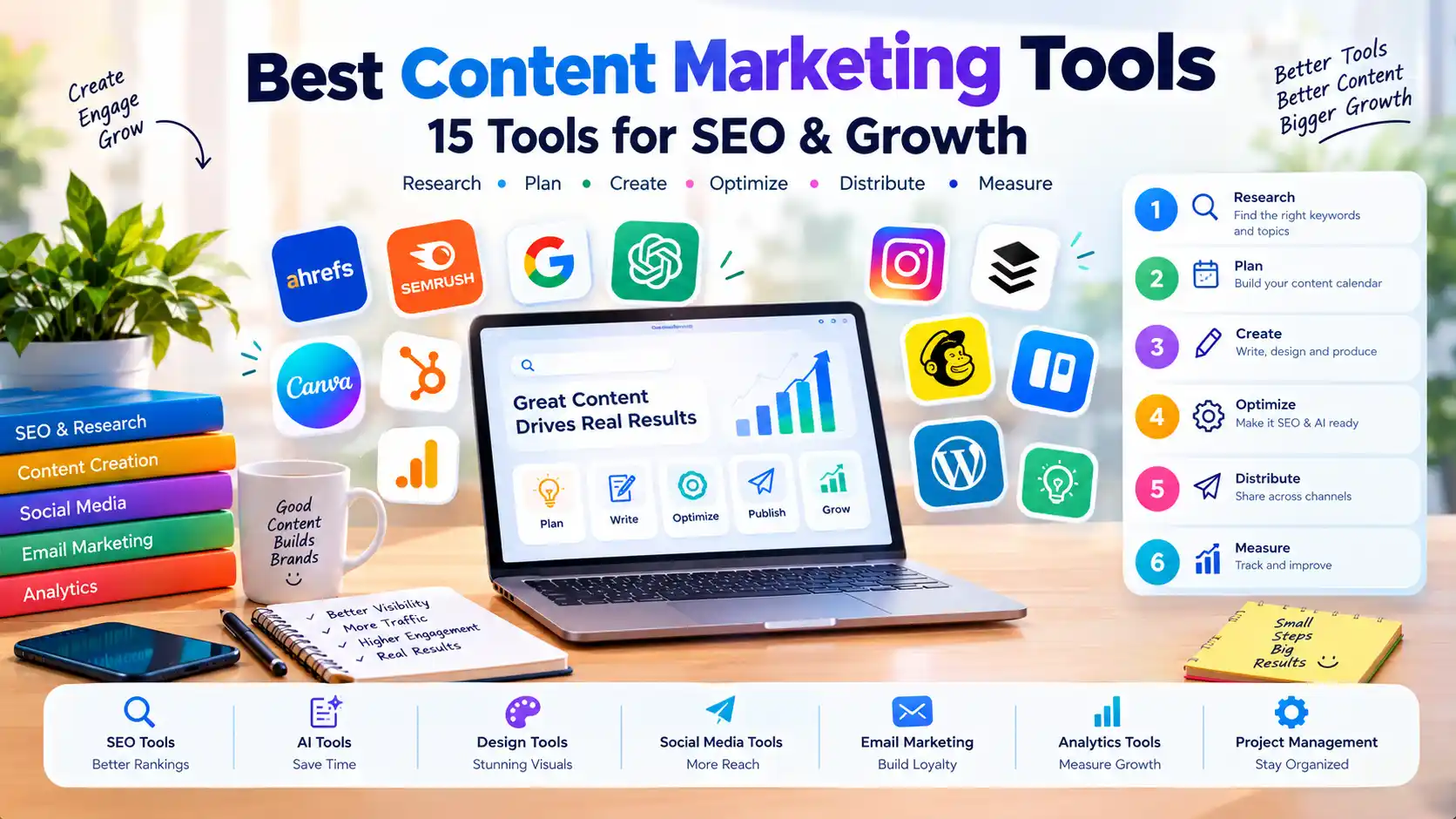
Best Content Marketing Tools: 15 Tools for Research, Creation, SEO & Growth

Content marketing is no longer just writing blog posts and publishing them.
A modern content workflow can involve keyword research, topic discovery, content planning, AI-assisted writing, SEO optimization, graphic design, social media distribution, email marketing, analytics, and conversion tracking.
The right content marketing tools can make this workflow faster and more organized—but you do not need dozens of subscriptions to build a successful content operation.
For most bloggers, creators, freelancers, startups, and small businesses, a focused stack of four to six tools is often enough.
In this guide, we’ll cover the best content marketing software and tools for each stage of the workflow, including free options and AI-powered tools.
Quick Answer: What Are the Best Content Marketing Tools?
The best tool depends on the job you need to accomplish.
| Tool | Best For | Category | Free Option |
|---|---|---|---|
| Semrush | SEO research and content strategy | SEO | Limited |
| Ahrefs | Keywords, competitors and backlinks | SEO | Limited/free tools |
| Google Trends | Trending topics and demand | Research | Yes |
| ChatGPT | Ideation, research and drafting assistance | AI | Yes |
| HubSpot | Content, CRM and marketing automation | All-in-one | Yes |
| Canva | Graphics, social posts and visual content | Design | Yes |
| Grammarly | Editing and writing quality | Writing | Yes |
| Google Search Console | Google Search performance | Analytics/SEO | Yes |
| Google Analytics | Traffic and user behavior | Analytics | Yes |
| Buffer | Social media publishing | Distribution | Yes/limited |
| Mailchimp | Email newsletters and campaigns | Yes/limited | |
| Trello | Content calendars and workflows | Planning | Yes |
| Rank Math | WordPress SEO publishing | SEO | Yes |
| Hotjar | Behavior and conversion insights | Analytics | Limited |
There is no single best content marketing tool for every business. The best choice depends on whether your biggest problem is research, content creation, SEO, distribution, workflow management, or measurement.
What Are Content Marketing Tools?
Content marketing tools are software applications that help you research, plan, create, optimize, publish, distribute, and measure content.
They can include:
- SEO and keyword research tools
- AI writing tools
- Content planning software
- Editorial calendar tools
- Graphic design platforms
- Social media schedulers
- Email marketing software
- Website analytics tools
- Content optimization software
- Marketing automation platforms
A good content marketing stack connects these stages instead of treating every task as a separate activity.
1. Semrush — Best for SEO Content Strategy
Best for: Keyword research, competitor analysis, topic research and content optimization.
Semrush is one of the strongest choices if your content strategy depends heavily on organic search.
Its current Content Toolkit combines topic discovery, SEO briefs, AI-assisted article creation, content optimization, repurposing and publishing workflows. Its Topic Finder is designed to surface content opportunities using SEO data, while its Keyword Magic Tool provides keyword ideas that can be filtered by intent and difficulty.
Why use Semrush?
You can use it to:
- Research keywords
- Analyze competitors
- Find content gaps
- Discover topic ideas
- Create SEO briefs
- Optimize existing articles
- Track rankings
- Research backlinks
- Explore AI-search visibility
It is particularly useful for SEO professionals, agencies and publishers producing content at scale.
Best for: Serious SEO-focused content marketing.
2. Ahrefs — Best for Keywords, Competitors and Backlinks
Best for: SEO research and competitive analysis.
Ahrefs is another major platform for content marketers who rely on organic search.
Its value goes beyond keyword research. A content marketer can use SEO research to understand what competitors rank for, identify content gaps, analyze backlinks and evaluate existing organic visibility.
If your strategy is:
Find demand → analyze competitors → create better content → earn rankings
Ahrefs is a strong choice.
Best for: Publishers and SEO teams focused on organic growth.
3. Google Trends — Best for Finding Trending Topics
Best for: Topic discovery and trend validation.
Google Trends is one of the most useful free content research tools.
Before writing an article, you can use it to compare topics and determine whether interest is:
- Increasing
- Declining
- Seasonal
- Location-specific
- Related to a recent event
This is particularly useful for content marketing trends, news-driven topics and emerging technologies.
For example, instead of blindly choosing between two topics, compare their search-interest patterns first.
Best for: Finding timely content opportunities.
4. ChatGPT — Best AI Content Marketing Assistant
Best for: Brainstorming, research assistance, outlines, editing and content repurposing.
AI tools have become a major part of modern content workflows.
You can use an AI assistant to:
- Brainstorm article ideas
- Build outlines
- Generate questions
- Summarize research
- Improve headlines
- Rewrite sections
- Create social-media variations
- Repurpose long-form content
- Develop content briefs
However, AI should support the editorial process rather than replace it.
Google’s current guidance emphasizes unique, valuable, people-first content and warns against creating large quantities of low-value pages primarily to manipulate Search.
A better workflow is:
Research → AI assistance → human verification → original analysis → editing → publication
rather than:
Keyword → AI article → automatic publishing
Best for: Solo creators and teams that want faster content workflows.
5. HubSpot — Best All-in-One Content Marketing Platform
Best for: Content, CRM, automation and marketing operations.
HubSpot is useful when content marketing needs to connect directly with leads and customers.
Its platform can bring content, marketing automation, analytics and CRM data into one ecosystem. HubSpot’s Content Remix can also turn an existing piece of content into additional formats such as social posts, emails and other marketing assets.
This makes HubSpot particularly interesting for businesses that want to answer:
Which content generated traffic?
and eventually:
Which content generated leads or revenue?
Best for: Businesses that want content marketing connected to CRM and customer journeys.
6. Canva — Best for Visual Content
Best for: Blog graphics, social media images, presentations, thumbnails and branded visual content.
Content marketing is not only text.
A strong article may need:
- Featured images
- Infographics
- Charts
- Social graphics
- Pinterest images
- Presentation slides
- Short-form visual content
Canva makes this accessible without requiring professional graphic-design skills.
Its Brand Kit can centralize logos, colors, fonts, imagery and brand guidelines so teams can produce more consistent visual content.
Best for: Bloggers, creators, small businesses and social-media marketers.
7. Grammarly — Best for Editing and Readability
Best for: Grammar, clarity, tone and editing.
Even well-researched content can lose credibility because of:
- Grammar mistakes
- Awkward sentences
- Repetition
- Inconsistent tone
- Poor readability
Grammarly can work as a final editorial layer after the content has been researched and drafted.
The important distinction is that a writing assistant should improve communication—not manufacture expertise that the writer does not have.
Best for: Anyone publishing professional written content.
8. Google Search Console — Best Free SEO Content Tool
Best for: Measuring Google Search performance.
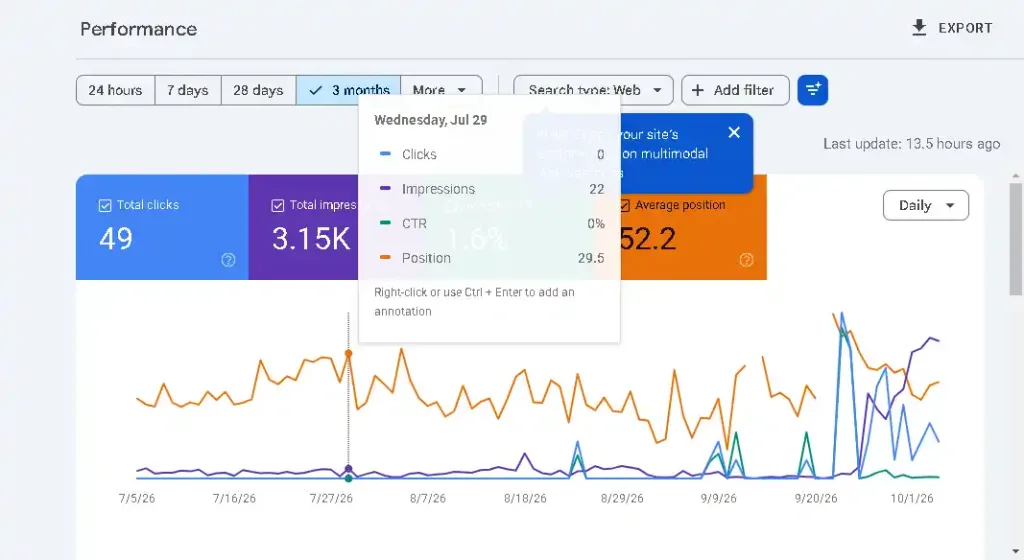
If you publish content for Google, Search Console should be part of your basic toolkit.
It provides information about:
- Search queries
- Clicks
- Impressions
- Average position
- Indexing
- URL inspection
- Search appearance
- Core Web Vitals
Google specifically describes Search Console as a tool for measuring Search traffic and performance, submitting sitemaps and URLs, diagnosing indexing issues and understanding how Google sees your pages.
For content marketing, one of its biggest benefits is discovering what your audience is actually searching for.
Best for: Every website owner publishing organic-search content.
9. Google Analytics — Best for Content Performance
Best for: Website traffic, engagement and conversion analysis.
Search Console tells you what happens in Google Search.
Google Analytics helps you understand what happens after visitors arrive.
You can use it to analyze:
- Traffic sources
- User behavior
- Landing pages
- Engagement
- Conversions
- Campaign performance
- Audience journeys
Google Analytics reports provide data for monitoring traffic and understanding users and their activity.
The combination is powerful:
Search Console → Did people find my content?
Google Analytics → What did they do after arriving?
Best for: Measuring the business impact of content.
10. Buffer — Best for Social Content Distribution
Creating content is only half the job.
You also need distribution.
Social media scheduling tools can help you prepare and publish content across multiple channels without manually posting everything one platform at a time.
Buffer is particularly useful for creators and small teams that want a relatively simple publishing workflow.
Use it to distribute:
- Blog posts
- Short-form content
- Quotes
- Videos
- Educational tips
- Product content
- Content updates
Best for: Creators and small businesses managing social distribution.
11. Mailchimp — Best for Email Content Marketing
Best for: Newsletters and email campaigns.
Email remains important because you do not have to rely entirely on search or social algorithms to reach an audience you have already earned.
You can use email marketing to distribute:
- New blog posts
- Weekly newsletters
- Guides
- Product updates
- Promotions
- Curated content
- Lead magnets
The basic content funnel can look like:
Blog → Email signup → Newsletter → Returning visitor → Customer
Best for: Publishers and businesses building an owned audience.
12. Trello — Best for Content Planning
Best for: Editorial calendars and content workflows.
A common content marketing problem is not a lack of ideas.
It is poor organization.
Trello can turn your content pipeline into a visual workflow such as:
Ideas → Research → Brief → Writing → Editing → SEO → Design → Scheduled → Published → Updated
This makes it easier to see what is stuck and what should be published next.
Best for: Solo creators and small content teams.
13. Rank Math — Best for WordPress SEO Publishing
Best for: On-page SEO inside WordPress.
For WordPress publishers, Rank Math can fit directly into the publishing workflow.
You can use it to manage:
- SEO titles
- Meta descriptions
- Focus keywords
- Schema
- Canonical URLs
- XML sitemaps
- Social metadata
- Basic on-page SEO checks
The important point is that an SEO plugin does not create a successful content strategy by itself.
It helps you implement one.
A strong workflow is:
Keyword research → Search intent → Content → Internal links → Rank Math optimization → Publish → Search Console monitoring
14. Hotjar — Best for Understanding User Behavior
Best for: Heatmaps, recordings, surveys and behavioral insights.
Search rankings tell you how users discover your content.
Behavior analytics can help explain what happens after they arrive.
For example, if visitors consistently leave before reaching your CTA, your problem may not be traffic.
It may be:
- Poor page structure
- Weak introduction
- Slow page
- Confusing navigation
- Poor CTA placement
- Unclear value proposition
HubSpot’s current content-tool research also positions behavioral analytics such as Hotjar as a way to understand the “why” behind user behavior rather than simply measuring traffic.
Best for: Conversion-focused content teams.
15. Content Marketing Tools Don’t Need to Be Expensive
One of the biggest mistakes beginners make is subscribing to too many platforms.
You can build a surprisingly capable free content marketing stack.
A practical free stack
| Need | Tool | Purpose |
|---|---|---|
| Keyword/search performance | Google Search Console | Queries, impressions, clicks and indexing |
| Trend research | Google Trends | Topic and trend validation |
| Writing | Google Docs + AI assistant | Drafting and collaboration |
| Design | Canva | Images and social graphics |
| Website analytics | Google Analytics | Traffic and user behavior |
| WordPress SEO | Rank Math | On-page SEO and structured data |
This can be enough to start a serious content marketing operation before paying for expensive SEO platforms.
Best Content Marketing Tools by Use Case
| Goal | Recommended Tool | Why |
|---|---|---|
| Keyword research | Semrush / Ahrefs | Search demand and competitive research |
| Topic ideas | Google Trends / Semrush | Demand and topic discovery |
| AI-assisted writing | ChatGPT | Ideas, research assistance and drafts |
| SEO content optimization | Semrush / Ahrefs | SEO research and optimization workflows |
| WordPress SEO | Rank Math | On-page SEO and schema implementation |
| Graphic design | Canva | Fast branded visual production |
| Social distribution | Buffer | Scheduling and distribution |
| Email marketing | Mailchimp | Newsletters and campaigns |
| Content workflow | Trello | Editorial planning |
| Search performance | Google Search Console | Organic Search data |
| Traffic analysis | Google Analytics | User and conversion analysis |
How to Choose the Right Content Marketing Tools
Do not choose tools simply because they have the largest feature list.
Evaluate them against your actual workflow.
1. Identify your bottleneck
Ask:
What is slowing down my content operation?
If the answer is research, invest in SEO and research tools.
If it is writing, consider AI-assisted creation and editing tools.
If it is distribution, prioritize social and email platforms.
If you have traffic but few conversions, behavioral analytics may be more valuable.
2. Avoid tool sprawl
More software does not automatically mean better content marketing.
Semrush’s current research notes that most teams can work effectively with a smaller group of tools matched to their workflow rather than subscribing to every available platform.
Five tools that work together are usually more useful than fifteen disconnected subscriptions.
3. Check integrations
Look for integrations with the platforms you already use.
For example:
WordPress + Rank Math + Search Console + Analytics + Canva
can provide a very practical publishing and measurement workflow.
For larger organizations:
HubSpot + CRM + analytics + content + email + automation
may make more sense.
4. Consider AI carefully
AI can dramatically reduce production time, but faster production does not automatically produce better marketing.
Google’s current Search guidance emphasizes unique, useful and people-first content rather than large volumes of commodity AI content.
Use AI for efficiency while keeping human research, verification, judgment and originality in the workflow.
Content Marketing Tools for Small Business
Small businesses usually do not need an enterprise marketing stack.
A practical starting combination could be:
Google Search Console — Search performance
Google Analytics — website analytics
Google Trends — topic research
Canva — visual content
Rank Math — WordPress SEO
AI assistant — research and writing assistance
Buffer — social distribution
As the business grows, add:
Semrush or Ahrefs for deeper SEO research.
Mailchimp for email marketing.
HubSpot when CRM and marketing automation become important.
This approach keeps costs under control while allowing the content operation to scale.
AI Content Marketing Tools: What Should You Actually Automate?
A modern content workflow can automate repetitive work without automating the entire editorial process.
Good candidates for automation
- Brainstorming
- Formatting
- Content repurposing
- Social captions
- First-draft outlines
- Internal workflow notifications
- Reporting
- Publishing reminders
- Basic content transformations
Keep human oversight for
- Original research
- Fact verification
- Expert opinions
- Product reviews
- Sensitive topics
- Strategic decisions
- Final editing
- Brand positioning
The goal should be better content with less wasted time, not simply more content.
How Content Marketing Tools Fit Into SEO, AEO and GEO
Content marketing and SEO are increasingly connected to AI search.
Google’s current guidance says SEO fundamentals remain relevant for AI-powered Search features and recommends creating unique, useful content rather than chasing special AEO or GEO tricks.
That means your content workflow should focus on:
- Clear search intent
- Useful answers
- Original information
- Strong topical coverage
- Accurate facts
- Good internal linking
- Crawlable pages
- Helpful images and media
- Clear authorship where appropriate
- Strong user experience
Do not create hundreds of pages simply because an AI tool makes it easy.
Content quantity is not a substitute for content quality.
A Simple Content Marketing Workflow
Here is a practical workflow that works for a blog or small business.
Step 1: Find a topic
Use Google Trends, Search Console, Semrush or Ahrefs.
Step 2: Validate search intent
Determine whether users want:
- Information
- A comparison
- A tutorial
- A product
- A tool
- A solution to a problem
Step 3: Build the outline
Identify the main question, related questions, important entities and missing information.
Step 4: Research
Collect reliable sources and original information.
Step 5: Create
Write the article, design visuals and add useful examples.
Step 6: Optimize
Use Rank Math or another SEO workflow to improve titles, descriptions, internal links, schema and on-page structure.
Step 7: Publish
Make sure the page is technically accessible and useful on mobile.
Step 8: Distribute
Share through social media, email and relevant communities where appropriate.
Step 9: Measure
Use Search Console and Analytics to determine what actually happened.
Step 10: Update
Improve pages based on real performance rather than publishing endlessly.
Final Verdict: Which Content Marketing Tool Should You Choose?
There is no universal winner.
If SEO research is your priority, start with Semrush or Ahrefs.
If you need an all-in-one marketing platform, HubSpot is a strong option.
If you need AI-assisted content workflows, an AI assistant can accelerate research, outlining and drafting.
If you need visual content, Canva is one of the easiest choices.
If you need free SEO data, Google Search Console is essential.
If you need website analytics, use Google Analytics.
If you need WordPress SEO, Rank Math can handle the publishing layer.
If you need social distribution, use a scheduler such as Buffer.
If you need email distribution, use an email marketing platform such as Mailchimp.
The best content marketing stack is not the one with the most tools.
It is the one that helps you consistently move from:
Research → Strategy → Creation → Optimization → Distribution → Measurement → Improvement
That is what turns content from a collection of blog posts into a real marketing system.
Frequently Asked Questions
Content marketing tools are software platforms that help businesses research, plan, create, optimize, distribute and measure marketing content.
There is no single best tool for every business. Semrush and Ahrefs are strong for SEO research, HubSpot is useful for integrated marketing operations, Canva is excellent for visual content, and Google Search Console is essential for organic-search monitoring.
Google Search Console, Google Analytics, Google Trends, Canva’s free tools, Google Docs and many AI or project-management tools with free tiers can form a useful starter stack.
The best choice depends on the format. AI assistants and Google Docs are useful for written content, Canva is useful for graphics, and dedicated video tools are better for video marketing.
AI-assisted content is not automatically a problem. The important issue is whether the finished content is useful, original, accurate and created primarily for people. Google warns against scaled content created primarily to manipulate Search.
No. Most beginners do not need both. Start with one SEO platform and add another only when its additional data or workflow provides enough value to justify the cost.
A small business can start with Google Search Console, Google Analytics, Google Trends, Canva, an AI assistant, a WordPress SEO plugin and a social or email distribution tool.
You probably need fewer than you think. Start with the tools that solve your biggest bottlenecks, then add software as the content operation grows.
They can improve the research, planning, optimization and measurement processes that support SEO. However, no tool can guarantee rankings. Google’s current guidance continues to emphasize useful, unique and people-first content.