Perplexity vs Google Search in 2026: Can AI Replace Google?

Quick answer: Perplexity is the better research tool — it reads the sources for you and returns a cited answer in seconds, free for everyday use. Google Search is still the better everything-else tool — shopping, local results, maps, images, and the long tail of the web. Perplexity cannot replace Google in 2026, but it has already replaced the “open 12 tabs and skim” part of searching for millions of people.
Google owns roughly 90% of traditional search, and Perplexity is the startup that made “answer engines” a category. They look like competitors, but they are built on opposite philosophies: Google gives you links and lets you do the reading; Perplexity does the reading and gives you the answer, with the links attached as citations. This comparison breaks down where each wins in 2026, with current pricing and an honest verdict on the “Google killer” question.
How Each One Works
Perplexity: the answer engine
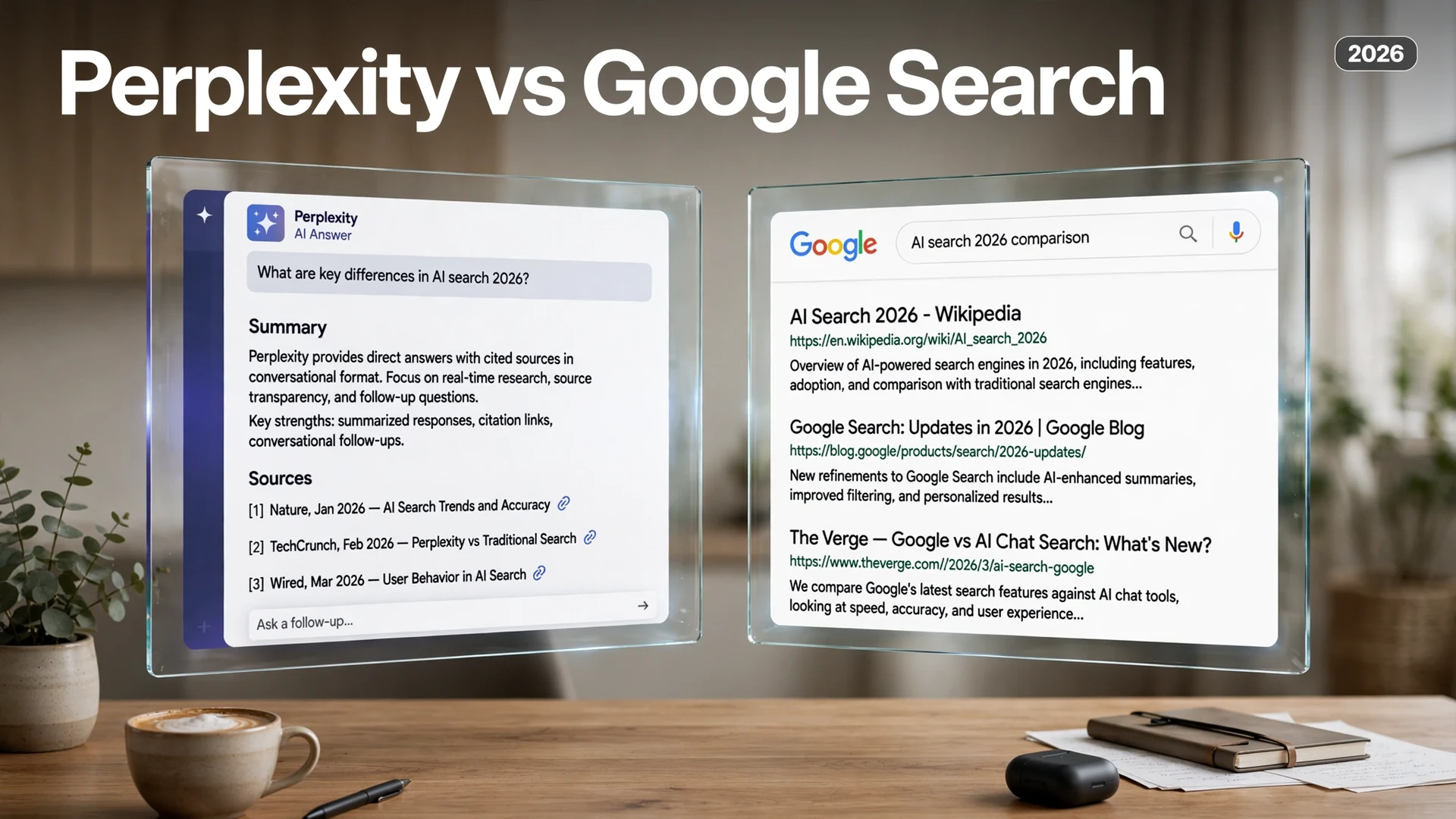
You ask a question in plain language. Perplexity searches the web, reads the top sources, and writes a direct answer with numbered citations you can click to verify. Follow-up questions keep the conversation going, and a Deep Research mode produces long cited reports. It runs on frontier AI models and launched its own AI browser, Comet, in 2025 (free for everyone since October 2025, with mobile apps added in 2026). The free tier is genuinely usable: unlimited quick searches with citations, a few Pro searches per day, and one Deep Research query per month. Pro costs $20 per month ($16.67 on annual billing) for unlimited Pro searches, 20 deep research runs per day, model choice, and Comet Plus premium publisher content. Official site: perplexity.ai.
Google Search: the index, plus AI
Google remains the index of the web: billions of pages, ranked by two decades of refinement, wrapped in the ecosystem — Maps, Images, Shopping, Flights, YouTube — that no answer engine can replicate. In 2026, Google answers the AI challenge with AI Overviews and AI Mode: AI-generated summaries at the top of results, still sitting above the classic link list. Search itself is free, funded by advertising. Official site: google.com.
Head-to-Head: Where Each Wins
Getting a direct answer: Perplexity
This is Perplexity’s home turf. “Why did the Fed hold rates?” returns a synthesized paragraph with citations, not ten links. Google’s AI Overviews attempt the same thing, but they sit awkwardly between two products — sometimes excellent, sometimes a thin summary above the links you actually wanted. For question-answering, Perplexity’s single-purpose design wins clearly.
Citation quality and verification: Perplexity (narrowly)
Perplexity’s numbered inline citations make verification fast: click the number, read the source. Google gives you the sources too, but as a link list you must open and skim yourself. The honest caveat applies to both: AI summaries can misread sources, so click through on anything that matters. Neither tool replaces reading the primary source for high-stakes claims.
Freshness and breaking news: Google
Google’s crawl is the deepest and fastest on the planet. For breaking news, live scores, and events from the last hour, Google’s index plus its news vertical still beat Perplexity’s retrieval. Perplexity is good at “recent,” Google is better at “right now.”
Shopping, local, maps, images: Google (by miles)
This is the part of the comparison that ends the “Google killer” narrative. Product searches with prices and reviews, “near me” local results, Maps navigation, image search, flight tracking — Google’s verticals are entire products that Perplexity does not attempt to replicate. If your search ends in a purchase, a booking, or a place, you are using Google.
Research depth: Perplexity
Perplexity’s Pro Search reads more sources per query than most humans would open, and its Deep Research mode (1/month free, 20/day on Pro) produces cited briefings that rival ChatGPT’s and Gemini’s research modes. For the “understand this topic deeply” job, Perplexity is the stronger tool. For the research-assistant comparison across AI tools, see our ChatGPT vs Gemini breakdown and the AI batch’s research guides.
Ads and commercial bias: Perplexity (for now)
Google Search is an advertising product with search attached — sponsored results, shopping ads, and SEO-gamed content shape what you see. Perplexity’s answers are currently cleaner of commercial pressure, though its publisher partnerships (Comet Plus, $5/month for premium journalism) show the business model is still being built. Enjoy the clean answers while they last; no free product stays ad-free forever.
Privacy: Perplexity (slightly)
Google builds an advertising profile from your searches across its ecosystem. Perplexity collects less and ties it to no ad network. Neither is a privacy tool in the strict sense — if that is the priority, you are looking at a different category entirely.
Comparison: Perplexity vs. Google Search at a Glance
| Feature | Perplexity | Google Search |
|---|---|---|
| Core model | Answer engine: reads sources, gives cited answer | Link index + AI Overviews/AI Mode |
| Direct answers | Excellent — the product’s purpose | Good via AI Overviews, inconsistent |
| Citations | Inline, numbered, click-to-verify | Link list you open yourself |
| Breaking news | Good | Best — deepest, fastest index |
| Shopping / local / maps | Weak — not its job | Best in class |
| Deep research | Strong (Deep Research mode) | Manual — you do the reading |
| Ads in results | Minimal (for now) | Heavy — ads fund the product |
| Price | Free tier; Pro $20/mo | Free (ad-supported) |
When Perplexity Wins
- Research questions: anything starting with “why,” “how,” or “compare” — Perplexity returns the synthesis, not the homework.
- Follow-up chains: conversational refinement (“now compare that to 2023”) is native to Perplexity and clumsy on Google.
- Cited briefings: Deep Research mode produces sourced reports for work and study.
- Ad fatigue: when you are tired of sponsored results and SEO spam between you and the answer.
When Google Still Wins
- Buying anything: shopping results, prices, reviews, local inventory — no contest.
- Going anywhere: Maps, directions, hours, “near me” — Google’s local data is irreplaceable.
- Finding specific pages: navigational searches (“that article on…”, site: queries) favor the index.
- Breaking news and live data: scores, markets, developing stories.
- Images and video: Google Images and YouTube integration remain unmatched.
Can Perplexity Replace Google? The Honest Verdict
No — and that is the wrong question. Perplexity did not replace Google; it replaced a part of Google: the research-shaped queries where you used to open a dozen tabs. What remains with Google is everything transactional and local — the parts of search tied to money and place, which happen to be the parts that fund Google’s business.
The practical setup in 2026 is both, used deliberately: Perplexity for questions, Google for everything else. Start Perplexity free — the free tier covers everyday research — and keep Google as your default for shopping, maps, and news. That split will serve you better than loyalty to either side. For the other AI showdowns in this series, see ChatGPT vs Gemini in 2026 and Midjourney vs DALL-E 3 in 2026, plus Perplexity vs ChatGPT for Research.
FAQs
Not fully. Perplexity has replaced the research-shaped part of Google — questions where you used to open a dozen tabs. But shopping, local results, Maps, images, and breaking news still belong to Google. In 2026 the practical setup is both: Perplexity for questions, Google for everything else.
For direct question-answering, yes — Perplexity reads the sources and synthesizes an answer with citations, while Google gives you links to read yourself. For breaking news and the deepest index, Google is still more comprehensive. Accuracy depends on the query type.
Yes. Perplexity's free tier offers unlimited quick searches with citations, a few Pro searches per day, one Deep Research query per month, and the Comet browser. No credit card required.
Google, by a wide margin. Product searches with prices and reviews, local 'near me' results, and Maps are entire Google verticals that Perplexity does not attempt to replicate.
Perplexity's answers currently carry minimal advertising, unlike Google's ad-heavy results pages. Its business model is still evolving (Comet Plus offers premium publisher content for $5/month), so enjoy the clean answers while they last.
For research and question-answering, start with Perplexity free. Keep Google as your default for shopping, maps, images, and breaking news. Most people end up using both deliberately rather than choosing one.
Final Thought
Perplexity vs Google Search is not a fight to the death — it is a division of labor. Perplexity wins every query where the answer matters more than the links; Google wins everything involving money, maps, and the moment. Use both, and you will search less and find more.