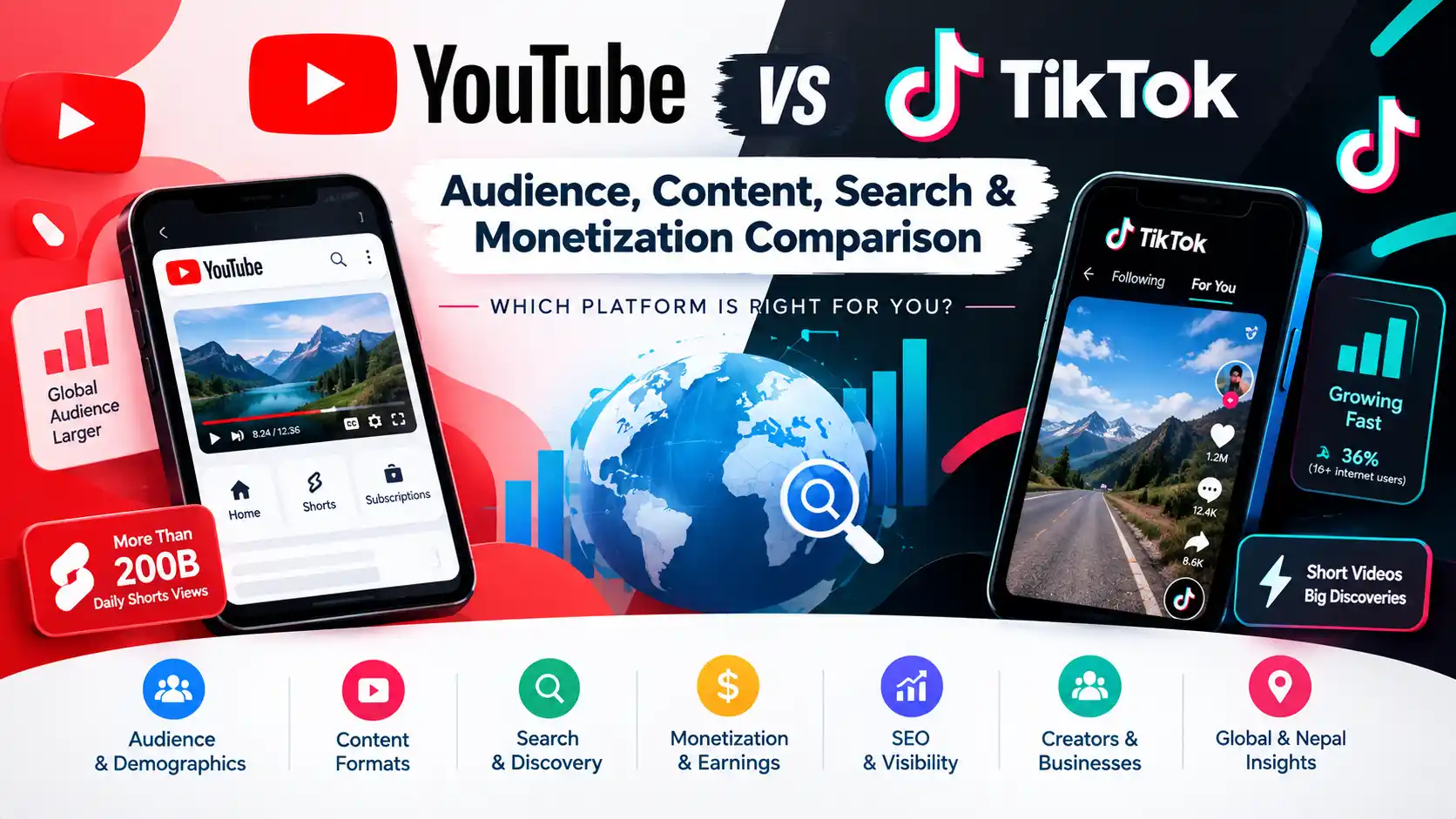
YouTube vs TikTok: Audience, Content, Search & Monetization Comparison

YouTube and TikTok are two of the world’s biggest video platforms, but they are built around different viewing and discovery experiences.
YouTube combines long-form videos, Shorts, livestreams, search, recommendations, podcasts, music, and TV viewing. TikTok is primarily built around short-form vertical video and personalized discovery through its recommendation feed, while also investing heavily in search and creator tools.
So, YouTube vs TikTok is not simply a question of which platform has more users. The more useful comparison is audience behavior, content format, discovery, search, monetization, content lifespan, and the type of creator or business each platform can support.
YouTube vs TikTok at a Glance
| Feature | YouTube | TikTok |
|---|---|---|
| Core format | Long-form + Shorts | Short-form video |
| Search | Strong search ecosystem | Growing search ecosystem |
| Discovery | Search + recommendations + Shorts | Primarily personalized discovery + search |
| Long-form content | Yes | More limited |
| Short-form content | YouTube Shorts | Core TikTok format |
| Livestreaming | Yes | Yes |
| Monetization | Ads, Premium, memberships, fan funding, Shopping and more | Creator Rewards, LIVE features, TikTok One, commerce and other programs |
| Content lifespan | Can continue receiving search/recommendation traffic | Strongly oriented toward fast discovery and trend cycles |
| Best content opportunities | Tutorials, education, reviews, entertainment, podcasts, documentaries, Shorts | Trends, entertainment, short tutorials, reactions, storytelling, product discovery |
| Search-oriented content | Strong | Increasingly important |
| TV viewing | Major platform | Primarily mobile-oriented |
| Creator ecosystem | Long-form + short-form + live | Short-form + live + commerce |
Which Platform Has More Users?
There is no single universally comparable number because YouTube and TikTok publish different types of audience data.
DataReportal’s Digital 2026 Mid-Year Global Update found that 55.3% of internet users aged 16 and above said they had used YouTube during the previous month, compared with 36% for TikTok.
The same report’s Similarweb app data showed YouTube with a substantially larger active app audience than TikTok.
However, these measurements should not be interpreted as exact monthly active-user totals for both platforms because the underlying methodologies are different.
This is an important distinction when comparing social-media statistics: survey usage, active-app users, advertising reach, registered users, and monthly active users are different metrics.
YouTube Audience
YouTube has a broad global audience and is used across smartphones, computers, tablets, smart TVs, and other connected devices.
YouTube’s own press information says the platform has billions of monthly logged-in users, while YouTube Shorts now averages more than 200 billion daily views.
YouTube is also deeply established outside the traditional short-video category. Users can watch:
- Long-form educational videos
- Product reviews
- Tutorials
- Documentaries
- Music
- Podcasts
- News and commentary
- Livestreams
- YouTube Shorts
- Gaming content
- Children’s content
This breadth gives YouTube a different content ecosystem from TikTok.
TikTok Audience
TikTok has become one of the world’s largest short-form video platforms.
DataReportal’s latest global research reports that 36% of internet users aged 16+ said they had used TikTok in the previous month.
TikTok is particularly associated with:
- Short-form entertainment
- Trends
- Challenges
- Music
- Comedy
- Quick tutorials
- Product discovery
- Creator-led storytelling
- Educational clips
- LIVE content
TikTok’s discovery system is heavily centered around personalized content recommendations, although search has become increasingly important.
TikTok itself introduced Creator Search Insights, a tool that shows creators what people are searching for and identifies content-gap opportunities in selected regions.
YouTube vs TikTok: Content Format
The biggest structural difference is content format.
YouTube
YouTube supports several major formats:
- Long-form videos
- Shorts
- Livestreams
- Podcasts
- Community posts
- Music
- TV-oriented viewing
A creator can therefore build a content ecosystem around one topic instead of relying exclusively on short-form videos.
TikTok
TikTok’s identity is much more closely associated with short-form vertical video.
This makes the platform particularly suited to content that communicates an idea quickly:
- Tips
- Reactions
- Trends
- Short stories
- Entertainment
- Product demonstrations
- Quick educational explanations
TikTok also supports longer videos and additional creator features, so it should not be treated as a platform limited to a single video length.
YouTube vs TikTok for Search
Search is an increasingly important part of the comparison.
YouTube has a mature search system. YouTube says its search ranking considers factors including relevance, engagement, and quality, with signals such as how well the title, description, and video content match the query.
YouTube also combines search with personalized recommendations.
This creates opportunities for videos targeting explicit queries such as:
- How to use ChatGPT
- How to edit videos
- Best phones under $500
- How to cook a particular recipe
- WordPress tutorials
- Software comparisons
- Educational lessons
TikTok is also developing its search experience.
TikTok’s Creator Search Insights allows eligible creators in supported regions to discover frequently searched topics and identify content gaps.
This means TikTok is increasingly becoming a search-and-discovery platform, rather than relying exclusively on the For You feed.
YouTube vs TikTok: Discovery
The discovery mechanisms are different.
YouTube discovery can happen through:
- YouTube Search
- Home recommendations
- Suggested videos
- Shorts Feed
- Subscriptions
- Topic and destination pages
- External search
- Google Search
YouTube says its recommendation system uses signals such as watch history, search history, subscriptions, likes, dislikes, viewer feedback, and satisfaction signals.
TikTok’s primary discovery experience is strongly associated with personalized recommendations through its For You feed, while search is becoming increasingly significant.
For creators, this means a video can be discovered because someone actively searched for the topic, because the recommendation system matched it with an interested viewer, or because it became part of a broader trend.
YouTube vs TikTok for Long-Term Content
Long-form content gives YouTube a different content lifecycle.
A tutorial published months or years ago can continue attracting viewers through YouTube Search, Google Search, recommendations, playlists, and related videos.
YouTube explicitly describes Search as a system designed to help viewers find relevant content for their queries.
TikTok can also surface older content, but its ecosystem is particularly strong around current trends, rapid discovery, and short-form consumption.
Therefore, evergreen tutorials, educational content, reviews, and problem-solving videos can have a different lifecycle on YouTube from trend-driven short-form videos.
YouTube vs TikTok for Short Videos
The comparison becomes much closer when comparing YouTube Shorts with TikTok rather than comparing YouTube’s entire ecosystem with TikTok.
Both support vertical short-form video.
Creators can use short videos for:
- Entertainment
- Education
- Tips
- Comedy
- Product demonstrations
- Stories
- Trends
- News-related content
- Audience discovery
YouTube Shorts has become enormous. YouTube currently reports more than 200 billion daily Shorts views.
TikTok, meanwhile, was built around short-form video from the beginning.
YouTube vs TikTok Monetization
Both platforms provide multiple ways for eligible creators to make money, but their monetization systems are structured differently.
YouTube monetization
YouTube’s Partner Program can provide access to:
- Watch Page advertising
- Shorts Feed advertising
- YouTube Premium revenue
- Channel memberships
- Super Chat
- Super Stickers
- Super Thanks
- Shopping features
YouTube’s current published full ad-revenue eligibility threshold is 1,000 subscribers plus either 4,000 qualified public watch hours in the previous 12 months or 10 million qualified Shorts views during the previous 90 days, subject to program policies and review.
YouTube has also announced changes scheduled for February 1, 2027, including new YPP entry thresholds for new creators.
TikTok monetization
TikTok’s monetization ecosystem includes programs and tools such as:
- Creator Rewards
- LIVE-related monetization
- TikTok One
- Brand collaborations
- Commerce opportunities
- Other region-dependent creator features
TikTok’s Creator Rewards Program has eligibility requirements that include being in an eligible region, having a personal account in good standing, being at least 18, having at least 10,000 followers, and receiving at least 100,000 video views in the previous 30 days.
Eligible Creator Rewards videos also need to satisfy content and length requirements.
Availability varies by country.
Does YouTube Pay More Than TikTok?
There is no universal fixed answer based solely on views.
YouTube and TikTok use different monetization systems, and creator earnings depend on factors such as:
- Audience country
- Content category
- Video format
- Advertiser demand
- Viewer behavior
- Monetization eligibility
- Qualified views
- Sponsorships
- Affiliate sales
- Commerce
- Memberships
- Other revenue sources
YouTube does not publish a universal average RPM that applies to every creator.
Similarly, TikTok’s Creator Rewards payments vary according to qualifying factors and program rules.
Therefore, claims such as “1 million YouTube views always earns X dollars” or “1 million TikTok views always earns Y dollars” should be treated cautiously.
YouTube vs TikTok for Businesses
Businesses can use both platforms, but the content strategy can differ.
YouTube can support
- Product demonstrations
- Detailed reviews
- Tutorials
- Webinars
- Educational content
- Podcasts
- Case studies
- Search-driven content
- Long-form brand storytelling
- Shorts
TikTok can support
- Short product demonstrations
- Trends
- Creator collaborations
- Quick tutorials
- Product discovery
- Behind-the-scenes content
- Customer-focused storytelling
- Short educational content
- LIVE experiences
The appropriate platform depends on the audience, product, content resources, and business objective.
YouTube vs TikTok for SEO
For a website owner or SEO professional, YouTube has an important advantage: video content can participate in a broader search ecosystem.
YouTube itself has a dedicated search-ranking system, and videos can also appear in Google Search.
This makes YouTube particularly relevant for search-oriented content such as tutorials, guides, reviews, comparisons, and how-to videos.
TikTok should not be ignored for search.
TikTok’s investment in Creator Search Insights demonstrates that the platform is actively building tools around search demand and content gaps.
For creators, a useful strategy is to research the actual questions people ask and then create content that directly satisfies those questions on the appropriate platform.
YouTube vs TikTok for Different Content Types
| Content Type | YouTube | TikTok |
|---|---|---|
| Long tutorials | Strong fit | Possible, but different format |
| Short tutorials | Shorts | Strong fit |
| Product reviews | Strong fit | Strong fit |
| Educational content | Strong fit | Strong fit |
| Comedy | Strong fit | Strong fit |
| Trends | Shorts + regular videos | Strong fit |
| Podcasts | Strong ecosystem | Short clips/discovery |
| Gaming | Strong ecosystem | Short clips/highlights |
| Documentaries | Strong fit | Less traditional |
| Product discovery | Strong | Strong |
| Search-driven guides | Strong | Increasingly relevant |
| Livestreams | Strong | Strong |
YouTube vs TikTok in Nepal
Nepal is an important GEO angle for this comparison.
DataReportal’s Digital 2026 Nepal report says Nepal had 16.6 million internet users at the end of 2025, representing 56.0% of the population, and 14.8 million social-media user identities in October 2025.
The report also emphasizes that platform audience figures can represent different things and should not automatically be treated as unique active users.
For a Nepal-focused creator or business, the practical question is therefore not simply “Which platform has more users?”
Instead, consider:
- Where your target Nepalese audience spends time
- Whether your content is primarily short or long form
- Whether people search for your topic
- Whether your target audience watches on mobile or TV
- Whether you need long-term search traffic
- Which monetization features are available in Nepal
- Whether your content depends on trends
- Whether you can consistently produce videos for the platform
YouTube vs TikTok: Which Content Strategy Works?
Instead of treating the platforms as mutually exclusive, creators can assign each platform a different role.
For example:
YouTube: publish the complete tutorial, review, guide, or story.
YouTube Shorts: turn important sections into short discovery-focused videos.
TikTok: create native short-form versions designed for fast discovery and TikTok’s audience behavior.
The content should still be adapted to each platform rather than simply copying the exact same video everywhere.
Frequently Asked Questions
Available third-party measurements indicate that YouTube has a larger overall audience than TikTok, but exact numbers depend on the definition and data source. DataReportal’s 2026 GWI data found monthly self-reported usage of 55.3% among internet users aged 16+ for YouTube versus 36% for TikTok.
TikTok was built around short-form video and remains strongly associated with this format. YouTube also has a major short-form ecosystem through YouTube Shorts.
YouTube has a much more established long-form video ecosystem, including tutorials, reviews, documentaries, podcasts, livestreams, and educational content.
Yes. Both platforms provide monetization programs and other revenue opportunities, but eligibility and available features vary by country and account.
Yes. TikTok has search functionality and has introduced Creator Search Insights to help creators understand what people are searching for and identify content gaps in supported regions.
YouTube has a mature video-search system that explicitly considers relevance, engagement, and quality. TikTok is also investing in search and search-driven discovery.
The platforms report different metrics, so direct comparisons require caution. YouTube currently reports more than 200 billion daily Shorts views, but that figure is specifically for Shorts and should not be compared directly with a total TikTok platform view count.
Final Takeaway
YouTube and TikTok serve overlapping but different roles in online video.
YouTube combines search, recommendations, long-form video, Shorts, livestreaming, podcasts, TV viewing, and multiple monetization options.
TikTok is strongly centered on short-form discovery while increasingly investing in search, creator tools, commerce, and monetization.
The most useful comparison therefore depends on the objective.
For creators and businesses, evaluate content format, audience behavior, search demand, discovery, monetization availability, geography, and content lifespan rather than relying on a single user-count statistic.
For Nepal-focused creators, the same principle applies: use current local audience data and platform availability rather than assuming global statistics represent Nepal exactly.