Lovable vs Bolt: Which AI App Builder Is Better?

Lovable is the better AI app builder for most people who want a polished, working web app from a prompt — database, logins, and hosting included, with almost no setup. Bolt is the better buy for developers who want to see and steer the code, pick their own framework, and build mobile apps too. They charge the same $25 a month at the entry level, but they meter completely differently: Lovable sells credits per task, Bolt sells tokens per project size, and for a team of three the bill can be $25 or $90 depending on which one you pick.
I checked both products on their own pricing pages and worked the same jobs through each meter: a first version of a small app with a landing page and logins, and a month of building for a three-person team. Lovable’s Pro plan gives you 100 credits a month; a landing page costs 1.70 credits and adding authentication costs 1.20, by Lovable’s own published examples — so one $25 month covers roughly eight or nine such first versions. Bolt’s Pro plan gives you 10 million tokens a month and does not publish a per-build token figure, because its meter scales with the size of your project. The prices below are the standard rates from each company’s pricing page, read on November 22, 2026.
Lovable vs Bolt at a glance
| Lovable | Bolt | |
|---|---|---|
| What it is | AI app builder for polished full-stack web apps, from Stockholm, founded 2023 | In-browser AI app builder by StackBlitz, built on WebContainers |
| Where it runs | Hosted cloud workspace — your project lives on Lovable’s servers | Entirely in your browser tab — a real Node environment runs locally via WebAssembly |
| Stack it generates | React, Vite, Tailwind, Supabase — one fixed stack | Framework-agnostic — React, Vue, Astro, and more, your choice |
| Backend | Lovable Cloud built in, powered by Supabase — database, auth, storage, hosting | Bolt Cloud built in, or your own Supabase or other database provider |
| How it meters usage | Credits per task — 0.50 to 1.70 depending on complexity; Plan Mode is 1 credit per message | Tokens — scales with project size, not a flat per-message rate |
| Entry paid price | Pro $25 a month — 100 credits | Pro $25 a month — 10 million tokens |
| Annual billing | 2 months free on yearly plans | Save up to 28% — Pro works out to about $18 a month |
| Free tier | 5 build credits a day, up to 30 a month, plus 20 Cloud credits a month | 1 million tokens a month, with a 300,000 daily cap |
| Team pricing | Unlimited users on every paid plan — Pro $25 flat, Business $50 flat | Pro allows unlimited collaborators on one shared pool; Teams is $30 a month per member |
| GitHub | Two-way sync — changes flow both ways | One-way export or ZIP download |
| Mobile apps | Web apps only | Native mobile apps via the Expo integration (React Native) |
| G2 rating | 4.6 out of 5 from 456 reviews | 4.3 out of 5 from 95 reviews |
What is the real difference between Lovable and Bolt?
The difference is where the work happens, and who the tool is built for. Lovable is a hosted product: you describe an app in a chat box, Lovable’s AI builds it in the cloud, and you get a live URL. The stack is fixed — React, Vite, Tailwind, and Supabase — and the backend comes with the product. Lovable Cloud provisions the database, authentication, storage, and hosting for you, so a non-developer never has to choose infrastructure. That is the whole point of the product: the fastest path from an idea to a working full-stack app, with the decisions already made.
Bolt is a development environment that happens to live in a browser tab. It runs on StackBlitz’s WebContainers, which compile Node.js to WebAssembly, so the app actually executes on your machine — file tree, terminal, packages, and live preview, all in the tab, with no server to wait on and no local setup. You pick the framework, you see the code as it is written, and you can edit any file directly. Bolt Cloud adds built-in databases, auth, storage, and hosting, but you can also bring your own database provider — Bolt does not lock you to one backend the way Lovable does.
The scale of the two companies tells the same story from the other side. Lovable, founded in Stockholm in 2023 by Anton Osika and Fabian Hedin out of the open-source GPT Engineer project, passed $600 million in run-rate revenue in September 2026 and was valued at $13.3 billion after a $400 million Series C in August 2026, with more than 70 million projects created and apps built on it receiving over 900 million visits a month (AI Magazine, October 2026). Bolt, launched by StackBlitz with a single tweet in October 2024, went from zero to about $40 million in annual recurring revenue in five months — one of the fastest software ramps on record — and StackBlitz raised a $105.5 million Series B in January 2025 at roughly a $700 million valuation. Bolt has published no updated revenue figure in 2026, so that $40 million is the last widely cited number, not a current one. Lovable is the bigger business by a wide margin; Bolt is the developer’s tool with the deeper technical moat.
How much do Lovable and Bolt cost?
Lovable’s pricing, checked on its own pricing page: Free $0, with a daily grant of 5 build credits (up to 30 a month) plus 20 Cloud credits a month, unlimited collaborators, 5 lovable.app domains, and invite-only publishing for up to 10 people. Pro is $25 a month with 100 monthly credits, unlimited users, credit rollover for one month on monthly plans, on-demand credit top-ups, unlimited lovable.app domains, custom domains, user roles and permissions, per-member credit limits, removing the Lovable badge, and email support. Business is $50 a month with the same 100 credits — the extra $25 buys governance, not capacity: a team workspace, role-based access, workspace-only publishing, single sign-on, a security center, design templates, and priority support. Enterprise is a custom platform fee with volume-based pricing. Yearly billing gives 2 months free, and students get up to 50% off Pro.
Bolt’s pricing, checked on its own pricing page: Free $0, with 1 million tokens a month and a 300,000 daily cap, public and private projects, up to 3 collaborators, Bolt branding on published sites, unlimited databases, and website hosting. Pro is $25 a month with 10 million tokens a month, rollover included, your own domain with no Bolt branding, unlimited collaborators, expanded database capacity, a choice of database provider, access to the newest AI models, Connectors and MCPs, and SEO boosting for published sites. Teams is $30 a month per member, adding shared capacity, centralized billing, team-level access management, granular admin controls, user provisioning, organization-wide sharing, private npm registries, design-system knowledge, and priority support. Enterprise is a custom annual contract with SOC 2 Type II, single sign-on, data governance, unlimited tokens priced by consumption, and 24/7 support. Yearly billing saves up to 28%, which puts Pro at about $18 a month.
Both companies are SOC 2 Type II certified. Lovable also lists ISO 27001 on its security page; Bolt lists GDPR and CCPA compliance. Neither product’s entry plan is meaningfully cheaper than the other’s — the pricing decision is about the meter and the seats, which is where the two diverge.
What does $25 actually buy on each?
On Lovable, you can work the answer out exactly, because Lovable publishes what each kind of task costs. In Default Mode, a small style change such as making a button gray costs 0.50 credits, removing a footer costs 0.90, adding authentication with sign-up and login costs 1.20, and building a landing page with images costs 1.70. In Plan Mode, every message costs a flat 1 credit. Take a typical first version of a small app — a landing page (1.70), authentication (1.20), and a dozen small fixes averaging 0.70 credits each (8.40) — and you spend about 11.30 credits. A $25 Pro month with 100 credits covers roughly eight or nine such first versions, or about 200 single-line tweaks at 0.50 credits each, or exactly 100 Plan Mode messages. Unused monthly credits expire two months after they are issued, and top-up credits last twelve months.
On Bolt, you cannot do the same math, and that is itself a difference worth knowing before you pay. Bolt does not publish a per-build token figure: its pricing page says tokens are consumed when Bolt reads your prompts and project files, makes a plan, or writes code, and that the amount scales with the size of your project. A prompt on a small landing page costs a fraction of what the same prompt costs on a large app with dozens of files, because Bolt re-reads the project each time. The hard numbers are the caps: 10 million tokens a month on Pro, with unused tokens rolling over, against 1 million a month on the free plan with a 300,000 daily cap. If you want predictable per-task pricing, Lovable’s credits are easier to budget; if you build small projects and iterate fast, Bolt’s token pool stretches further than it looks, because small projects are cheap to re-read.
The free tiers tell the same story in miniature. Lovable’s free plan gives you 5 build credits a day, capped at 30 a month — enough for one small app a week, and then you wait. Bolt’s free plan gives you 1 million tokens a month with a 300,000 daily cap, which is the more generous trial in the category: you can build and rebuild several real projects before the meter forces a decision. If you only need to test, start on Bolt’s free tier — it lasts longer. If you already know you will build every week, Lovable’s $25 Pro is the cheaper habit to keep, because its credits roll over for a month and its daily grants stack on top.
What does a 3-person team pay?
This is where the $25 tie breaks. Lovable charges per workspace, not per seat: Pro is $25 a month flat with unlimited users, and Business is $50 a month flat with unlimited users. Three people building together on Lovable Pro pay $25 a month between them, sharing one 100-credit pool, and the step up to Business buys single sign-on and role-based access, not more credits. Bolt charges per member on its team plan: Teams is $30 a month per member, so three people pay $90 a month, with each member getting their own 10-million-token allotment plus centralized billing and admin controls.
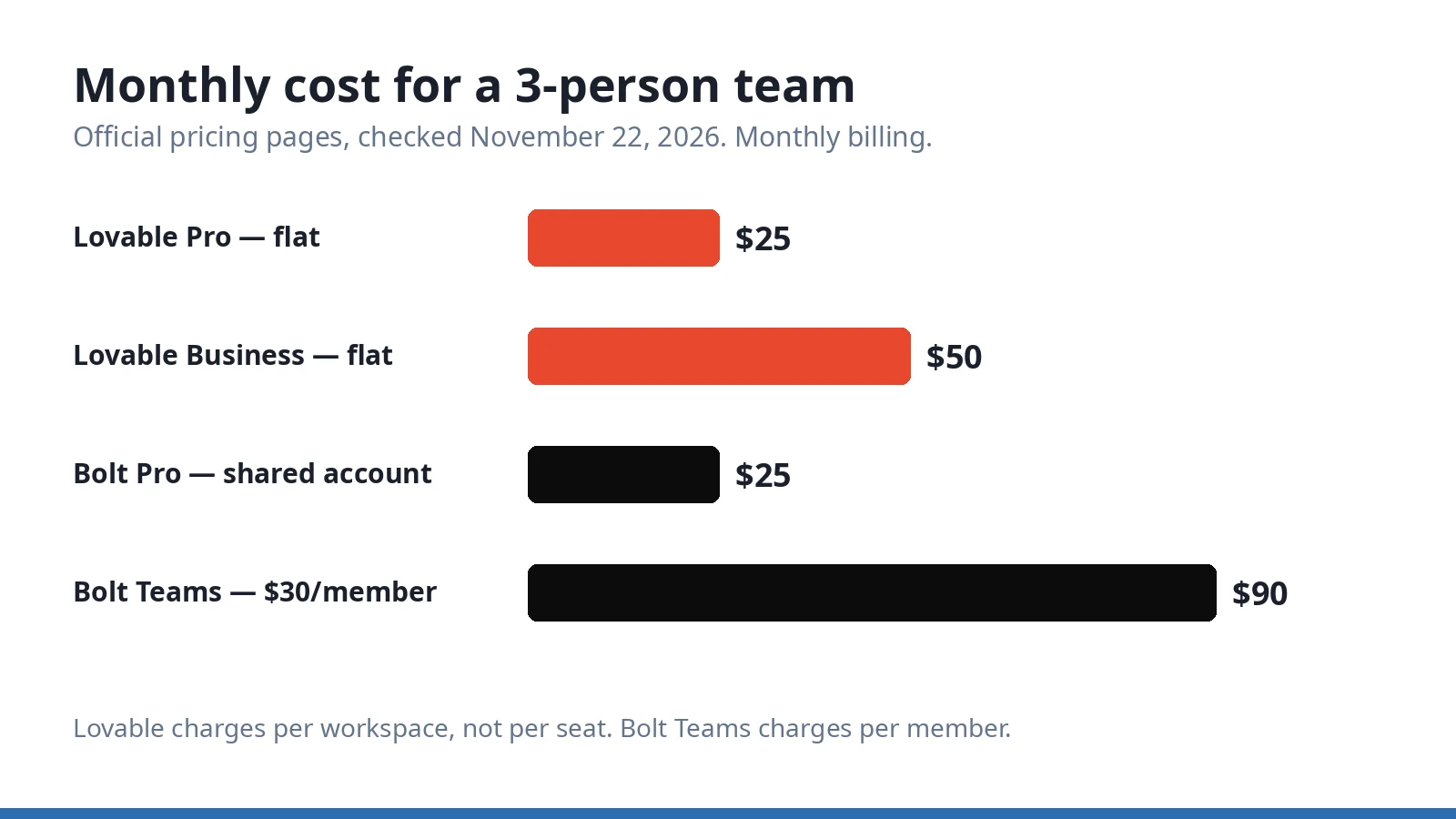
There is one nuance that saves Bolt teams money: Bolt’s Pro plan allows unlimited collaborators on a single $25 account, so three people can share one Pro subscription and one 10-million-token pool for $25 a month — the same as Lovable Pro. What you give up is control: no per-member token allotments, no centralized billing, no team-level access management, and no audit trail. The honest comparison is $25 shared-and-informal on either product, $50 for Lovable Business with governance included, or $90 for Bolt Teams with governance plus a separate token pool per person. For a solo builder, the team question is moot and the two are tied at $25; for a real team, Lovable is decisively cheaper unless you need Bolt’s per-member pools.
Which is better for non-developers?
Lovable, clearly. The fixed stack is a feature when you cannot judge infrastructure trade-offs: you never choose a framework, a database, or a host, because Lovable already chose React, Tailwind, and Supabase for you. Plan Mode shows you what it intends to build before it writes code, so you can catch a wrong assumption before any credits are spent — a September 2026 update to Lovable’s chat also added researching ideas, drafting documents, inspecting existing apps, and querying your Lovable Cloud database in plain language. The output is consistently more polished out of the box: reviewers and head-to-head testers keep landing on the same finding, that Lovable’s first version needs less cleanup to look presentable. That shows in the ratings too — Lovable holds 4.6 out of 5 on G2 from 456 reviews, against Bolt’s 4.3 from 95 reviews (checked October 2026).
Lovable is also the safer place to keep a real project. Its two-way GitHub sync means changes flow in both directions: you can hand the code to a developer, they can push fixes, and Lovable picks them up. Bolt’s GitHub support is one-way export or a ZIP download — you can take your code out, but the round trip is manual. If you are a founder building your first product, Lovable’s combination of a built-in backend, two-way sync, and a polished first draft is the reason it is the default recommendation. My Lovable review goes deeper on the one big catch — the credit meter — and my vibe-coding setup guide walks through the workflow from a first prompt to a deployed app.
Which is better for developers?
Bolt, just as clearly. The in-browser environment is the product: a file tree, a terminal, and a live preview from the first prompt, with the code visible and editable at every step. You choose the framework instead of accepting one, you can wire in any database provider, and Connectors with MCP support let Bolt read and write to tools like Notion, Linear, and GitHub. In September 2026 Bolt added a third agent, Forge, built on open-weight models with its own token pool, alongside its standard agents. When a build goes wrong — and on both tools it will, eventually — Bolt lets you open the file and fix it yourself instead of spending credits re-prompting. That is why developers who already read code prefer it, and why Lovable projects often graduate to a real editor once they outgrow prompting.
The trade-off is that Bolt asks more of you. Its first drafts need more prompting and cleanup to look presentable, and its token meter punishes large projects: every prompt re-reads the codebase, so the bigger your app gets, the more each fix costs. Non-developers hit this wall as confusion — the tool shows you files and errors you did not ask for. Developers hit it as a budget line they can see and manage. If you write code, or you work with someone who does, Bolt’s control is worth the rougher edges. If you want to compare the coding side more deeply, my Claude vs Gemini for coding comparison covers the AI pair-programming tools that many Bolt users run alongside it.
Can either build a mobile app?
Only Bolt. Through its Expo integration, Bolt can build React Native apps that run on iOS and Android — you describe the app, Bolt scaffolds the mobile project, and you publish outside Bolt. Lovable builds web apps only; there is no native mobile output, and a Lovable app on a phone is a website in a browser, not an app in a store. If a mobile app is on your roadmap at all, this one difference settles the choice regardless of price: pick Bolt. If you only need a web app, ignore this section entirely — it is the one category where Lovable has nothing to offer and Bolt wins by default.
Which should you pick: Lovable or Bolt?
Pick Lovable if you are a non-developer or a founder who wants a polished, working web app with a database and logins, built fast, with almost no decisions to make — and especially if you are building with a team, where its flat $25 or $50 a month beats Bolt’s $30 per member by a wide margin. Pick Bolt if you write code or work closely with someone who does, if you want to choose your framework and database, if you need to see and edit the code directly, or if you need a native mobile app through Expo. For one person building alone, the entry price is a tie at $25, so choose on the work: Lovable for polish and a backend that just exists, Bolt for control and the code in your hands.
If you do both jobs — say, you prototype landing pages for clients and also ship a mobile app — Bolt is the safer single subscription, because Lovable cannot build mobile at all and Bolt can still produce a decent web app. The reverse is not true: Lovable cannot replace Bolt’s code control or its framework choice. And if you are still deciding whether to pay at all, start with Bolt’s free tier: its 1 million tokens a month let you build real projects, while Lovable’s 30 credits a month run out after a week of serious building.
How I checked this: every price, limit, and feature above comes from the two companies’ own pricing and product pages, read on November 22, 2026 — Lovable’s pricing page and security page, and Bolt’s pricing page and homepage. The company numbers (Lovable’s $600 million run rate and $13.3 billion valuation; Bolt’s $40 million ARR in five months) come from company reporting covered by AI Magazine, Sacra, and Lenny’s Podcast, and the G2 ratings are from October 2026. I did not run a signed-in build on either product for this comparison, so the per-task credit figures are Lovable’s own published examples and the token behavior is from Bolt’s own documentation — not from my own metered builds. Prices change; the standard rates are quoted here, and both companies change their meters often enough that you should confirm the current numbers on each vendor’s pricing page before you commit.
Frequently asked questions
For most people, yes — Lovable produces more polished first versions, includes a Supabase backend with no setup, and charges a flat price no matter how many people use it. Bolt is better for developers who want to see and edit the code, choose their framework, or build a mobile app. Choose by the job: polish and a backend, or control and mobile.
For one person, they cost the same: both entry plans are $25 a month, and annual billing is about $21 a month on Lovable (2 months free) versus about $18 a month on Bolt (up to 28% off). For a team, Lovable is cheaper — $25 or $50 flat with unlimited users, against Bolt Teams at $30 a month per member, which is $90 for three people.
Only with Bolt. Its Expo integration builds React Native apps for iOS and Android. Lovable builds web apps only — a Lovable app on a phone is a website in a browser, not an app in a store. If you need a native mobile app, Bolt is the only choice of the two.
Yes, both. Lovable’s free plan gives 5 build credits a day, up to 30 a month, plus 20 Cloud credits a month. Bolt’s free plan gives 1 million tokens a month with a 300,000 daily cap. Bolt’s free tier lasts longer for real building; Lovable’s runs out after about a week of serious use.
Yes, both let you own your code, but the round trip differs. Lovable offers two-way GitHub sync, so a developer’s fixes flow back into your Lovable project. Bolt offers one-way export to GitHub or a ZIP download — you can take the code out, but changes made outside do not sync back automatically.
Lovable. Its fixed stack means you never choose a framework, database, or host, its Plan Mode shows you the plan before it builds, and its first versions need less cleanup to look presentable. It also rates higher on G2 at 4.6 out of 5 from 456 reviews, against Bolt’s 4.3 from 95 reviews (checked October 2026).