Lovable AI Review: Fast, Impressive — and One Big Catch

Lovable is the fastest way I have found to turn a plain-language idea into a working web app with a real database, a login system, and a live URL — no code required. It is also the AI app builder with the most uncomfortable fine print in its category: credits that burn faster than the sticker price suggests, and a November 2026 security study that found thousands of Lovable-built apps exposing their databases to anyone who asked. This review weighs both sides. The speed is real, the catch is real, and whether Lovable is worth $25 a month depends entirely on what you build with it.
The verdict: Lovable is the best AI app builder for a non-technical founder who needs a working prototype or internal tool this week. It is not a safe place to ship an app that holds real customer data until you understand its security model — and it is not cheap once you move past a simple build. Buy Pro for a project with a deadline; stay on the free plan for experiments.
Lovable AI Review at a Glance
| Aspect | Lovable |
|---|---|
| What it is | AI app builder: a plain-language prompt becomes a full-stack React web app with a Supabase backend, authentication, and hosting |
| Starts at | $0 (5 build credits a day); Pro from $25 a month |
| Best for | Non-technical founders, product managers, and small teams shipping an MVP, prototype, or internal tool fast |
| Ratings | Trustpilot 4.2 out of 5 (about 1,900 reviews); G2 4.6 out of 5 (364 reviews); Product Hunt 4.7 out of 5 (212 reviews) |
| Biggest strength | Speed to a working app — database, login, and payments wired in, not just a pretty front end |
| Biggest catch | Credit burn, and the security record: thousands of Lovable apps shipped with open databases |
How I Checked Lovable for This Review
I did not run a live signed-in Lovable session for this review, so nothing here is presented as a hands-on test I performed. Instead, I checked Lovable’s own documentation and pricing pages, read hands-on reviews from builders who ran real projects through it, and pulled its public ratings from Trustpilot, G2, and Product Hunt with check dates. Pricing and plan details were re-verified against Lovable’s documentation and four independent pricing guides checked in November 2026. Where a claim comes from a reviewer or a study rather than from Lovable itself, I say so.
What Is Lovable?
Lovable is an AI app builder from Stockholm, founded in 2023 by Anton Osika and Fabian Hedin. It grew out of Osika’s open-source GPT Engineer project, and it keeps that project’s core idea: you describe what you want in plain language, and the AI writes the software. What changed is the scope. Lovable does not generate a snippet or a mockup. It generates a working web application — a React front end, a Supabase back end with a PostgreSQL database, authentication, file storage, and a live URL — and it keeps iterating on it through a chat window until you are happy with the result.
The scale is hard to ignore. Lovable reports more than 50 million projects built on the platform, with 1.2 million new ones every week, and says around 80% of its builders are non-technical. Investors have noticed: the company raised a $330 million Series B in December 2025 at a $6.6 billion valuation, then a $400 million Series C in August 2026 at a $13.3 billion valuation, led by Menlo Ventures and the Scaleup Europe Fund. On paper, the platform is enterprise-ready, with SOC 2 Type II and ISO 27001:2022 certifications and GDPR compliance. The question this review answers is whether the product lives up to the pitch for an ordinary builder — and what it costs when it does not.
How Lovable Works: Chat, Plan, and Build Modes
Every Lovable project runs through a chat window with a mode picker, and the mode decides how much the agent is allowed to change. Chat mode answers questions about your app, helps you think through what you want, and changes nothing. Plan mode investigates your project first — it can search files, inspect logs, and send out research subagents — then writes a plan you can edit and approve before anything is built. A Plan mode message costs one credit plus any research it runs, which makes it the cheapest insurance on the platform. Build mode, formerly called Agent mode, is the default: you describe a feature, and the agent explores the codebase, edits files across the front end and back end, reads build errors and console output to fix its own mistakes, and ends with a summary. A single Build mode message can run for up to 10 hours, and goal runs keep working until a target you set is reached — with a warning from Lovable’s own docs that goals can use many credits.
Agent mode started as a beta in June 2025 and became the default within weeks. Lovable claims it cut errors on complex tasks by 91% compared with the old one-pass approach. You do not pick a model: Lovable routes each kind of work to whichever model does it best, and by August 2026 its own post-trained models were handling a meaningful share of app-building work in production. Projects created since May 2026 use a TanStack Start template that renders pages on the server, which helps search engines and link previews — a quiet but real advantage over builders that ship client-rendered pages.
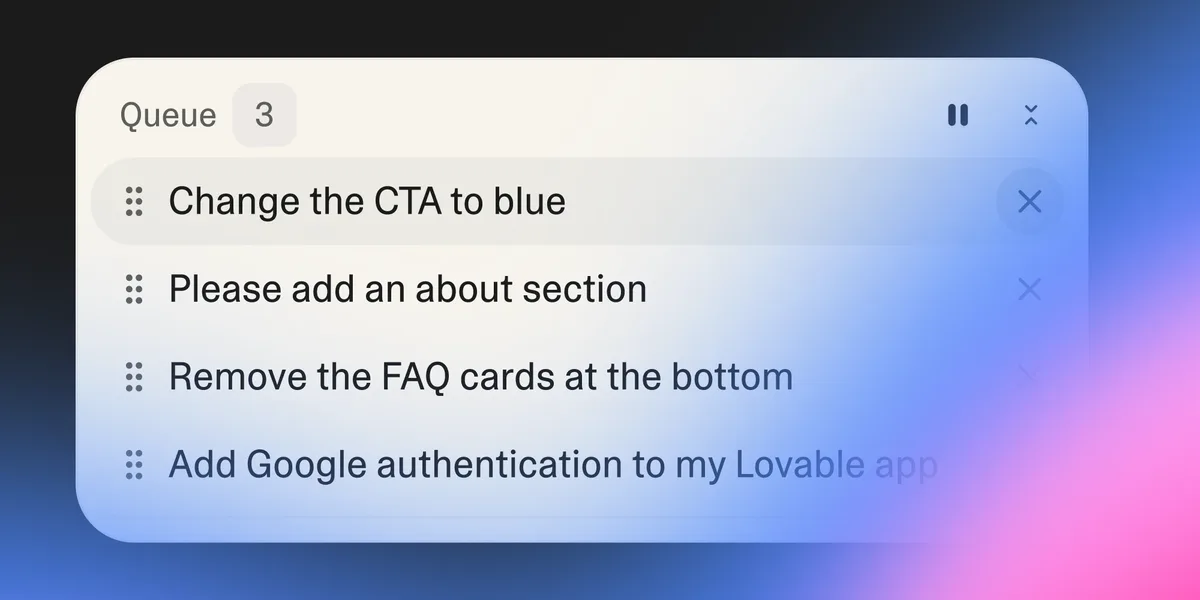
Lovable 2.0, launched in April 2025, is the version most people use today. It added shared workspaces with real-time collaboration for up to 20 people, the agentic Chat mode, a Security Scan that runs when you publish, custom domains you can buy inside Lovable, and Dev Mode, which lets you edit the generated code directly. Visual Edits lets you click on any element in the preview and change text or styling without writing a prompt. There are also iOS and Android companion apps for queuing prompts on the go, a desktop app, a Slack integration, and an MCP server that lets other AI assistants work with your Lovable projects.
What Lovable Does Well
It is fast to something that actually works. The consistent finding across hands-on reviews is speed: type a description, and in a few minutes you have a clickable app with a database, login, and live link, not a screenshot of one. One reviewer who built a bill-splitting app through Lovable called the jump from idea to something clickable the fastest in the category. That speed is the whole product. If your job is to show a working prototype in a meeting tomorrow, nothing else in this category gets you there sooner.
The back end is real, not a demo. Lovable provisions a genuine Supabase project for your app — real PostgreSQL, real authentication with sign-up, login, password reset and OAuth, real file storage — and Stripe checkout comes preconfigured. That matters because the most common failure of AI app builders is an app that looks finished and collapses the moment a second user signs in. Lovable Cloud, the built-in back end, means a simple project needs no separate Supabase account at all.
You keep the code. Your project syncs to GitHub, GitLab, or Bitbucket, and Pro lets you download the code and edit it in Dev Mode. The code is standard React, not locked inside a proprietary runtime, so the moment the AI gets stuck, a developer can take over in a familiar editor. That exit ramp is the difference between a prototype tool and a platform you can build a business on — and it is the feature reviewers praise most after speed.
Plan mode saves more money than any discount. The single best habit on Lovable is planning before building: one credit for a plan you can edit, instead of ten credits of rework when the agent builds the wrong thing. Chat mode is free in the same sense — it costs nothing to ask the agent how your app works before you spend a Build credit changing it.
Teams and governance are genuinely built in. Shared workspaces, roles and permissions, per-member credit limits, audit logs, single sign-on on the Business plan, and an EU inference option for AI requests. That is why companies like eXp Realty and The Scion Group run internal tools on it. For a solo builder none of this matters; for a team deciding whether Lovable is a toy or a tool, it is the difference.
Where Lovable Struggles
Credits burn fast, and that is the number one complaint. Across Trustpilot, Reddit, and G2, the recurring grievance is the same: the credit balance disappears faster than expected, especially once you move past a simple build. Every fix for something the AI got wrong costs more credits, and since June 2026 the same credit pool pays for building, hosting, and the AI features inside your live app — so the meter keeps running after launch. On Trustpilot, 16% of reviews are one-star, and credit cost is the most common theme in them, followed by bugs and slow support.
Complex logic is where the AI starts guessing. Reviewers converge on the same failure pattern: Lovable is excellent at scaffolding and visual work, and shaky once the logic gets specific. Multi-step forms, state management across pages, and authentication edge cases are where the output degenerates after three or four iterations — the interface looks right while the underlying behavior is fragile. If your app is mostly forms and dashboards, expect to finish the last 20% yourself, in Dev Mode or in your own editor.
Debugging loops are expensive in both senses. When the agent breaks something, it usually fixes it — and charges you for the attempt. Builders report loops where each fix introduces a new error, and each error costs credits. Plan mode and small, single-feature prompts are the defense, but there is no way to make the agent’s mistakes free.
Support is the second most common complaint. One-star reviews repeatedly mention slow responses and billing disputes, including charges after cancellation and accounts closed without a clear explanation. Paid plans get email support; free users get the docs assistant and the community Discord. If you are running a business on Lovable, that gap is worth knowing before you need help at midnight.
What you build is a web app, not a native app. Lovable builds websites and web applications. There is no native iOS or Android output, and mobile layouts, while improved, are still the weakest part of the generated front end according to practitioner reviews. If your product has to live in an app store, Lovable is the wrong tool.
The Security Catch: What the November 2026 Study Found
This is the section that decides whether Lovable is right for you, so it deserves the detail. In November 2026, German security firm Crissy Field, working with the newspaper Handelsblatt, published research on AI-built apps. The researchers pulled 159,041 Lovable projects created between December 2025 and September 2026 out of Common Crawl, the open web archive. Of those, 34,545 used Supabase as their back end. On 24,664 of them — more than 70% of the Supabase-backed apps — database records came back to the browser as soon as the page loaded, with no login and no interaction. Using the same public key the app itself ships to every visitor, the researchers then found records containing email addresses in 10,560 tables across 7,403 sites. The worst cases were not theoretical: one service provider exposed more than 1,000 identity records with passport numbers, expiry dates, and nationalities; one lifestyle forum exposed more than 200,000 private chat messages and 80,000 user profiles; one app exposed about 280,000 customer emails. (Cybernews)
Read those numbers honestly, because the researchers were explicit about the limits. Thirty percent is not a confirmed leak rate for all Lovable apps: the sample is not representative, some email addresses are public contact or test data, and records without an email address were not counted. The researchers could not establish whether any exposed data was misused, and the record counts are a floor, not a total — only part of each dataset was retrieved. And this was not a hack of Lovable’s systems. The researchers used read-only requests with the same public key the app already hands to the browser. The root cause is Row Level Security left off in the app’s Supabase database, with the public anonymous key doing the rest.
That framing matters, and so does the history. The same class of bug had already been disclosed eight months earlier as CVE-2025-48757: in March 2025, a security researcher scanned 1,645 Lovable showcase sites and found 170 with database tables open to anonymous reads. The vulnerability carried a CVSS score of 9.3 out of 10. Lovable added a Security Scanner and an AI Security Reviewer after that disclosure — and the exposure repeated at a larger scale in November. Lovable’s response to the new study is that the issue reflects a wider database setup problem affecting Supabase users, not a flaw in Lovable itself. That is technically fair. It is also beside the point for a buyer: Lovable’s entire pitch is that non-technical people can ship software, and around 80% of its builders are non-technical. The security setup lands on exactly the people least equipped to spot it.
What to do before you publish anything that holds user data:
- Run Lovable’s Security Scan before every publish. It flags missing Row Level Security policies and exposed data. Lovable’s own docs say the scan does not guarantee complete security, so treat it as a floor, not a verdict.
- Turn on Row Level Security on every Supabase table, with a policy for each table that says who can read and write what. No exceptions, including tables that look harmless.
- Never put real customer data in an app until the scan is clean and you have opened the live app in a logged-out browser to check what loads.
- Keep secrets out of the front end. API keys and credentials belong in Lovable’s secrets handling, never hardcoded where the browser can read them.
- If you already shipped a Lovable app, re-check it now. The November study shows the problem is still widespread, and the fix is a configuration change, not a rebuild.
For a prototype, a landing page, or an internal tool with no personal data, none of this is a reason to avoid Lovable. For anything that stores names, emails, orders, or messages from real people, it is the first thing to get right — before you worry about the design.
Lovable Pricing: What $25 Actually Buys
Lovable’s sticker price is simple. Its real price is a credit balance, and since June 2026 one balance pays for building your app, hosting it, and running the AI features inside it. Prices below are from Lovable’s pricing page and documentation, as checked by independent pricing guides in November 2026. Credit rules change often, so confirm the current figures on Lovable’s pricing page before you pay.
| Plan | Price | Credits | What you get |
|---|---|---|---|
| Free | $0 | 5 build credits a day, capped at 30 a month, plus 20 Cloud and 4 AI grants a month | Try Lovable and build small prototypes; no custom domain, no credit top-ups |
| Pro | $25 a month, or $21 a month billed annually ($250 a year) | 100 monthly credits, plus 5 daily build credits with no monthly cap; scales to 10,000 credits at $2,250 a month | Custom domains, badge removal, code editing and download, on-demand top-ups, email support |
| Business | $50 a month, or $42 a month billed annually | Same 100 monthly credits as Pro | Everything in Pro, plus single sign-on, governance, and admin controls |
| Enterprise | Custom | Negotiated | Dedicated support, integrations, negotiated terms |
The mechanics matter more than the tiers. A credit costs $0.25 on Pro up to 800 credits a month, so the $25 plan is really 100 credits at $0.25 each. Grants are spent before plan credits: every plan gets 5 build credits a day, 20 Cloud credits a month, and 4 AI credits a month. Daily build grants expire at midnight UTC if you do not use them. Monthly plan credits roll over while you stay subscribed and expire two months after they are issued. Top-up credits last 12 months. Verified students and teachers get 50% off the 100-credit Pro plan for up to 12 months.
A worked cost example. These are estimates built from Lovable’s published credit rules and reviewer reports, not a metered test I ran. A simple landing page with a contact form takes a handful of build messages — roughly 10 to 20 credits — and hosting that mostly fits inside the 20-credit monthly Cloud grant. Total: the $25 Pro month, or $21 on annual billing. A SaaS MVP with sign-in, a database, and a few rounds of fixes is a different bill: reviewers report 100 or more credits in the first build week. That is $25 for Pro plus a $25 top-up for another 100 credits — about $50 in month one — and the live app keeps drawing credits as people use it, so the bill does not stop when the build does. The honest way to read the $25 price is as a door fee. The credits are the bill.
Lovable vs v0 vs Bolt.new: Which AI App Builder Should You Pick?
Lovable, v0, and Bolt.new all start around $20 to $25 a month, but they charge in different units and build different things. The choice is about the job, not the logo.
One more option sits outside the app-builder trio: Manus is a general agent that takes a single prompt and returns a finished report, site, or deck — our Manus AI review covers its credit pricing and where it beats Lovable on research-led builds.
| Lovable | v0 by Vercel | Bolt.new (StackBlitz) | |
|---|---|---|---|
| What it builds | Full-stack web apps: React front end plus Supabase back end | Front-end UI and components in React and Next.js | Full-stack apps in a Node environment running in the browser |
| Back end, auth, database | Built in (Supabase) | Not included — database, auth, and hosting are separate bills | In-browser runtime; bring your own database and auth for production |
| Entry paid plan | Pro $25 a month (100 credits) | Premium $20 a month ($20 of credits) | Pro $25 a month, $18 a month billed annually (10M tokens) |
| Best for | Non-technical founders shipping an MVP with login and data | Developers in the Vercel and Next.js world who need UI fast | Developers prototyping fast in the browser |
| Watch out for | Credit burn; security checks are on you | No back end included | Token burn; production needs external services |
Prices checked in November 2026; all three vendors move prices often. The cheapest entry is v0 Premium at $20 a month, but it buys the least — a front end with no back end. Lovable costs $5 more a month and includes the database, auth, and hosting that v0 leaves to you. Bolt.new sits in the middle on price and closest to Lovable on scope, but its in-browser environment is a prototyping strength and a production compromise at the same time. I compared the two directly in my Lovable vs Bolt head-to-head, including the team pricing that decides it for groups. If you are not a developer, Lovable is the only one of the three that takes you from an idea to a working product without a second service. If you are a developer who already lives on Vercel, v0 is the better tool — and the cheaper one. (v0 pricing, Bolt.new pricing)
Who Should Use Lovable — and Who Should Not
Use Lovable if you are a non-technical founder validating an idea, a product manager who needs a working prototype for a meeting, or a team replacing a spreadsheet with an internal tool. Use it if you have a deadline this week and a simple scope, and if you are willing to plan first and build in small steps. The free plan is genuinely useful for this: five credits a day is enough to learn the workflow and test whether your idea survives contact with a real app.
Do not use Lovable if you are shipping an app that holds real customer data without a security review, building complex business logic or multi-step flows and expecting the AI to finish them, or working to a fixed budget that cannot tolerate a variable bill. Do not use it if your product has to live in an app store. And if you already write code, consider whether a tool like Claude Projects or a plain editor with an AI assistant gives you more control for less money — Lovable’s advantage is speed for non-developers, not power for developers. If you are new to building with AI at all, our vibe coding setup guide and our guide to learning coding with AI cover the foundations first. For a deeper look at working with an AI coding assistant on a real project, see our Claude Projects guide.
How to Get the Most Out of Lovable
- Start in Plan mode. One credit for a plan you can edit beats ten credits of rework when the agent builds the wrong thing.
- Build in small steps. One feature per prompt, and queue the small jobs instead of writing one giant request. The queue is there for a reason.
- Use Chat mode to debug before you spend Build credits. Ask the agent what is wrong before you ask it to fix anything.
- Sync to GitHub early. It is your exit ramp if the AI gets stuck, and your safety net if a fix makes things worse.
- Run the Security Scan before every publish, and check Row Level Security on every table. Twice if the app holds real user data.
- Watch the credit meter daily in week one. Set a top-up cap before you start building, not after the first surprise bill.
Lovable earns its reputation. No other tool turns a sentence into a working app with a database and login this quickly, and for a founder with an idea and a deadline, that speed is worth paying for. But the price on the pricing page is not the price you will pay, and the security of what you ship is your job, not the AI’s. Go in with Plan mode, a small scope, and the Security Scan on — and Lovable is the fastest route from an idea to a product on the internet today.
Frequently Asked Questions
Yes — Lovable is built for beginners, and around 80% of its builders are non-technical. You describe what you want in plain language, and it builds the app. The honest caveat is that beginners are exactly the people who need to run the Security Scan and check Row Level Security before publishing anything with user data, because the tool does not do that for you. Start on the free plan, which gives you 5 build credits a day, and learn the workflow before you pay.
Lovable’s free plan costs $0 and gives you 5 build credits a day, capped at 30 a month. Pro costs $25 a month, or $21 a month billed annually at $250 a year, and includes 100 monthly credits plus 5 daily build credits with no monthly cap. Business costs $50 a month with the same 100 credits plus single sign-on and governance controls. Enterprise pricing is custom. The plan price is not the whole bill: credits cost $0.25 each on Pro, and your live app draws from the same credit pool as building does.
One credit balance pays for building your app, hosting it, and running the AI features inside it. Every plan gets grants that are spent first: 5 build credits a day, 20 Cloud credits a month, and 4 AI credits a month. Daily build grants expire at midnight UTC if unused. Monthly plan credits roll over while you stay subscribed and expire two months after they are issued. Top-up credits last 12 months. A Build mode message costs a variable number of credits depending on how much work it turns out to be, while a Plan mode message costs one credit plus any research it runs.
The platform itself holds SOC 2 Type II and ISO 27001:2022 certifications and is GDPR compliant. The risk is not Lovable getting hacked — it is your app shipping with its database open. A November 2026 study by German security firm Crissy Field found database records exposed with no login on 24,664 Lovable-built apps, because Row Level Security was left off in their Supabase databases. Before you publish anything that holds user data, run Lovable’s Security Scan, turn on Row Level Security on every table, and open the live app in a logged-out browser to check what loads.
Choose Lovable if you are not a developer and want a complete app with a database, login, and hosting from one prompt — Pro is $25 a month. Choose v0 by Vercel if you are a developer in the Next.js world who needs front-end UI fast — Premium is $20 a month, but the back end, auth, and hosting are separate bills. Choose Bolt.new if you are a developer who wants to prototype quickly in a full Node environment in the browser — Pro is $25 a month, $18 a month billed annually. For a non-technical founder shipping an MVP, Lovable is the only one of the three that does the whole job.
Yes. Your project syncs to GitHub, GitLab, or Bitbucket, and the Pro plan lets you download the code and edit it directly in Dev Mode. The code is standard React, so a developer can take over in a familiar editor if the AI gets stuck. You own your code, and that ownership is one of Lovable’s real advantages over builders that lock your app inside a proprietary runtime.