Suno vs Udio: Which AI Music Generator Is Better?

Quick answer: If you need to export and use your songs anywhere, Suno is the clear winner — the only one of the two with working downloads and commercial rights as of October 2026. Udio still sounds excellent and its in-app playground is worth a free account, but with downloads disabled since October 2025 and songs limited to personal, non-commercial use, it is a licensed sandbox waiting for its next platform.
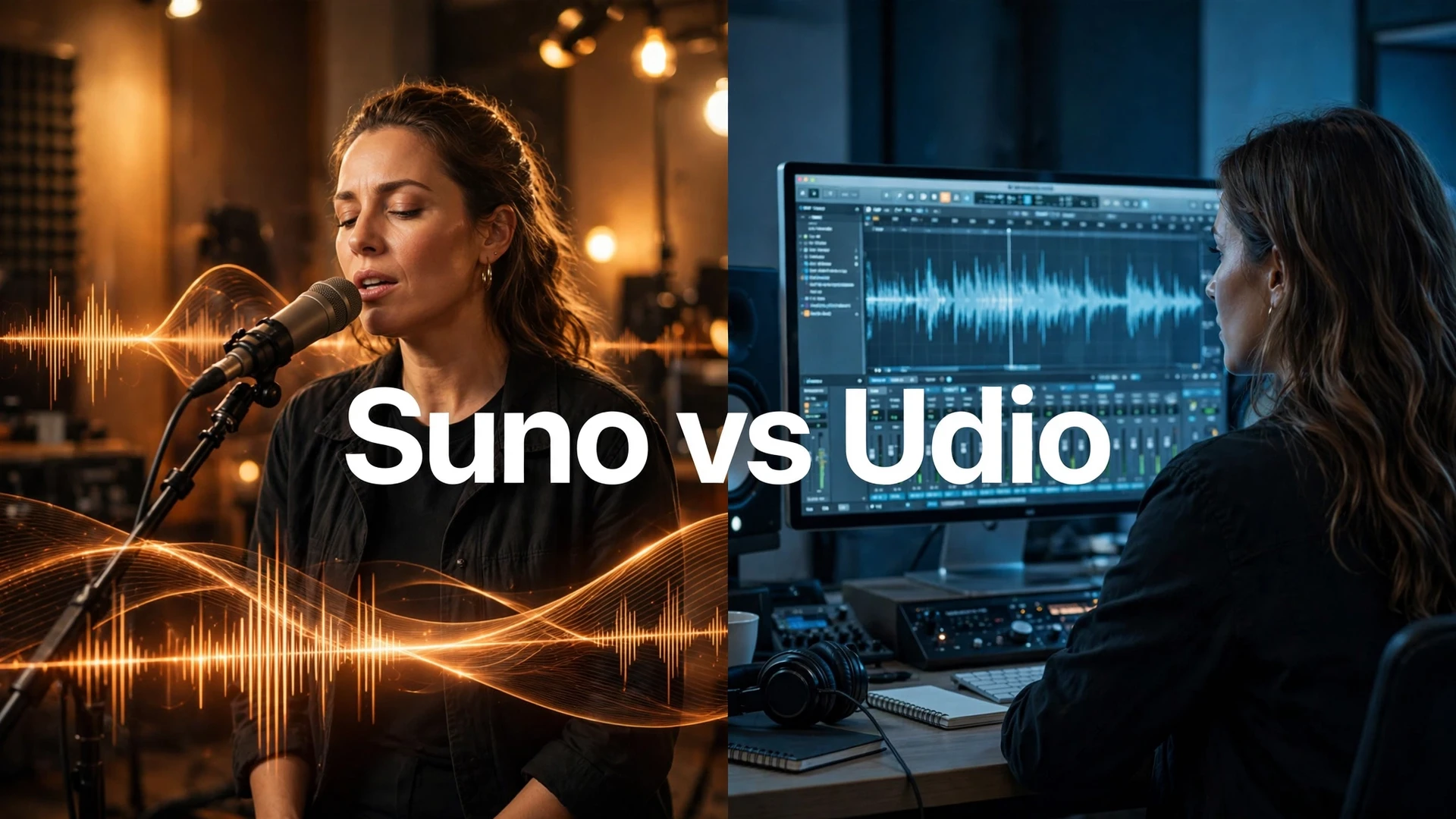
Suno vs Udio used to be a simple taste test: two AI music generators, and you picked the one that sounded better. In 2026 it is no longer that comparison — one is a working product you can take songs out of, the other a walled garden you can only listen inside of. That single difference, export, now outweighs every debate about vocal realism.
I have tested both tools hands-on. Here is the honest breakdown, with every price and limit re-verified against the official pages as of October 2026.
What Suno Is
Suno is the AI music generator most people reach for first: type a prompt — a genre, a mood, a few lyric lines or full custom lyrics — and get a complete song with vocals, instrumentation, and arrangement, mixed surprisingly close to playlist quality. It remains the more complete product of the two: generation, editing, stems, downloads, and commercial licensing all function in one place.
Suno’s current model family is v6, launched in September 2026 as v6 (flagship), v6-wild (experimental), and v6-mini (free-plan model). It adds plain-language editing of song sections, mashups, and generation from text, audio, images, or video — up to around 8 minutes per generation, unusually long for this category.
For editing, Suno offers Custom Mode for your own lyrics, Personas for saving and reusing custom voices, Covers for reinterpreting a song in a new style, an Extend tool, and a remaster option. Paid tiers get Advanced Split (stem separation — vocals, drums, bass, and more) and Suno Studio, a DAW-like editor for finishing tracks.
What Udio Is
Udio is the other name everyone compares first, and for good reason: listeners consistently rated its sound quality and vocal realism as exceptional — some said best-in-class. It generates full songs with vocals from text prompts, with Extend and Remix modes, style controls, stem editing added in 2026, and song sharing through Udio URLs.
But Udio is a fundamentally different kind of product today. On October 29, 2025, it announced a strategic partnership with Universal Music Group that settled their copyright litigation, and as part of that transition downloading of audio, video, and stems was disabled — still disabled on every plan a year later. A Warner deal followed in November 2025. The promised licensed platform — artists opt in and get compensated — is a roadmap, not a shipped product: as of October 2026 it had not launched.
Udio right now is a place to make and hear music, not a tool to ship music — everything you create stays inside its walls.
Sound and Vocal Quality
Suno is the better all-rounder for vocal synthesis: natural voices, clear pronunciation, and strong lyrics understanding — it handles complex prompts without garbling words.
One wrinkle: Suno’s v6 drew user complaints in September 2026 of muddy, flat mixes. Udio’s users continue to rate its sound highly — if your only criterion is the browser speakers, both are excellent, with Udio arguably edging vocal realism.
But the browser is the only speaker Udio gives you: a stunning vocal you cannot export is a demo, not an asset.
Features Head-to-Head
| Dimension | Suno | Udio |
|---|---|---|
| Core identity | Full song generator + production workflow | High-fidelity song generator, in-app only |
| Latest model | v6 family (v6, v6-wild, v6-mini); Sep 2026 | Licensed next-gen model in development; v1/v1.5 models live |
| Max song length | Around 8 minutes per generation (v6) | Around 2 minutes per generation, extendable |
| Vocal quality | Excellent — natural voices, strong lyrics understanding | Excellent — often rated best-in-class realism |
| Custom lyrics | Yes — Custom Mode | Yes |
| Custom voices | Yes — Personas | Limited — style-based controls |
| Covers / remix | Covers, remaster, mashups (v6) | Remix, Extend, Styles |
| Stem separation | Yes — Advanced Split (paid tiers) | Yes — stem editing added 2026 |
| Editor / DAW features | Yes — Suno Studio on Premier | Limited |
| Downloads / export | Yes — paid plans, monthly allowance | No — disabled on all plans since Oct 2025 |
| Commercial rights | Yes — on paid tiers, for downloaded songs | No — personal, non-commercial use only |
| Best for | Publishing, monetizing, and finishing songs | Experimenting and listening in-app |
Pricing and Free Tiers
Pricing as of October 2026, verified against both official pricing pages — confirm on Suno’s pricing page and Udio’s pricing page before you pay:
Suno: the Free plan costs $0: 50 credits a day (roughly 10 songs) on the v6-mini model — but output is watermarked, with no commercial use and no monthly song downloads. Pro is $10 a month (around $8 a month on annual billing) with 2,500 credits, 20 song downloads a month, the flagship v6 and v6-wild models, and commercial rights. Premier is $30 a month (around $24 annual) with 10,000 credits, 60 downloads a month, Advanced Split, and Suno Studio.
The key Suno detail: downloads are the real limit now, not credits. Since September 3, 2026, plans cap downloads — 20 a month on Pro, 60 on Premier — even though your credits can generate hundreds of songs. Extra downloads cost around $2.99 each, so plan your subscription around how many finished tracks you need out the door, not how many experiments you want to run.
Udio: the Free plan costs $0: 10 credits a day (capped at 100 a month), with up to 3 full-length generations a day. Standard is $10 a month with 2,400 credits and up to 6 songs generating at once; Pro is $30 a month with 6,000 credits and up to 10 songs at once, with annual billing around $8 and $24 a month where surfaced. Udio raised these credit limits after the Universal deal (Standard 1,200 to 2,400, Pro 4,800 to 6,000) — the value pitch is in-app generation volume.
The free-tier verdict: Suno’s free plan is the more generous sandbox (50 credits a day vs 10), and the only one whose songs can ever leave the platform.
Commercial Rights
This is where the comparison stops being close. On Suno’s paid Pro and Premier plans, you own the music you generate and can use it commercially — including the songs you download while subscribed. That covers YouTube videos, podcasts, ads, client projects, and streaming releases. (Read the current terms before you invoice a client — AI terms of service change, and Suno’s September 2026 terms tightened how commercial use connects to permitted downloads.)
Udio’s terms, revised in November 2025, limit everything you make to personal, non-commercial use — and with no exportable file, there is nothing to license anyway. The terms also bar posting Udio songs to YouTube, Spotify, or TikTok. For a YouTuber needing background tracks or a creator selling beats, Udio is simply not a candidate right now, at any price.
Who Should Pick Which
Pick Suno if you need files: YouTubers, podcasters, marketers, indie artists, anyone doing client work. Pro at $10 a month is the cheapest way into downloadable, commercially usable AI music; Premier fits if Suno is becoming your production environment — more downloads, more credits, Suno Studio, and stem splitting. Watch the monthly download cap before committing to Premier volume.
Pick Udio if you are an experimenter, a hobbyist, or a songwriter’s-block sufferer who just wants to hear ideas come to life fast. The free plan costs nothing, the sound quality is genuinely lovely, and sharing songs via Udio URLs is easy. But go in with eyes open: nothing you make can leave the app, and none of it can be monetized.
Pick both if you are a serious hobbyist: audition ideas in both, then finish and export the keepers in Suno. The combined free tiers cost nothing.
Wait on Udio if your decision hinges on its licensed platform: as of October it had not publicly shipped. If it launches with restored downloads and licensed artist voices, this comparison gets rewritten. Until then, it is a promise, not a product.
FAQs
Both are excellent, and it is genuinely close. Udio is often rated best-in-class for vocal realism and mix fidelity, while Suno’s v6 models offer natural voices with strong lyrics understanding — though some users reported muddy mixes when v6 launched in September 2026. The bigger difference is that only Suno’s songs can leave the app.
Suno’s free plan is more generous: 50 credits a day (roughly 10 songs) on the v6-mini model, versus Udio’s 10 credits a day capped at 100 a month with up to 3 full generations a day. Both free tiers are for personal, non-commercial use only.
Both charge $10 and $30 a month, with annual billing around $8 and $24 a month. Suno Pro ($10) gives 2,500 credits and 20 downloads a month; Premier ($30) gives 10,000 credits and 60 downloads. Udio Standard ($10) gives 2,400 credits a month; Pro ($30) gives 6,000. Prices verified against official pages in October 2026 — re-check before buying.
On Suno’s paid Pro and Premier plans, you own the music you generate and can use it commercially, including songs you download while subscribed. Udio’s terms limit everything to personal, non-commercial use — and with downloads disabled, there is no file to license anyway.
No. Udio disabled downloading of audio, video, and stems on October 29, 2025 as part of its Universal Music Group partnership transition, and downloads remain off on every plan as of October 2026. Songs can only be created, remixed, and shared in-app via Udio URLs.
Pick Suno if you need exportable, commercially usable music — YouTubers, podcasters, marketers, indie artists, and client work. Pick Udio’s free plan if you are a hobbyist or experimenter who just wants to hear ideas come to life in-app. For serious hobbyists, using both free tiers costs nothing.
Final Thought
The Suno vs Udio debate is really about what an AI music generator is for. If it is for listening — hearing an idea bloom into a startlingly human voice — Udio remains a beautiful instrument, and its free tier is worth your afternoon. If it is for making — releasing, syncing, scoring, selling — there is no debate: Suno is the only working product of the two. The sound-quality gap is small; the usability gap is a canyon. And if you enjoy these head-to-heads, see our Midjourney vs DALL-E 3 comparison for which AI image generator is worth your money.