Claude Duet: Anthropic’s Proactive AI Agent That Messages You First

Claude Duet is Anthropic’s proactive AI agent — a standalone app where Claude messages you first instead of waiting for a prompt. Announced on October 21, 2026 as a research preview, it sends you a short morning brief drawn from your connected apps, keeps working on your tasks in its own cloud computer while your phone is off, and asks for your approval before it sends a message, pays for anything, signs a document, or deletes anything. It is available to Pro, Max, and Ultra subscribers in the United States through a waitlist, at no extra cost during the preview — but it shares your plan’s usage limits, so its background checks count against them.
The short answer: Duet is the third always-on agent from a major AI lab in seven weeks — Meta’s Muse arrived September 8, OpenAI’s Dots on September 29, and Duet on October 21 — but it is the most work-focused of the three. It is built around your inbox, calendar, and business apps: Gmail and Slack for messages, QuickBooks and Stripe for invoices, Gusto for payroll, Docusign for contracts. In Anthropic’s own words, it “comes to you with what needs your attention, completes tasks you ask of it, keeps working even when you step away, and checks with you before it acts on your behalf.” The Verge’s week-long hands-on test called it “surprisingly helpful” and “a little neurotic” — a fair summary of where proactive agents stand right now.
What Is Claude Duet?
Claude Duet is a separate app from the regular Claude app, available for iOS and Android and on the web at claude.ai. The difference is the direction of the conversation: the Claude app waits for you to open a chat and ask something; Duet comes to you. Each morning it sends a short brief on the most important items across the apps you have connected, then checks those apps every few hours and messages you only when something needs your attention. You can also hand it tasks by typing or talking in one ongoing thread — from scheduling a meeting to building a sales forecast or a prototype web app — and it works on them in the background, returning finished work as files you can edit: documents, spreadsheets, decks, and dashboards.
It runs on Claude Opus 5.5, the model Anthropic chose for its judgment — deciding what needs you, what can wait, and when to check with you first. You cannot pick a different model. It carries over your memory, skills, and connected apps from your Claude account, so setup is mostly a login, and it can reach more than 6,000 connectors and plugins in the Claude Marketplace. The work itself happens on Duet’s own virtual machine in the cloud, with its own browser, so a job keeps running after you close the app or your device goes to sleep.
One thing worth knowing before you get excited: Duet is a research preview, and Anthropic is blunt about its rough edges. It “might misread a thread or miscalibrate what’s urgent,” it checks your apps every few hours rather than constantly, so something urgent can arrive between check-ins, and it cannot yet show you its own browser. It is built around work — personal errands such as booking tickets “aren’t quite as strong,” in Anthropic’s words.
Claude Duet at a Glance
| Question | Answer |
|---|---|
| What is it? | A proactive Claude agent in its own app — it messages you first |
| Launched | October 21, 2026, as a research preview |
| Model | Claude Opus 5.5 (fixed — no model choice) |
| Price | Included in Pro, Max, and Ultra at no extra cost during the preview; shares your plan’s usage limits |
| Who can get it? | Pro, Max, and Ultra subscribers in the US, via waitlist. Team and Enterprise not included yet |
| Where? | Standalone iOS and Android apps, and the web at claude.ai |
| What does it do on its own? | Morning brief, checks apps every few hours, messages you when something needs you |
| What can you hand it? | Scheduling, inbox replies, invoices, payroll prep, contracts, dashboards, forecasts, decks, prototypes, web apps |
| Where does it work? | Its own virtual machine with a browser; your devices can be off |
| What needs your OK? | Sending messages, paying, signing, deleting |
| Never allowed | Trading securities, moving money between accounts, accessing someone else’s account |
| Connectors | 6,000+ in the Claude Marketplace |
What Can Claude Duet Actually Do?
Duet’s day is built around three behaviors. First, it briefs you, then goes quiet: each morning it sends a short brief on the most important items across your connected apps, and through the day it checks those apps every few hours and messages you only when something needs you. Anthropic is open about the trade-off — it checks every few hours, not constantly, “because checking nonstop would use up your plan’s limits much faster.” You can tell it what you want to hear about and how often.
Second, it takes tasks of any size. You message it by text or voice in one ongoing thread, and small jobs like scheduling a meeting and big ones like building a dashboard or a financial forecast start in the same place. It works out which apps to use, does the work in the background, and notifies you when it is done or needs review. Finished work comes back as files you can edit — a document, a spreadsheet, a deck, a dashboard — rather than a chat reply you have to copy out.
Third, it waits for you on the decisions that matter. Before it sends a message, makes a payment, signs a document, or deletes anything, “it shows you exactly what it’s about to do and waits for your approval.” That approval gate is the whole design: Duet reads, drafts, and prepares on its own, but the consequential step is always yours.
Anthropic’s launch examples show the shape of the work it is aimed at. On its product page, a café chain owner gets a morning brief with five items — a hiring deadline, a contract redline, a permit fee, a Series A meeting, delivery errors — a $640 permit fee waiting for one-tap approval, a rebuilt investor deck with two slides flagged, and a one-page business health dashboard that refreshes at 5:30 every morning. Early testers Anthropic named include a real-estate broker whose Duet flagged a showing booked on the wrong day without being asked, and a restaurant owner with about 110 employees who uses it for accounting, support, and marketing. I have not tested Duet myself — it is waitlisted, US-only, and tied to a paid plan — so everything about how it behaves in this post comes from Anthropic’s launch article and product page, the Claude Help Center, or The Verge’s hands-on review, each cited where it is used.
How Much Does Claude Duet Cost?
There is no separate Duet price. During the research preview it is included in Claude Pro, Max, and Ultra plans at no extra cost — but it is not free to run. It shares your plan’s usage limits with the rest of Claude, including the five-hour session limit and weekly limits, and its background work counts toward them. The morning brief and the every-few-hours check-ins draw from the same budget as your chats, so if you already hit your limits most weeks, Duet will compete for them. Bigger jobs — a financial model, a deck — need more model turns and background work. You can reduce the cost by telling it to check less often or to watch fewer topics.
| Claude plan | Price (checked on Claude’s pricing page) | Duet access | Preview limit resets |
|---|---|---|---|
| Pro | $20/month, or $17/month billed annually | Included, waitlist | 3 full resets |
| Max | $100/month (5x) or $200/month (20x) | Included, waitlist | 1 full reset |
| Ultra | Top tier — check Claude’s pricing page for the current price | Included, waitlist | 1 full reset |
| Team / Enterprise | — | Not included yet | — |
One detail worth knowing if you do get in: during the preview Anthropic adds full limit resets — Pro gets three, Max and Ultra get one each. Each reset refills the five-hour session and weekly limits when you use it in Settings > Usage, and unused resets expire December 15, 2026. Anthropic has not announced a price for Duet after the preview, and the waitlist invitation does not guarantee a date — invitations go out in waves, and access is tied to the email address you give on the waitlist, which must match your Claude account.
Claude Duet vs Claude, Cowork, and Claude Code
Duet is not a new model — it is a new way of working with Claude, and it sits at the consumer end of a ladder Anthropic has been building all year. The main Claude app waits for you to start a chat and work alongside it. Claude Projects organizes chats and files around a topic. Cowork works with files and apps on your desktop. Claude Code works in your codebase and terminal. Duet is the step where Claude comes to you, works in its own cloud computer, and messages you when it is done or needs a decision. If you already use Projects to keep long work organized, Duet is the version of that idea that runs while you are away — but it is a separate app for now, and Anthropic says what it learns from early users will shape how the two work together.
| Product | How you work with it | Best for |
|---|---|---|
| Claude app | You start a chat and work alongside Claude | Questions, writing, analysis |
| Claude Projects | Chats and files organized around a topic, with project instructions | Long-running work on one subject |
| Claude Cowork | Claude works with files and apps on your desktop | Office work on your own machine |
| Claude Code | Claude works in your codebase and terminal | Software development |
| Claude Duet | Claude comes to you, works in its own cloud computer, messages you when done or when it needs a decision | Running a workday across email, calendar, and business apps |
Claude Duet vs OpenAI Dots vs Meta Muse
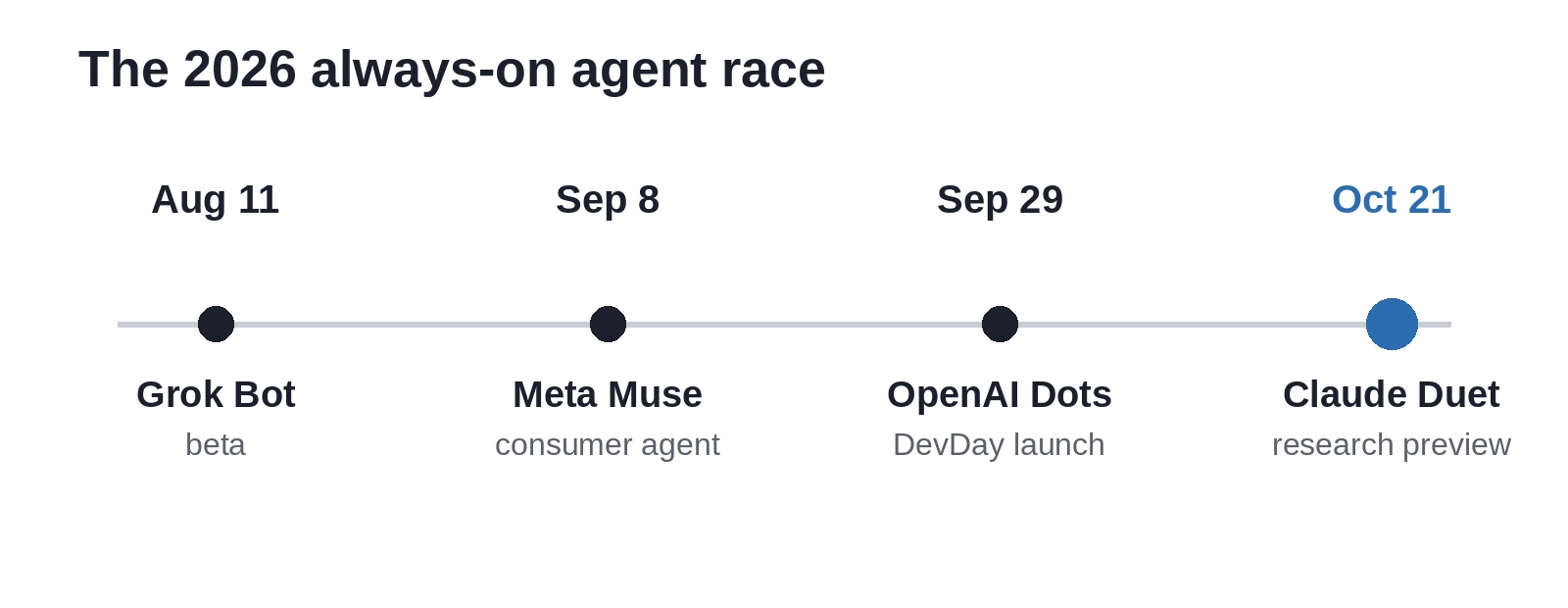
Duet did not arrive in a vacuum. Three always-on agents shipped within seven weeks of each other: SpaceXAI’s Grok Bot entered beta on August 11, Meta’s Muse launched on September 8, and OpenAI’s Dots launched at DevDay on September 29. Duet, on October 21, is the last of the four to arrive and the most work-focused of the three consumer agents. Muse is the errand runner — shopping, bookings, everyday tasks, in its own app and WhatsApp — while Dots are always-on agents inside ChatGPT, Slack, and Microsoft Teams that pursue goals you set. Duet’s pitch is narrower and more businesslike: your inbox, your calendar, your invoices, your payroll.
| Agent | Launched | Runs on | Where it lives | Best for |
|---|---|---|---|---|
| Meta Muse | September 8, 2026 | Muse Spark | Own app, web, WhatsApp | Errands, shopping, bookings |
| OpenAI Dots | September 29, 2026 | GPT-6 Astra | ChatGPT, Slack, Teams | Always-on goals across team apps |
| Claude Duet | October 21, 2026 | Claude Opus 5.5 | Own app (iOS/Android), claude.ai | Work: inbox, calendar, invoices, payroll |
The deciding differences are not the launch dates — they are access and the approval model. Dots are gated to ChatGPT Pro and Business Premium subscribers; Muse is the most widely available of the three, with paid tiers from $20 a month; Duet is the most restricted right now, US-only and waitlisted on paid Claude plans. On approvals, all three ask before consequential actions, but Duet’s design is the most explicit about it: a dedicated classifier and safety prompt screen every message, and some actions — trading securities, moving money between accounts — are off-limits even with your approval. If you want the full head-to-head on the agent category rather than one product, our Manus review covers the other end of the spectrum: a general-purpose agent that takes on whole jobs, with a usage meter you have to watch closely.
Is Claude Duet Safe?
An agent that reads your email and can send messages, pay, and sign on your behalf is a big trust ask, and Anthropic lists its safeguards in unusual detail. Duet’s handling of credentials follows the design used for Claude Managed Agents, so it never directly sees your passwords or sign-in tokens. Actions are approved by Anthropic’s auto mode classifier, the same safeguard used in Claude and Claude Code. Its defenses against hidden instructions in web pages and emails come from Anthropic’s browser-use research. And a new dedicated classifier and safety system prompt checks each message: it is designed to reject requests to share the strictest tier of information, such as credit card numbers and government identification, while health and personal-finance details go out only when you have explicitly told Duet to send them.
Anthropic also says it ran adversarial tests on Duet’s security infrastructure, had an external firm penetration-test it, and covers it under the company’s public bug bounty program. Purchases go through Stripe’s Link wallet or Shop Pay, only inside Duet for now, with your approval for each purchase — Link pays with a virtual card, so your real card number is never shared. And you stay in control of the connection itself: you can see what Duet has done and is doing, steer it, and disconnect any app.
None of that removes the core trade-off, and it is worth stating plainly: Duet can only be useful if it can read your email, your calendar, your messages, and your business apps. The Verge’s reviewer put it directly — it was “a little uncanny” knowing it could read every email, draft, and Slack message she sent, even though she had opted in. The practical rules from Anthropic’s own guidance apply here too: connect only the apps it actually needs, keep payment approvals on, review drafts before they go out, and do not connect an account whose contents you would not want an assistant to read.
What The Verge’s Week-Long Test Actually Found
The first long hands-on test of Duet came from The Verge’s Allison Johnson, who used it for about a week while travelling, with her work email, calendar, Google Docs, and Slack connected. Her verdict, in the headline’s words, was that Duet is “a little neurotic and surprisingly helpful” — and the examples cut both ways.
What worked: each morning Duet sent a short brief, including a reminder to pack an item she needed for a video shoot before her flight. It linked a point from a meeting summary email to a Slack direct message, and worked out who her boss was from a shared 1:1 document. Most usefully, it caught that upcoming time off would leave only a few working days before another big draft was due, proposed a fix, offered to update the shared Google Doc with weekly notes for her editor, and drafted a Slack message to him — a draft she said was “a little too good,” copying her lowercase writing habit and even shortening “signature” to “sig,” which she said she would never write.
What did not: before 9 a.m. one morning, Duet urged her to get her draft edited so she could send a promised link to a source — missing that her note to the source was not a hard deadline, and that it was only 7 a.m. for her editor. It often offered to start her drafts, which she declined every time. Its Slack message carried a “sent with Claude” label. Her conclusion is the one that matters for anyone considering the waitlist: she likes Duet as a backstop for spotting gaps across email, chat, meetings, and docs — not as a replacement for her own organization, and not for creative work. That is one reviewer, one week, and one set of work accounts, not a benchmark — but it is the only independent test published so far, and it matches Anthropic’s own caveat that the product is still learning when to message you.
What Isn’t Ready Yet
Anthropic is direct about the gaps in this research preview, and they are the right things to weigh before joining the waitlist. Duet may misread a thread or miscalibrate what is urgent, and it can miss something that arrives between its every-few-hours check-ins. It cannot yet show you its browser, so you cannot watch it work or take over mid-task. It is built around work, so personal errands such as booking tickets are not as strong yet. It makes no phone calls and sends no text messages to other people, it cannot see all the projects or files on your computer, and Personal Finance is not available inside Duet. And access itself is narrow: US only, Pro/Max/Ultra only, waitlisted, with Team and Enterprise plans not included yet.
The other honest limit is the usage meter. Duet shares your plan’s limits, and its background checks count toward them — Anthropic warns that you may reach your limits “sooner than with chat alone.” If you already run Claude Code hard enough to hit your weekly limits, Duet will compete for the same budget, and the preview’s limit resets (three for Pro, one each for Max and Ultra) are a one-time cushion, not a fix. Tell it to check less often and watch fewer topics if you want it to last the week.
Should You Join the Waitlist?
Join if you are a US Pro, Max, or Ultra subscriber drowning in email, calendar, and admin — especially if you run a small business on tools like Stripe, QuickBooks, Gusto, or Shopify, where Duet’s connectors do real work. Duet’s best case is the person with more decisions than they can track: the morning brief alone, if it catches one missed deadline a week, is worth the waitlist spot.
Wait if you are outside the US, on a Team or Enterprise plan, need personal errands handled well, or already hit your usage limits every week. And go in with the right expectation: Duet is a backstop for spotting gaps, not a replacement for your own organization. If you want a tool that does whole jobs end to end today, our Manus review and our Perplexity research guide cover agents with different trade-offs — Manus for delegated work with a visible meter, Perplexity for research where you check every citation yourself.
How to Join the Claude Duet Waitlist
There is no app to buy and no separate subscription to add. To join the waitlist, open Anthropic’s Claude Duet page and join the waitlist with the email address tied to your Claude account — access is granted to that address, so use the same one you sign in with. Invitations go out in waves, and joining does not guarantee a date; an invitation from the waitlist, or from a Claude Duet user, is what opens access. Once you are invited, download the standalone Duet app for iOS or Android, or open it on the web at claude.ai, and connect the apps you want it to watch — starting with the few it actually needs, not everything at once.
One last note on timing: “claude duet” is currently a breakout rising search in US Google Trends data, and Claude searches overall are up sharply on a year earlier — so the waitlist is likely to stay crowded while the preview is US-only. If you are eligible, joining now costs nothing; the decision that matters is which apps you connect once the invitation arrives.
Frequently Asked Questions
Claude Duet is a proactive AI agent app from Anthropic, launched as a research preview on October 21, 2026. Instead of waiting for a prompt, it sends you a morning brief from your connected apps, checks those apps every few hours, messages you when something needs your attention, and works on tasks in its own cloud computer while your devices are off. It runs on Claude Opus 5.5 and asks for your approval before it sends a message, pays, signs, or deletes anything.
There is no separate Duet price. During the research preview it is included in Claude Pro, Max, and Ultra plans at no extra cost. It shares your plan’s usage limits, including the five-hour session limit and weekly limits, and its background checks count toward them. Pro costs $20 a month, or $17 a month billed annually, and Max costs $100 or $200 a month depending on the tier — those prices were checked on Claude’s pricing page. Anthropic has not announced a price for Duet after the preview.
During the preview, Duet is available to Pro, Max, and Ultra subscribers in the United States through a waitlist — invitations go out in waves, and joining does not guarantee a date. Team and Enterprise plans are not included yet. It runs as a standalone app on iOS and Android and on the web at claude.ai, and access is tied to the email address you give on the waitlist.
Claude Duet runs on Claude Opus 5.5, the model Anthropic chose for its judgment in deciding what needs you, what can wait, and when to check with you first. You cannot choose a different model — Duet decides how much effort to spend on each job itself.
Duet never directly sees your passwords or sign-in tokens, and a dedicated classifier is designed to block it from sharing the strictest tier of sensitive information, such as credit card numbers and government identification. Health and personal-finance details go out only when you explicitly instruct it to send them. It always asks before sending, paying, signing, or deleting, and some actions — trading securities and moving money between accounts — are off-limits even with your approval. Anthropic had Duet red-teamed and penetration-tested by an external firm. Even so, it can only help if it can read your email, calendar, and messages, so connect only the apps it actually needs and review its drafts before they go out.
The regular Claude app waits for you to open a chat and ask something. Duet comes to you: it sends a morning brief, checks your connected apps every few hours, messages you when something needs you, and keeps working in its own cloud computer after you close the app. It uses the same Claude account, memory, skills, and connectors, but it lives in a separate app for now, and it is built around running your workday rather than answering questions.