Manus AI Review: The Agent That Does the Work — and the Meter You Can’t See

Manus is the closest thing to a general-purpose AI employee you can buy today: give it one prompt and it researches, browses, writes code, and hands back a finished report, website, or slide deck. It is also the hardest AI tool to budget for, because it bills in credits and cannot tell you what a task will cost before it runs. For this Manus AI review, I read Manus’s own documentation and pricing pages, its independence announcements, and every independent hands-on test I could find. My verdict is: worth a trial month at $20 for research sprints and one-off builds — not a tool to run unattended, and not one to put on a company card without a spending check.
The verdict: Manus 2.0 is genuinely impressive at turning a single prompt into finished work — research reports, websites, decks, automations. The catch is cost predictability: credits burn at $0.005 each with no upfront quote, and the free tier only runs the Lite model. Try it on the free plan’s 300 daily credits; pay $20 a month only if you have a repeating research or one-off-build job. Score: 7.5/10 for solo builders and analysts; 5/10 for teams that need predictable spend.
Manus AI at a glance
| What | The detail |
|---|---|
| What it is | General-purpose AI agent: one prompt in, finished deliverable out (research, slides, websites, apps, video, automations) |
| Price | Free plan ($0, 300 credits a day, Lite model only); Pro from $20 a month (4,000 credits), $40 (8,000), $200 (40,000); 17% off on annual billing; Team from $20 per seat a month |
| Cost per credit | $0.005 on every plan — the tier only changes how many credits you get |
| Current version | Manus 2.0 (September 28, 2026): Cascade harness, Cloud Computer, Automations, Manus Studio, and the Cue app |
| Platforms | Web app, desktop (Manus Studio), mobile app, Slack, email, API |
| Company | Butterfly Effect (Singapore); independent again since September 1, 2026, after Meta’s blocked $2 billion acquisition |
| Best for | Research sprints, competitor reports, one-off websites and decks, scheduled and event-triggered automations |
| Not for | Unattended production work, anyone who needs a fixed price per task, or teams that need predictable monthly spend |
How I reviewed Manus (and what I did not test)
Honest note first: I did not run a signed-in Manus session for this review, so this is a desk review, not a hands-on test — I am saying so plainly rather than implying otherwise. What I did do: read Manus’s own pricing page, help-center articles, and launch posts on November 23, 2026; verified the Meta-acquisition timeline against Manus’s own blog and independent reporting; and weighed the independent hands-on tests that exist — MIT Technology Review‘s three-task test drive, the delta4 tests cited in the Notis review, and the G2 review record. Where the evidence is a vendor claim (benchmarks, efficiency numbers), I label it as one. Where reviewers disagree, I show both sides.
What is Manus AI?
Manus is a general-purpose AI agent, which is a different kind of product from a chatbot. A chatbot answers you in the chat window; Manus takes your goal, plans the steps, and executes them in its own cloud computer — browsing the web, running code, writing files — then returns a finished artifact. Ask for a five-competitor research report and you get a formatted document, not a chat transcript. Ask for a landing page and you get a working site. That is the whole pitch, and on bounded, one-off jobs it is the pitch that made Manus famous.
Anthropic’s entry in this category is Claude Duet, a proactive agent that messages you first — it sends a morning brief, works in its own cloud computer, and asks before it sends, pays, signs, or deletes anything.
Manus launched on March 6, 2025, from Butterfly Effect, a startup founded in China that later moved its staff to Singapore. It went viral within days, and its launch claim was a benchmark chart: on GAIA, the general-assistant benchmark of 466 real-world questions from researchers at Meta AI, Hugging Face, and AutoGPT, Manus reported pass rates of 86.5% on Level 1, 70.1% on Level 2, and 57.7% on Level 3 — ahead of the figures OpenAI had published for Deep Research a month earlier (74.3%, 69.1%, and 47.6%).
| GAIA level | Manus (March 2025, self-reported) | OpenAI Deep Research (Feb 2025) |
|---|---|---|
| Level 1 (basic) | 86.5% | 74.3% |
| Level 2 (intermediate) | 70.1% | 69.1% |
| Level 3 (complex) | 57.7% | 47.6% |
Three caveats matter. First, the scores are self-reported by Manus and, as far as independent reviewers can tell, were never independently replicated. Second, the Level 2 margin over Deep Research is a single percentage point — inside run-to-run variance for agentic systems. Third, GAIA measures research-style questions with verifiable answers; it does not measure what the demos show, like building a game or booking a service. Treat the chart as directional evidence, not proof. What the independent tests actually found is in the section below.
What is new in Manus 2.0?
Manus 2.0 shipped on September 28, 2026, and Manus describes it as a new architecture rather than a version update. The pieces that matter:
Cascade is the new in-house agent harness. Instead of loading every capability up front, it keeps a project light and attaches specialized tools only when the work calls for them. In one tested configuration Manus reports, Cascade used 23.2% fewer tokens, finished tasks in 28.2% less time, and cost 32% less to run than the previous system. That is a vendor benchmark with no published test method — treat it as a claim, not a measurement.
Cloud Computer is a dedicated environment you can buy for projects that need to stay up — a multiplayer game server, an automation that runs around the clock. It costs $30 or $50 a month per computer, on top of your plan.
Automations replace fixed schedules with event triggers: a new email, a change in ad performance, a calendar event, a Slack message, or a Notion update can start a workflow you set up in a single prompt.
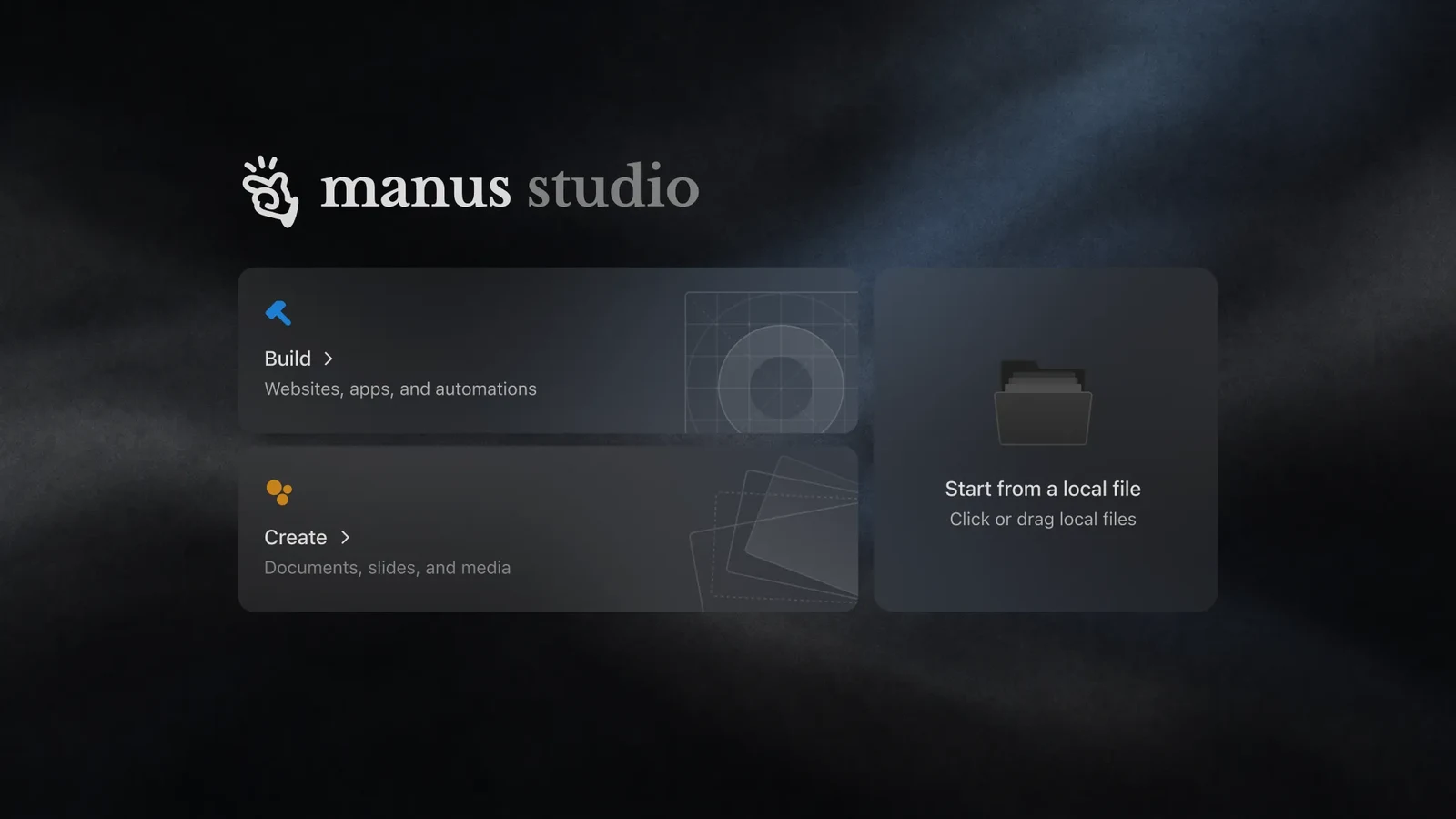
Manus Studio is the upgraded desktop app — a shared workspace for documents, spreadsheets, PDFs, slides, websites, code, games, and video. Two new professional environments ship inside it: a Video Editor built for 30-to-60-second ads and tutorials, with a timeline you can edit by hand, and Game Dev, which builds playable games from templates and handles multiplayer hosting for you.
Cue is a separate app for personal agents, in invite-only early access. Each agent gets its own email address, phone number, wallet, and computer, so it can send messages, pay within a budget you set, and see a task through on its own machine. You can start with the invite code MEETCUE while early access lasts.
Manus Flex, introduced a day after 2.0, lets you use your own API key in the Manus workspace — from OpenAI, Anthropic, Google AI Studio, xAI, Meta, OpenRouter, Fireworks, or Modal — with a model and effort level you choose. It is the escape hatch if you would rather pay a model vendor directly than buy Manus credits.
Manus and Meta: what actually happened
Any honest Manus review has to deal with the ownership saga, because it is the first thing a careful buyer asks about — and because it once put user data at risk. Here is the timeline, verified against Manus’s own blog and independent reporting:
| Date | What happened |
|---|---|
| March 6, 2025 | Manus launches as an invite-only general agent and goes viral |
| December 29, 2025 | Meta closes its acquisition of Manus in a deal reported at roughly $2 billion |
| April 27, 2026 | China’s National Development and Reform Commission prohibits the acquisition and orders the parties to withdraw it |
| August 11, 2026 | Manus tells users it will “soon return to operating as an independent company” |
| August 23–24, 2026 | Data generated by affected users on or after December 29, 2025 is deleted to satisfy regulatory requirements; backup window closed August 23, restore opened August 25 |
| September 1, 2026 | Manus formally resumes independent operations with the founding team continuing |
| September 28, 2026 | Manus 2.0 ships |
| October 8, 2026 | Manus’s parent, Butterfly Effect, raises more than $500 million as an independent company |
The important part for buyers: the separation is complete, the founding team stayed, and the company has fresh funding — this is not a product in limbo. The honest caveat is that the August 2026 data deletion was real and affected real users: if you had Manus data from the Meta period, it was deleted unless you backed it up in the window. Manus states explicitly that the deletion was a regulatory requirement, not a security incident. The lesson for any agent platform applies here too: keep your own copy of anything you cannot afford to lose.
What does Manus cost?
Manus sells credits, not tasks. One credit costs $0.005 on every plan from $20 to $200 a month — the tier only changes how many credits you get. Paying yearly brings the per-credit cost to a little over $0.004. The plans, as listed on Manus’s pricing page and help center in November 2026:
| Plan | Price | Credits | Limits |
|---|---|---|---|
| Free | $0 | 300 refresh credits a day (Lite model only), capped at 1,500 a month; plus 1,000 credits once at sign-up | 1 concurrent task, 2 scheduled automations |
| Pro | $20 a month ($17 a month billed yearly) | 4,000 a month, plus 300 a day | 20 concurrent tasks, 20 scheduled tasks |
| Pro | $40 a month ($34 a month billed yearly) | 8,000 a month, plus 300 a day | 20 concurrent tasks, 20 scheduled tasks |
| Pro | $200 a month ($167 a month billed yearly) | 40,000 a month, plus 300 a day | 20 concurrent tasks, 20 scheduled tasks |
| Team | $20 per seat a month ($200 per seat a year) | 4,000 per seat a month, pooled across the team | Collaboration, admin dashboard, audit logs |
Monthly plan credits do not roll over, and payments are generally non-refundable except where the law requires — measure your typical task on the free daily credits first. A Cloud Computer costs another $30 or $50 a month if you need one.
What does a month of Manus actually cost? A worked example
Manus publishes no fixed price per task, but it does publish example costs. Running those examples through the $0.005-per-credit rate (worked out in detail by Notis): a 15-minute data analysis costs about $1.00 (200 credits), a 25-minute website build about $1.80 (360 credits), and an 80-minute app build about $4.50 (900 credits). Now put a realistic month on the $20 plan: four weekly competitor reports at 200 credits each ($4.00) plus one landing-page build at 360 credits ($1.80) comes to 1,160 credits — $5.80 of your $20, or about 29% of the allowance, leaving 2,840 credits for everything else. That math is kind to Manus. The unkind version is the one independent reviewers keep hitting: a heavy multi-step job can eat hundreds of credits in one run, a failed task still spends, and nothing tells you the cost before you run it. Manus’s own help center says it cannot predict what a task will cost in advance — and warns users to treat the agent’s own cost estimates as unreliable. Budget for the worst case, not the example.
What Manus is good at
The independent tests agree on the shape of the strength, even when they disagree on the details. In MIT Technology Review‘s hands-on test drive, Manus produced better output than ChatGPT’s Deep Research on two of three research tasks — compiling a list of reporters covering China tech, finding two-bedroom property listings in New York, and nominating candidates for an Innovators Under 35 list. In the delta4 tests cited by the Notis review, a five-competitor research report came back in 8 minutes and a working landing page in 20. The pattern: bounded jobs with a clear start and a clear finish — research sprints where you want a formatted deliverable, prototypes you will throw away next week, anything that crosses browsing, code, and documents in one run. Manus is built for the first shape of work, and it wins the demo for a reason.
Where Manus breaks
The same tests found the same two failure modes, and both are about trust rather than capability. First, Manus finishes even when it should stop: the delta4 research report was missing seat minimums for two of five competitors, and the generated landing page shipped with a success message while still incomplete. The output looks complete. It is not complete. You cannot skip the review pass, which means the time saved is real but smaller than the demo suggests. Second, you cannot see the meter: nothing tells you what a task will cost before it runs, a failed task still spends credits, and the G2 record is dominated by exactly this complaint. G2 currently shows two conflicting profiles — “Manus” at 4.6 out of 5 on 10 reviews, and “Manus AI agent” at 2.4 out of 5 on 8 reviews — both thin samples, and the low-rated one is heavy with billing and refund disputes rather than complaints about the agent’s capability. Manus does not have a Capterra listing. Read the G2 signal as a warning about billing, not a verdict on the product.
Other honest limits: Manus stalled at captchas and paywalls and froze under load in the MIT Technology Review test; the free tier’s 300 daily credits only work on the Lite model and will not cover two 200-credit analyses in the same day; and Manus does not publicly name the models behind its modes, so you are trusting the platform rather than a model you chose — unless you use Manus Flex with your own key.
Manus vs ChatGPT, Lovable, and Perplexity
| Tool | What it does best | Price from | Pick it when |
|---|---|---|---|
| Manus | One prompt becomes a finished report, site, deck, or automation | $0 (Lite only); Pro $20 a month | You want a deliverable, not a conversation |
| ChatGPT Deep Research | Long-form research with citations, inside a chat you already use | Included in ChatGPT Plus ($20 a month) | You want research you can interrogate step by step |
| Lovable | Fastest path from idea to working web app with a database | $0 (5 build credits a day); Pro $25 a month | The job is an app, not research |
| Perplexity Research | Fast, cited answers with a research mode and Spaces projects | $0; Pro $20 a month ($17 a month billed yearly) | You want verified citations quickly and cheaply |
The practical way to think about it: if you want to ask questions and check the answers as you go, use Gemini Deep Research or ChatGPT’s Deep Research. If you want a working app, Lovable is the faster, cheaper specialist — I reviewed it last week and its build loop beats Manus for pure app work. If you want cited research on a budget, Perplexity’s Research mode does the verification work Manus skips. Manus earns its $20 when the job spans all three — research a market, pull the data, and turn it into a deck or a small site in one run. If your work is mostly one of those, the specialist wins.
Who should use Manus — and who should not
Use Manus if you are a solo founder, analyst, or marketer who regularly needs a finished research report, a competitor teardown, a pitch deck, or a prototype site — and you are willing to check every deliverable before it goes anywhere. The $20 plan buys roughly twenty 15-minute analyses or eleven website builds a month at Manus’s own example rates, which is real value if you actually use them.
Skip Manus if you need a fixed price per task, you cannot tolerate a surprise bill, you want to run agents unattended in production, or your work involves sensitive data you cannot risk uploading to a third-party sandbox. In those cases, a chat-first tool with a flat subscription — ChatGPT Plus, Perplexity Pro — is the saner buy. And if you only need one research report a month, the free plan’s 300 daily credits on the Lite model will cover it without spending anything.
How to try Manus on the free plan
Start at manus.im and create an account — the free plan needs no card. You get 300 refresh credits a day, capped at 1,500 a month, plus 1,000 credits once at sign-up. The daily credits only work on the Lite model, so pick a small, bounded first task: a one-page competitor summary, not a full app. Watch the credit counter as it runs, and check the output against its sources before you trust it. If the first task saves you real time, the $20 Pro plan is the next step — and set a calendar reminder to review your credit usage after the first month, before it renews.
The bottom line
Manus is the most convincing general agent on the market, and the most honestly priced in one sense — a credit is half a cent on every plan, no games with tiers — and the least predictable in the sense that matters, because no one can tell you what your task will cost until it is done. The Meta saga is over, the product is shipping fast, and the 2.0 rebuild is a real step forward. Buy it for what it demonstrably does — turn one prompt into a finished deliverable — and budget for the meter you cannot see. If you want the same research with a fixed price and citations you can check, start with AI data analysis in a chat tool first, and come to Manus when the job outgrows the chat window.
Frequently asked questions
Yes, Manus has a free plan: 300 refresh credits a day, capped at 1,500 a month, plus 1,000 credits once at sign-up. The catch is that the daily credits only work on the Lite model, and you can run one task at a time. It is enough to test a small research or build task; the full agent modes need a paid plan.
There is no fixed price per task. A credit costs $0.005 on every plan, and Manus’s own examples put a 15-minute data analysis at about $1.00 (200 credits), a 25-minute website build at about $1.80 (360 credits), and an 80-minute app build at about $4.50 (900 credits). Manus’s help center says it cannot predict what a task will cost before it runs, so treat any estimate as a rough guide and watch the counter.
No. Meta closed its acquisition of Manus on December 29, 2025, in a deal reported at roughly $2 billion. China’s National Development and Reform Commission blocked the deal in April 2026, and Manus formally resumed independent operations on September 1, 2026, with its founding team continuing. Its parent company raised more than $500 million in October 2026.
Manus 2.0 shipped on September 28, 2026, and rebuilt the platform around a new agent harness called Cascade, a rentable Cloud Computer, event-triggered Automations, the Manus Studio desktop workspace, and a separate app called Cue for personal agents. Manus says Cascade used 23.2% fewer tokens and cost 32% less to run in one tested configuration — a vendor claim, not an independent measurement.
It depends on the job. On the GAIA benchmark at launch, Manus reported higher scores than OpenAI Deep Research (86.5% vs 74.3% on Level 1, 57.7% vs 47.6% on Level 3), but those numbers are self-reported and were never independently replicated. In MIT Technology Review’s hands-on test, Manus beat Deep Research on two of three research tasks but ran more slowly and stalled at captchas and paywalls. Use Manus when you want a finished deliverable; use Deep Research when you want to interrogate the research step by step.
Manus runs your tasks in its own cloud sandbox, and you should not upload sensitive data you cannot afford to share with a third party. The August 2026 deletion of some users’ data was a regulatory requirement tied to the unwinding of the Meta acquisition, not a security incident — but it is a real reminder to keep your own copy of anything important. Check the trust center at trust.manus.im before putting work data through any agent.