How to Learn a Language With ChatGPT (Prompts That Work)

You do not need a $200 tutor or a 400-day streak to start learning a language. You need a conversation partner who never sleeps, never judges your accent, and corrects your mistakes the second you make them. ChatGPT is exactly that — if you prompt it right.
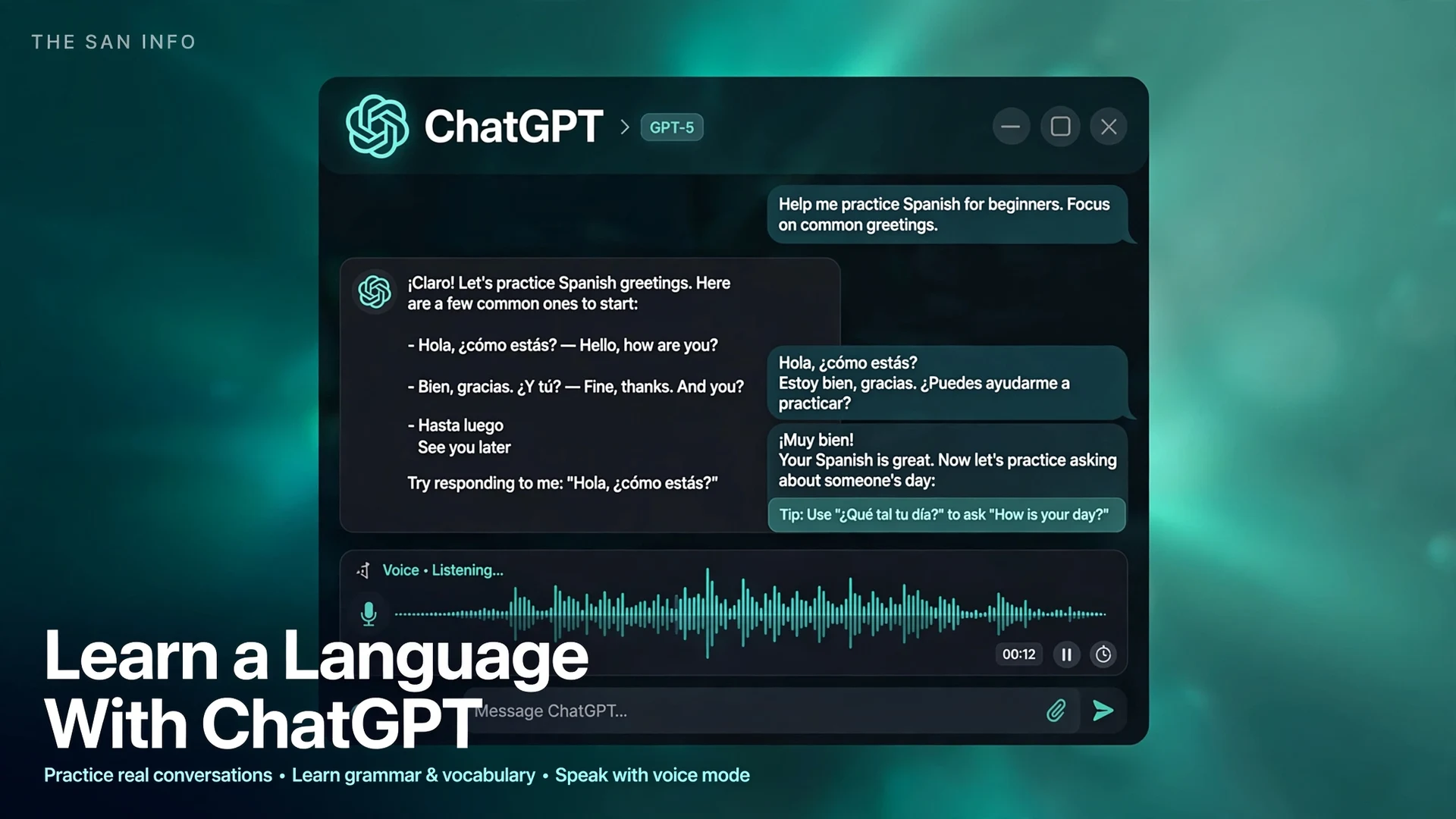
Most people open ChatGPT, type “teach me Spanish,” and get a generic vocabulary list they never open again. The trick is giving it a job description: tell it your language, your level, your goal, and exactly how you want feedback. Do that, and it becomes a 24/7 tutor, conversation partner, and writing coach in one tab.
This guide gives you the exact prompts to paste — the same seven I use in my own practice sessions — plus a 20-minute daily routine and the honest limits nobody mentions. If you want to sharpen the prompt-writing instincts behind these templates, my guide on how to write better AI prompts breaks down the formulas they are built on.
Can ChatGPT really teach you a language?
Short answer: it can teach you a lot of a language — especially the parts that require output. Language research keeps converging on the same finding: learners improve fastest when they produce the language and get corrected, not when they passively absorb it. That is precisely what a chatbot is good at: unlimited, judgment-free repetitions with instant feedback.
The evidence is stronger than most people expect. A 2025 study published in the peer-reviewed journal Education split 30 secondary-school students into two groups: one practiced English conversation with a GPT-powered chatbot for three weeks, the other followed traditional classroom practice. The chatbot group showed a statistically significant improvement in speaking competence (mean gain of 5.24, p < 0.001), reported high motivation and confidence (overall attitude score 4.35 out of 5), and — tellingly — the students who used the chatbot more improved more (correlation r = 0.61) (MDPI Education, 2025).
Where it shines: vocabulary in context, grammar explanations on demand, writing correction, and conversation practice. Where it is weakest: pronunciation feedback over text (it cannot hear you) and listening comprehension — both need the voice features or real audio. Set your expectations there and the rest of this guide will pay off.
What you need: the free plan handles almost everything here
Every text-based prompt in this guide works on ChatGPT’s free plan, which includes unlimited text chats. The only feature tied to a paid tier is extended voice conversation. Here is how the plans compare for a language learner (pricing verified on OpenAI’s official pricing page on October 20, 2026 — prices change, so check the current page):
| Plan | Price | What a language learner gets | Enough? |
|---|---|---|---|
| Free | $0 | Unlimited text chats; all 7 text prompts below; limited voice chats | Yes — for everything except heavy pronunciation practice |
| Go | $8/month | More messages, uploads, and voice chats than Free | Nice-to-have if you practice daily |
| Plus | $20/month | Advanced reasoning models; 3 hours of voice per rolling 24 hours with the full GPT-Live-1.1 voice model | Worth it if pronunciation practice is your priority |
A note on voice: on October 15, 2026, OpenAI rolled out GPT-Live-1.1 with 13 new voices and more natural accents across French, German, Hindi, Japanese, Korean, and Mexican Spanish — genuinely useful if you are learning one of those languages. Voice usage is metered per plan (Free gets limited access; Plus gets 3 hours a day), and the exact voices you see can vary by region and account. Full details are on OpenAI’s ChatGPT Voice help page.
The 7 prompts that actually work
Every prompt below follows the same formula: language + level + goal + feedback rules. That is the whole secret — the prompts that fail are the vague ones. Replace the bracketed parts, paste into a fresh chat, and you will get a complete mini-lesson in one exchange. Here is the playbook at a glance:
| # | Prompt | Skill it trains | Free plan? |
|---|---|---|---|
| 1 | Level check + 4-week study plan | Direction — know where you stand | Yes |
| 2 | Daily conversation partner | Speaking / writing fluency | Yes |
| 3 | Role-play real situations | Real-world conversation | Yes |
| 4 | Vocabulary in context + spaced repetition | Vocabulary retention | Yes |
| 5 | Grammar explained + self-made quiz | Grammar accuracy | Yes |
| 6 | Writing correction with explanations | Writing | Yes |
| 7 | Pronunciation drills + Voice mode | Pronunciation / listening | Limited — voice caps apply |
Prompt 1: Get a level check and a real study plan
Start here. This turns ChatGPT from a phrasebook into a coach that knows your starting point — and it only takes one exchange.
You are my expert Spanish coach. My native language is English and I am a complete beginner.
1. Start with a short level assessment: ask me 8-10 questions in Spanish, increasing in difficulty.
2. Then summarize my level (CEFR-style: A1, A2, B1...) plus my main strengths and weaknesses.
3. Based on that, create a 4-week study plan for 20 minutes a day that mixes conversation, grammar, vocabulary, and listening.
Keep all explanations in English, but ask the questions in Spanish.
What you will get: a back-and-forth quiz, then something like “Estimated level: A1. Strengths: basic greetings, numbers. Weaknesses: verb conjugation, gender agreement.” followed by a week-by-week plan. Save this chat — you will come back to it for your weekly re-check.
Prompt 2: Your daily conversation partner
This is the highest-value prompt in the guide. Ten minutes of forced output with instant correction beats an hour of flashcards.
For this conversation, act as my friendly Spanish speaking partner.
Goal: a 10-minute conversation about weekend plans, at A2 level.
Rules:
- Use only Spanish. If I type HELP, briefly explain in English, then continue in Spanish.
- Ask me one question at a time. Keep your messages to 2-3 sentences.
- If my answers are very short, push me gently to add more detail.
- At the end, give me: (1) 3-5 mistakes I made — quote my sentence, then show the correction; (2) 3 useful new phrases based on what I tried to say.
Start now with an easy warm-up question in Spanish.
What you will get: a real conversation — “¿Qué hiciste el fin de semana pasado?” — with a feedback report at the end. The “quote my sentence, then correct it” rule matters: vague corrections (“watch your verbs”) do not stick; quoted corrections do.
Prompt 3: Role-play the situations you will actually face
Generic conversation is good; rehearsing your trip, interview, or dinner is better. Run a new role-play each week for the situation you are preparing for.
Role-play: you are a waiter at a busy restaurant in Madrid. I am an English-speaking tourist ordering dinner.
- Speak only Spanish. Keep your responses under 3 sentences.
- After each of my replies, give a one-line correction in English if I made a mistake, then continue the scene in Spanish.
- If I get stuck, stay in character and offer me two things I could say.
Begin by greeting me in Spanish and asking how many people are at my table.
Try these variations: a job interview in French (“you are the hiring manager, ask me about my experience”), checking into a hotel in Japanese, or small talk with coworkers in German. The “offer me two things I could say” line is the difference between freezing and learning — it teaches you the phrase at the exact moment you need it.
Prompt 4: Vocabulary that sticks, with built-in spaced repetition
Word lists die in notebooks. Words learned in sentences — then retrieved under mild pressure — stick. This prompt does both in one exchange.
Teach me 10 Spanish words about cooking.
For each word give me: the word, one example sentence, and a short memory trick.
Then quiz me on 5 of them: ask me one at a time, wait for my answer, and do not move on until I get each one right. Mix up the format — sometimes ask for the English meaning, sometimes ask me to use the word in a sentence.
What you will get: words like sartén (frying pan) with a sentence and a mnemonic, then a quiz that refuses to let you off the hook. Come back the next day and say “quiz me again on yesterday’s cooking words, plus 5 new ones about restaurants” — that is spaced repetition without an app.
Prompt 5: Grammar explained in plain English, then drilled
Grammar explanations on demand are ChatGPT’s quiet superpower. Textbooks give you the rule; this gives you the rule plus an instant quiz on the exact thing confusing you.
Explain the difference between "por" and "para" in Spanish.
Give me 3 example sentences for each, with English translations.
Then create a 5-question fill-in-the-blank quiz: ask me one question at a time, wait for my answer, and explain why each answer is right or wrong before moving on.
What you will get: a clear contrast (“por = through/because of, para = for the purpose of”) with examples, then a quiz that explains each answer. If you prefer a tutor that asks you questions Socratically instead of lecturing, OpenAI’s built-in ChatGPT Study Mode is worth trying alongside this prompt.
Prompt 6: Get your writing corrected like a tutor would
Writing is where fossilized mistakes live — the errors you have made so long they feel right. A weekly correction session catches them.
I am going to write a short paragraph in Spanish about my last vacation.
For every error: (1) quote my original sentence, (2) show the corrected version, (3) explain the grammar rule behind the correction in one sentence.
Then rewrite the whole paragraph correctly so I can see how a native speaker would phrase it.
What you will get: something like “You wrote: Yo fue a la playa. Correction: Yo fui a la playa. Rule: ir is irregular in the preterite — fui, not fue, for ‘I went.'” Keep a running document of your corrections; patterns emerge fast, and that pattern list becomes your personal syllabus.
Prompt 7: Pronunciation — where text stops and voice begins
Honest caveat first: over text, ChatGPT cannot hear you, so its pronunciation help is approximate. It can still teach you the theory well — IPA transcriptions, minimal pairs, mouth-position descriptions. For actual ear training, use Voice mode.
I am learning Spanish and struggling with the rolled R.
1. Give me the IPA transcription for: perro, pero, caro, carro, para.
2. Explain exactly where my tongue should be for the rolled R vs. the single R.
3. Give me 5 minimal-pair sentences to practice (perro/pero, caro/carro...), and a 2-minute daily drill routine.
Then open Voice mode (microphone icon in the app) and say: “Let’s practice Spanish pronunciation. Say a sentence, I will repeat it out loud, then tell me which sounds I got wrong and how to fix them.” With the October 2026 GPT-Live-1.1 voices, French, German, Hindi, Japanese, Korean, and Mexican Spanish learners get noticeably more natural accents to imitate — worth the Plus upgrade if pronunciation is your bottleneck, though the free tier’s limited voice access is enough to try it.
A 20-minute daily routine that actually sticks
Prompts are useless without a routine. This is the minimum viable session I recommend — small enough to do daily, structured enough to cover all four skills:
- Minutes 0–5 — Vocabulary retrieval. Ask for yesterday’s quiz again plus 5 new words (Prompt 4). Retrieval, not re-reading, is what builds memory.
- Minutes 5–15 — Forced output. Run the daily conversation (Prompt 2) or a role-play (Prompt 3). Ten minutes of producing the language beats an hour of input.
- Minutes 15–20 — Writing. Write three sentences about your day and get them corrected (Prompt 6). Save every correction in one document.
Weekly additions: re-run the level check (Prompt 1) every 2–4 weeks to watch your CEFR estimate move, and do one grammar deep-dive (Prompt 5) on whatever error keeps appearing in your correction log. For reading practice, paste a real news article and ask ChatGPT to simplify it to your level with comprehension questions — real text beats textbook dialogue. Pair this routine with a structured study setup: my roundup of the best AI tools for students and the guide to using NotebookLM for studying both complement it well.
4 honest limits of learning a language with ChatGPT
No tool does everything. Here is where ChatGPT genuinely falls short, so you can plan around it:
1. It cannot hear your accent over text. Text-based pronunciation help is theory only. Voice mode narrows the gap, but an AI still will not catch the subtle vowel shifts a human tutor hears in two seconds.
2. It sometimes invents grammar with total confidence. ChatGPT occasionally states a “rule” that is actually a regional habit, an exception presented as the norm, or just wrong. Treat unfamiliar grammar claims as hypotheses: verify with a dictionary, a grammar reference, or a teacher before internalizing them.
3. It has no curriculum unless you build one. ChatGPT will happily drill restaurant vocabulary for six months while your subjunctive gathers dust. That is what Prompt 1’s study plan and the weekly re-check are for — you are the curriculum designer here.
4. Do not paste sensitive personal text. Correction practice works best on your real writing, but avoid pasting anything private — journal entries, work documents, messages with personal details. Write practice paragraphs about neutral topics instead. (On paid plans, OpenAI does not train on your data by default on business tiers; on personal plans, check your data controls.)
Frequently asked questions
Yes, especially for vocabulary, grammar explanations, conversation practice, and writing correction. A 2025 peer-reviewed study found that students who practiced speaking with a GPT-powered chatbot for three weeks improved their speaking competence significantly. It works best as a daily practice partner alongside real conversation, not as your only resource.
Partially. Over text it can teach pronunciation theory — IPA transcriptions, minimal pairs, and tongue-position descriptions. For actual speaking practice, use ChatGPT’s Voice mode: say a sentence out loud and ask it which sounds you got wrong. Voice access is limited on the free plan; Plus includes 3 hours per day.
No. Every text-based prompt in this guide works on the free plan, which includes unlimited text chats. Plus ($20/month) is only worth considering if pronunciation practice via Voice mode is a priority, since it raises voice access to 3 hours per day with the full voice model.
ChatGPT can take you far — to a solid conversational level with daily practice — but fluency also requires real human conversation, listening to native-speed audio, and cultural context no chatbot fully provides. Think of it as the best practice partner available at any hour, not a complete language program.
They do different jobs. Apps like Duolingo give you a structured curriculum, gamified streaks, and bite-sized lessons — great for consistency. ChatGPT gives you unlimited open-ended conversation, instant answers to your specific questions, and writing correction — great for depth. The strongest setup is both: the app for daily structure, ChatGPT for real practice.
Yes, and it is one of its best language-learning uses. Paste your paragraph and ask it to quote each error, show the correction, and explain the rule in one sentence. Keep a running log of your corrections — the patterns that repeat become your personal study syllabus. Avoid pasting sensitive personal text for practice.
The bottom line: ChatGPT will not learn the language for you, but it removes every excuse for not practicing. Twenty minutes a day with the prompts above — real conversation, real correction, real repetition — compounds faster than any app streak. Pick your language, paste Prompt 1, and start tonight.